
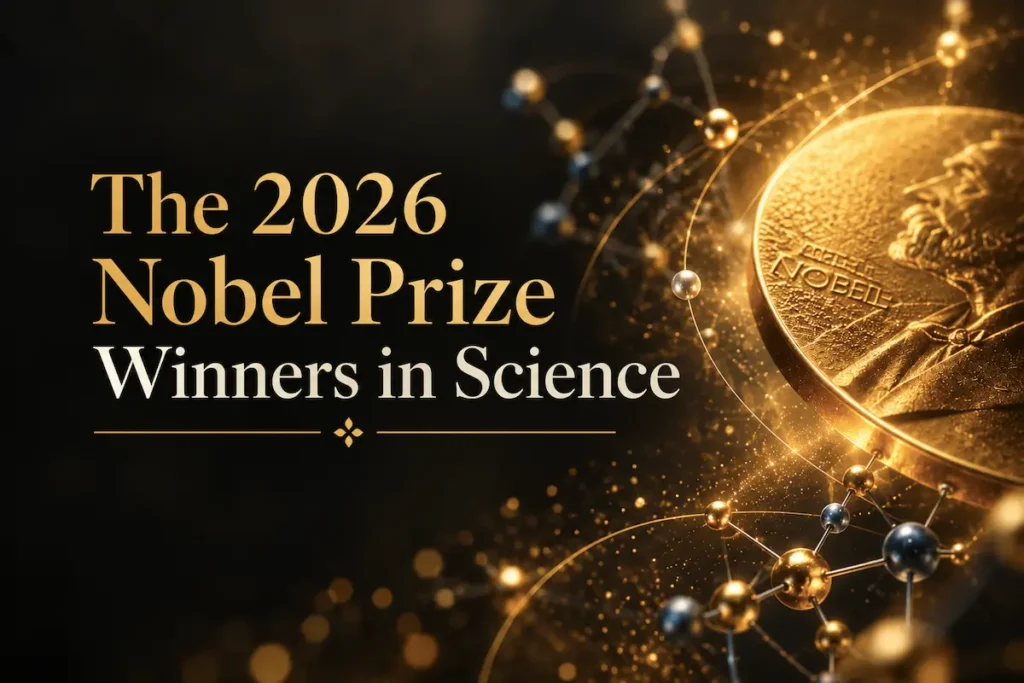
Karl Deisseroth, who carried channelrhodopsin into neuroscience and first used light to control nerve cells in a living brain, a founding step of optogenetics.
Nobel Prize week is the one moment each year when the whole world turns its attention to the people quietly expanding the limits of human knowledge.
The 2026 science prizes honor discoveries that let us switch individual brain cells on and off with light, capture ghostly particles from the far reaches of the universe, and teach chemistry to build molecules in a single mirror image.
Below is a clear guide to the winners in medicine, physics, and chemistry: who they are, what they discovered, and why their breakthroughs matter.
Nobel Prize in Physiology or Medicine: a light switch for the brain

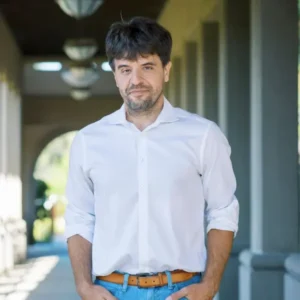
Peter Hegemann, whose question about how an alga senses light so quickly led to the discovery of channelrhodopsin, the protein at the heart of optogenetics.
The 2026 Nobel Prize in Physiology or Medicine was awarded to Karl Deisseroth, Peter Hegemann, and Georg Nagel for the discoveries that led to optogenetics, a method that uses light to switch individual nerve cells on or off in a living brain.
It began with a simple question about how a single-celled alga senses light so quickly.
Hegemann and Nagel traced the answer to a protein, channelrhodopsin, that acts as a light-controlled gateway in the cell. Deisseroth then carried the idea into neuroscience, inserting that protein into nerve cells so they could be activated by a pulse of light.
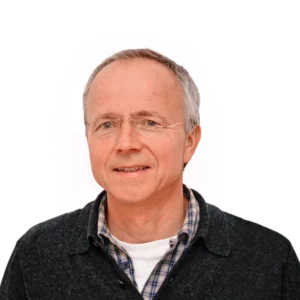
Georg Nagel, who showed that channelrhodopsin is a light-controlled ion channel, proving the protein could switch cells on with a pulse of light.
The result transformed brain research: scientists can now pinpoint exactly which neurons drive memory, fear, movement, or appetite, and the technique is already being tested to restore vision in people blinded by retinitis pigmentosa.
It is among the most consequential tools modern neuroscience has, a way to move from a blurry picture of the brain to precise, cell-by-cell understanding.
Nobel Prize in Physics: catching ghost particles beneath the South Pole
The 2026 Nobel Prize in Physics was awarded to Francis Halzen for the work behind the IceCube Neutrino Observatory, a cubic kilometer of South Pole ice turned into a telescope.
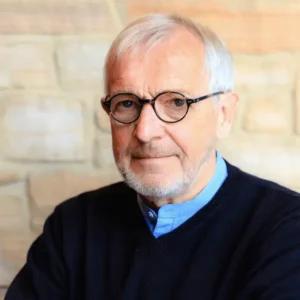
Francis Halzen, whose vision turned a cubic kilometer of South Pole ice into the IceCube observatory and founded a new era of neutrino astronomy.
Neutrinos are among the universe’s strangest particles: nearly massless, uncharged, and so reluctant to interact that billions pass through your fingertip every second unnoticed. Halzen’s insight was that the clear, deep ice of Antarctica could catch the rare flash of light a neutrino makes when it finally strikes an atom, and that tracking the highest-energy neutrinos could reveal the universe’s most violent engines, exploding stars and distant active galaxies, that other instruments cannot see.
First proposed in 1988 and completed in 2011, IceCube confirmed the first cosmic neutrinos and effectively founded a new kind of astronomy. It is a landmark of patient, visionary science: an idea that took more than two decades of persistence to prove.
Nobel Prize in Chemistry: building molecules in a single mirror image

Henri B. Kagan, who found a way to tilt a reaction toward a far greater excess of one mirror-image molecule than chemists thought possible.
The 2026 Nobel Prize in Chemistry was awarded to Henri B. Kagan and Kenso Soai for discoveries in asymmetric synthesis that solved a puzzle more than a century old.
Many of life’s molecules exist as two mirror-image forms, like a left and right hand, yet living organisms use only one. For chemists this is no abstraction: in a drug, one mirror image can heal while the other causes harm, as the thalidomide tragedy made devastatingly clear.
Kagan discovered a way to tilt a reaction so it produces a far greater excess of one mirror image than anyone thought possible. Soai went further, designing the first reaction that builds only one mirror image and then copies itself, the first time anyone but life itself had achieved such a feat.

Kenso Soai, who designed the first reaction to build only one mirror image and then copy itself, a feat no one but life itself had achieved.
Their work underpins the modern manufacture of pharmaceuticals, flavors, and fragrances, and it is central to one of science’s deepest questions: how life came to favor one-handedness at all.
Why the Nobel Prizes matter for events and audiences
Nobel laureates occupy a rare place on any stage.
A Nobel Prize is shorthand for the highest achievement in human thought, and a laureate’s presence signals to an audience that an occasion is truly significant.
Beyond the prestige, the best laureate speakers do something more valuable: they show how curiosity, persistence, and a willingness to chase an idea others dismissed can change the world, lessons that resonate far beyond the laboratory.
Aurum Speakers Bureau represents a distinguished roster of Nobel Prize winners across the sciences and economics, and helps organizations bring that level of insight and inspiration to their most important events.
For a fuller look at what a laureate brings to a corporate stage, see our guide on Nobel Prize keynote speakers for corporate events, and explore the full range of Nobel Prize speakers available for bookings.
Frequently Asked Questions
Who won the 2026 Nobel Prize in Physiology or Medicine?
The 2026 Nobel Prize in Physiology or Medicine was awarded to Karl Deisseroth, Peter Hegemann, and Georg Nagel for their discoveries concerning light-gated ion channels and optogenetics, a method that uses light to switch individual nerve cells on or off in a living brain. The technique has transformed neuroscience and is now being tested in treatments to restore vision.
Who won the 2026 Nobel Prize in Physics?
The 2026 Nobel Prize in Physics was awarded to Francis Halzen for his work behind the IceCube Neutrino Observatory at the South Pole, which laid the foundation for a new kind of astronomy by capturing high-energy neutrinos from distant, violent events in the universe.
Who won the 2026 Nobel Prize in Chemistry?
The 2026 Nobel Prize in Chemistry was awarded to Henri B. Kagan and Kenso Soai for the discovery of non-linear effects and autocatalysis in asymmetric organic synthesis, work that lets chemists build molecules in a single mirror image and is essential to modern pharmaceutical manufacturing.
Can you book a Nobel Prize winner to speak at an event?
Yes. Aurum Speakers Bureau represents a distinguished roster of Nobel laureates across the sciences and economics, available for keynotes, fireside chats, and high-profile corporate and academic events. To explore which Nobel Prize winner suits your event, contact Aurum Speakers Bureau and one of our founders will respond within 24 hours.
Each year the Nobel Prizes remind us that the biggest breakthroughs rarely arrive with fanfare; they come from people who followed a hard question for decades until the world caught up.
The 2026 science laureates, from the light switch for the brain to the telescope buried in Antarctic ice, carry exactly that spirit.
To bring the insight and inspiration of a Nobel laureate to your stage, contact Aurum Speakers Bureau and one of our founders will respond within 24 hours.