The Nobel Prize medal. Laureates in economics, science, and beyond are among the most sought-after keynote speakers for corporate events worldwide.
When a Nobel Prize winner walks onto your stage, something shifts in the room. The audience leans in differently. Questions go deeper. The conversation that follows the event changes.
This is not simply a matter of prestige. It is about the quality of ideas an organization chooses to put in front of its leadership, clients, and teams. Nobel Prize keynote speakers bring a credibility and intellectual density that few other speakers can match — particularly for events where the goal is not just inspiration, but genuine strategic insight.
This guide examines why organizations across sectors are booking Nobel Prize speakers for corporate events, what to look for when making a selection, and which laureates at Aurum Speakers Bureau are best positioned to address the challenges your audience faces today.
Why the Nobel Frame Matters for Corporate Events
The Nobel Prize is not a credential that ages. A laureate’s recognition signals that a body of work has passed the highest available peer review — that ideas have been tested, challenged, and found to hold. For a C-suite audience that is accustomed to filtering signal from noise, this matters enormously. If you are earlier in the planning process and want to understand the role itself before selecting a speaker, start with our guide on what a keynote speaker actually is.
Organizations booking Nobel Prize keynote speakers for corporate events typically have one of several objectives in mind:
Anchoring strategy in rigorous thinking. Innovation strategy, economic forecasting, and organizational transformation are areas where contested ideas circulate freely. A Nobel economist or scientist brings a framework grounded in decades of research, not a consultant’s framework built over years of client engagements.
Elevating the event’s signal value. Whether the audience is a board, a client summit, or a global leadership team, the choice of keynote speaker communicates what the organization values. A Nobel laureate signals that the event is substantive, not ceremonial.
Creating lasting reference points. The best keynote speakers give audiences a shared mental model they return to long after the event ends. Nobel laureates — whose frameworks have shaped fields — are exceptionally well placed to deliver this.
Driving media and internal visibility. For external events, a Nobel keynote speaker generates coverage and interest that other speakers rarely do.
The 2025 Nobel Prize in Economics: Why It Matters for Business Leaders Right Now
On 13 October 2025, the Royal Swedish Academy of Sciences awarded the Nobel Prize in Economic Sciences jointly to Philippe Aghion, Peter Howitt, and Joel Mokyr — recognized collectively “for having explained innovation-driven economic growth.”
Their combined body of work addresses one of the most urgent questions facing boards and executive teams today: what actually drives long-term economic growth, and what destroys it?
This is not abstract theory. The frameworks these three economists developed speak directly to decisions around AI investment, industrial policy, competitive strategy, and organizational transformation. All three are represented at Aurum Speakers Bureau — and for organizations designing events around innovation, growth, or the future of their industries, this Nobel class offers an unusually concentrated source of insight. For the full breakdown of what the Royal Swedish Academy recognised and why it matters for business, see our piece on the 2025 Nobel Laureates in Economics.
Philippe Aghion: The Keynote Speaker Redefining Creative Destruction
Why He Belongs at Your Next Event
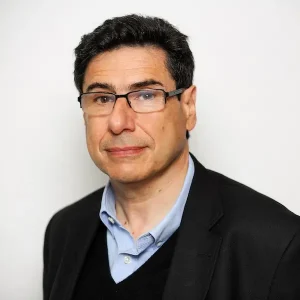
Aghion’s keynotes translate decades of growth economics into strategic insight for boards, investors, and leadership teams.
Philippe Aghion is one of the most consequential economists alive. His work sits at the intersection of theory, policy, and business reality in a way that few academics manage — and his Nobel recognition, long anticipated by the profession, has made him one of the most sought-after speakers in the world.
For a breakdown of how his economic frameworks apply across different corporate event formats, see our guide to the best economics keynote speakers for corporate events.
Since the prize announcement in October 2025, Aghion has delivered keynotes at MIPIM in Cannes, addressed the Finnish government’s Economic Council, and continued his academic roles at the Collège de France, INSEAD, and the London School of Economics. His calendar is full — and for event planners, that is the right kind of signal.
His Core Ideas — Translated for the Stage
Aghion is best known for the Aghion-Howitt model of creative destruction: the mathematical demonstration, developed with Peter Howitt in 1992, that sustained economic growth emerges from a continuous cycle of innovation displacing older technologies, products, and business models. This is Joseph Schumpeter’s intuition made rigorous.
For a corporate audience, the implications are direct. Competition is not the enemy of innovation — it is a precondition for it. Organizations that protect incumbents, whether internally or through policy advocacy, are betting against the very mechanism that creates prosperity. Aghion makes this case with clarity, evidence, and an ability to connect macroeconomic theory to firm-level decisions. For a deeper look at how these ideas apply to organizational decision-making, read our full breakdown of Philippe Aghion’s Ideas on Innovation and Growth.
His keynote topics at Aurum include:
- Creative destruction and long-run growth — the core framework and its implications for strategy
- Artificial intelligence and productivity — Aghion co-chaired France’s Artificial Intelligence Commission in 2024, advising President Macron directly on national AI strategy; he brings a policymaker’s perspective to the economics of AI adoption
- Green growth and climate innovation — how innovation-led thinking applies to the energy transition
- Industrial policy and competition — when governments and organizations should intervene, and when intervention becomes a brake on growth
- The future of capitalism — what sustaining prosperity requires from institutions, leaders, and markets
His Credibility on Stage
Aghion holds the Kurt Björklund Chair in Innovation and Growth at INSEAD and the Chair of Economics at the Collège de France. He earned his PhD from Harvard in 1987, and held appointments at MIT, Oxford, University College London, and
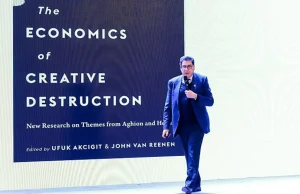
Philippe Aghion, 2025 Nobel Laureate in Economics and professor at the Collège de France, INSEAD, and the London School of Economics.
Harvard before his current roles. He is a fellow of the American Academy of Arts and Sciences, the British Academy, and the Econometric Society.
He received the Yrjö Jahnsson Award (Europe’s best economist under 45), the John von Neumann Award, and the BBVA Frontiers of Knowledge Award before the Nobel recognized his contribution to the field.
Importantly for speakers bureau clients: Aghion is known for adapting his presentations to audience context. When Ardian hosted him as keynote speaker at its AI and alternative investment conference before the Nobel announcement, he tailored his economic analysis specifically to the investment community’s concerns. That ability to translate between academic framework and executive decision-making is what separates the best speaker bookings from the most famous ones.
To inquire about Philippe Aghion’s availability for your event, contact Aurum Speakers Bureau.
Joel Mokyr: The Historian Who Explains Why Innovation Succeeds or Fails

Joel Mokyr, 2025 Nobel Laureate in Economics and Professor of Economics and History at Northwestern University, brings 50 years of research on innovation and long-run growth to the corporate stage.
If Aghion provides the mechanism of creative destruction, Joel Mokyr provides the long-run view of why it happens at all — and why it sometimes doesn’t.
Mokyr is the Robert H. Strotz Professor of Arts and Sciences at Northwestern University and one of the world’s leading economic historians. His Nobel citation recognized him “for having identified the prerequisites for sustained growth through technological progress.” His work examines why the Industrial Revolution happened in Britain in the 18th century rather than elsewhere, and extracts from that history the institutional and cultural conditions that allow innovation to compound.
For executive audiences, Mokyr’s central argument is bracing: knowledge that something works is not enough. Societies — and organizations — need to understand why it works. Scientific literacy, institutional openness, and the free circulation of ideas are not soft factors. They are the structural conditions for sustained innovation.
His keynote topics include:
- The historical roots of modern growth — why some societies sustain progress and others stagnate
- The Industrial Revolution as a leadership case study — what made 18th-century Britain a model for innovation ecosystems
- Diversity, knowledge exchange, and institutional tolerance — Mokyr’s research on how cultural and intellectual openness produces technological breakthroughs
- AI and the future of innovation — connecting today’s transformation to historical patterns of technological disruption
Mokyr brings wit, historical sweep, and concrete examples that make complex ideas immediately accessible to non-economist audiences. For events where the theme involves long-term thinking, organizational resilience, or the relationship between institutions and performance, his perspective is distinctive.
To inquire about Joel Mokyr’s availability for your event, contact Aurum Speakers Bureau.
Mariana Mazzucato: The Economics-Adjacent Voice Reshaping Innovation Strategy
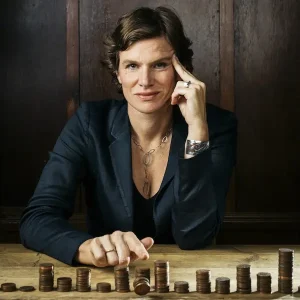
Mariana Mazzucato, Professor of Economics of Innovation and Public Value at UCL and one of the world’s most influential thinkers on innovation strategy, industrial policy, and the future of capitalism.
Not every Nobel-level thinker holds the medal. Mariana Mazzucato, Professor of Economics of Innovation and Public Value at University College London and Founding Director of the UCL Institute for Innovation and Public Purpose, is one of the most influential economists in the world — and one whose ideas are reshaping how governments and corporations think about their respective roles in driving growth.
Mazzucato’s argument is deliberately provocative: the state is not a corrector of market failures. It is an investor of first resort. Nearly every transformative technology — from the internet to the iPhone — was built on public investment that private capital was too risk-averse to fund. Her books The Entrepreneurial State (2013), The Value of Everything (2018), and Mission Economy (2021) have made this case across a generation of policymakers and executives.
For corporate events, Mazzucato’s appeal is her ability to challenge conventional assumptions in a way that is rigorous, not rhetorical. She does not arrive with talking points — she arrives with decades of research on where value actually comes from, and who captures it.
Her keynote topics include:
- Mission-driven innovation — how organizations can align around clear, ambitious goals rather than incremental problem-solving
- The entrepreneurial state — rethinking public-private collaboration in the age of AI, climate, and industrial transformation
- Value creation vs. value extraction — what finance, pharma, and tech companies often get wrong about where growth comes from
- The future of capitalism — her analysis of how markets need to be redesigned, not simply regulated
Mazzucato is available for corporate events, government summits, financial services conferences, and technology leadership gatherings. Her new book, The Common Good Economy, is expected in mid-2026, making this an ideal moment to book her ahead of a major publication cycle.
To inquire about Mariana Mazzucato’s availability for your event, contact Aurum Speakers Bureau.
How to Choose the Right Nobel Prize Keynote Speaker for Your Event
The Nobel Prize is not a genre. Laureates in economics, physics, medicine, peace, and literature address very different questions from very different traditions. Selecting the right speaker starts with matching the intellectual territory to the event’s objectives.
A few framing questions for event planners:
What does your audience need to think differently about? If the answer involves growth, AI, industrial strategy, or the economics of innovation, the 2025 Nobel class in economics is directly relevant. If it involves climate science, public health, or geopolitics, other laureates may be better positioned.
What is the event format? Nobel laureates vary significantly in their presentation style. Some are highly structured academic speakers who deliver polished lectures. Others — Aghion is a good example — are naturally conversational and adapt well to fireside chat formats or audience-driven sessions. Briefing a speaker on your format before confirming a booking prevents misalignment.
What is the right level of abstraction? Nobel Prize research is, by definition, at the frontier of knowledge. The best laureate keynote speakers translate that frontier into actionable frameworks for non-specialist audiences. This is a skill distinct from research excellence — and it is one of the factors Aurum evaluates when matching speakers to events. If your event is centered on AI strategy rather than economics broadly, our guide on how to choose an AI keynote speaker covers the full selection framework.
How far out are you planning? Demand for Nobel laureates increases sharply after prize announcements and around major publication dates. Philippe Aghion’s calendar, for example, has been under significant pressure since October 2025. Booking 4 to 6 months in advance — or longer for marquee events — gives your team the best chance of securing the right speaker at the right time.
Booking Nobel Prize Keynote Speakers Through Aurum
Aurum Speakers Bureau works with a curated portfolio of Nobel laureates, including the full 2025 Economics Nobel class. Our team handles all aspects of the engagement: speaker selection based on your event brief, fee negotiation, contract management, travel logistics, and pre-event content alignment calls.
For organizations designing high-stakes events — investor days, leadership summits, client conferences, or global strategy forums — the quality of the keynote speaker shapes the quality of the conversation that follows. Nobel Prize keynote speakers at corporate events are not a luxury category. For the right event, they are the most efficient investment available. Once your speaker is confirmed, our keynote speaker day-of-event checklist covers everything the organizing team needs to get right on the day — from green room setup to AV checks to the moment they walk offstage.
To discuss availability and fit for Philippe Aghion, Joel Mokyr, Mariana Mazzucato, or other Nobel Prize speakers in our roster, contact Aurum Speakers Bureau directly.
Explore our full Nobel Prize Speakers roster, or browse by topic: Economics Speakers, Innovation Speakers, AI Speakers.