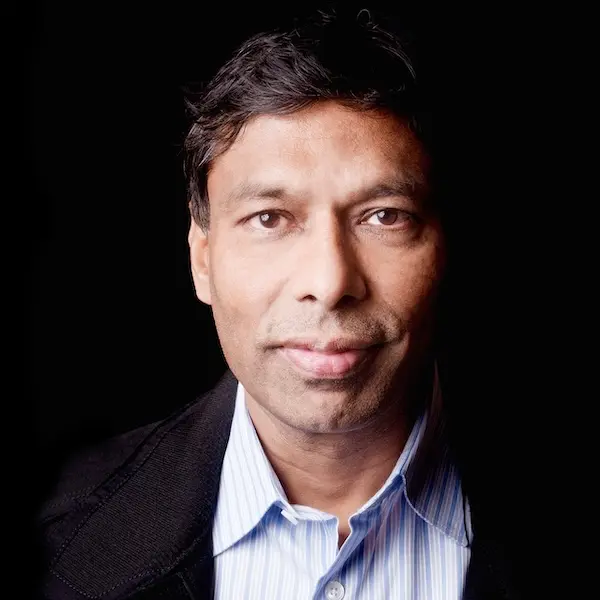
Naveen Jain
Founder & CEO of Viome | Co-Founder & Executive Chairman of Moon Express | Founder of InfoSpace | Author of 'Moonshots' | XPRIZE & Singularity University



UCLA Professor of Information Studies | Founder, Digital Cultures Lab | Bestselling Author of Beyond the Valley | Former Biden-Harris Innovation Policy Adviser
Speaker Ramesh Srinivasan is a leading bridge between AI policy, global innovation, and executive strategy. A UCLA professor, founder of the Digital Cultures Lab, and former Biden-Harris innovation adviser, he has worked across 70+ countries with policymakers, regulators, and Fortune 500 leaders. Audiences book Ramesh to understand how AI, automation, and Web3 will reshape their industry — and what to do next.
Want to book Ramesh Srinivasan as a speaker for your event? Please provide the info below and we’ll get in touch within 24h:
Speaker Ramesh Srinivasan is one of the most respected academic voices on the human, political, and economic consequences of new technology. A Professor of Information Studies at UCLA with a joint appointment in Design and Media Arts, he founded and directs the UCLA Digital Cultures Lab and serves as Assistant Director of the university’s DataX initiative. His work bridges engineering, social science, public policy, and business, giving senior audiences a sophisticated lens on how AI, automation, and digital platforms are reshaping the modern enterprise.
Srinivasan’s three books — including the acclaimed Beyond the Valley and Whose Global Village — argue that technology has become too concentrated in the hands of a few platforms and that a more democratic, ethical, and globally inclusive Internet is both possible and economically smarter. His fieldwork spans more than 70 countries and explores how innovation actually emerges in the parts of the world that represent the majority of digital users.
Beyond academia, Ramesh has advised members of the U.S. Congress, the European Union, India, Brazil, and African policymakers on technology regulation and innovation strategy. He served as an Innovation Policy adviser to the Biden-Harris campaign and previously to Senator Bernie Sanders, and informally counsels Representative Ro Khanna on the future of work and AI. His commentary appears regularly on NPR, MSNBC, BBC, and CNN, with bylines in the Financial Times, Forbes, The Economist, The Guardian, and The New York Times. More on his current work is available on his personal website.
His current focus areas include the responsible deployment of generative AI, the geopolitics of cloud and chip infrastructure, the future of work in an automated economy, and how Web3 and decentralized systems may — or may not — restore economic agency to ordinary users. He combines deep technical literacy with rare narrative clarity, translating complex shifts into decisions executives can act on.
As a speaker, Ramesh Srinivasan brings boards, leadership teams, and policy audiences a uniquely informed view of where technology is heading and how to lead through it. Book him through Aurum Speakers Bureau to give your next event a substantive, forward-looking conversation with one of the world’s leading AI speakers.
The Economist estimates that nearly half of existing jobs could be automated within the next two decades, and as artificial intelligence and intelligent automation move into every function — from finance to HR to customer operations — what does this mean for the future of business? Ramesh Srinivasan walks executive audiences through how AI-driven systems are reshaping competitive advantage, where the largest productivity gains are realistically available, and where the largest hidden risks live. Leaders leave with a concrete framework for prioritizing AI investment and avoiding the most common deployment pitfalls.
Immersive environments are no longer a side experiment for gaming companies. They are increasingly tied to global commerce, brand experience, training, and customer engagement. Ramesh examines how Meta, Microsoft, Apple, and a wave of Asian players are shaping this next interface layer, what its connection is to the multi-hundred-billion-dollar global gaming market, and what business and cognitive consequences leaders should anticipate. He helps executives identify where to participate, where to partner, and where to wait.
Every major technology company now describes itself as an AI company, and yet some of the most well-known systems carry documented racial, gender, and cultural biases. Where do these problems originate, how do they impact performance and trust, and how can leaders build internal review processes that catch them early? Ramesh draws on his work advising business leaders, members of Congress, and civil society organizations to give audiences a clear, actionable approach to ethical AI, content integrity, and the broader question of technology and ethics.
Ramesh advises U.S. members of Congress, the EU, India, Brazil, and several African governments on technology policy and innovation strategy. He served as an Innovation Policy adviser to the Biden-Harris campaign and previously to Senator Bernie Sanders. In this keynote, he gives senior leaders a strategic map of how AI, data, antitrust, and platform regulation are likely to evolve across major jurisdictions — and what to do today to be ready for what is coming.
The World Economic Forum has called the present moment the Fourth Industrial Revolution. Automated systems and intelligent networked software are rewriting what work means, how it is organized, and how it is paid. Ramesh helps leadership teams see what jobs are likely to disappear, which will be reshaped, and which will emerge — and explores serious policy responses such as universal basic income, microcompensation for personal data, and new social contracts. Audiences leave with a clear lens on workforce strategy for the next decade.
The vast majority of internet and platform users are not in the United States or Europe but in South Asia, Africa, and Latin America. Drawing on fieldwork in nearly 70 countries, Ramesh shows how some of the most creative product, business model, and platform innovation today is emerging from these regions — often built with fewer resources but greater contextual intelligence. The keynote opens executive eyes to entire markets, partnerships, and innovation patterns that most Western strategy teams overlook.
We are at an inflection point. Generative AI tools, multimodal models, and immersive environments are colliding to reshape how customers find products, how employees do work, and how brands engage. Ramesh — a former MIT-trained AI developer who studied under Marvin Minsky and now advises members of Congress and the White House on AI policy — equips leaders to understand how these systems actually work, where the genuine business value sits, and which strategic, regulatory, and ethical decisions cannot be delayed.
Founder & CEO of Viome | Co-Founder & Executive Chairman of Moon Express | Founder of InfoSpace | Author of 'Moonshots' | XPRIZE & Singularity University

World-Renowned Futurist & Humanist | CEO, The Futures Agency | Bestselling Author of Technology vs. Humanity | Filmmaker | Voice of "The Good Future"

Pulitzer Prize-Winning Author | Vice Chairman, S&P Global | Chairman, CERAWeek | Global Energy Expert

Co-Founder & Founding CEO of Crunchyroll | Co-Founder & CEO of Forge | Co-Founder of GGWP | Serial Entrepreneur in Content, Community & Gaming


© 2026 Aurum Speakers Bureau. All Rights Reserved

| Basic Data Protection Information | |
|---|---|
| Data controller | AURUM SPEAKERS BUREAU S.L. |
| Address | Parc Audiovisual de Catalunya 1, Oficina S11, 08225 Terrassa, Spain |
| Purposes | We will use your data to respond to your requests and deliver our services to you. |
| Marketing | We will only send you marketing correspondence if you have given your prior consent, which you can do by ticking the box for that purpose. |
| Lawful basis | We will only process your data if you have given your prior consent, which you can do by ticking the box for that purpose. |
| Recipients | Generally, only our members of staff who have been duly authorised may access the data that you have provided. |
| Your Rights | You have the right to know what information we hold about you, to rectify it and to erase it, as explained in the additional information available on our website. |
| Additional Information | For more information, please see our "PRIVACY POLICY". |