
Trent Shelton
Former NFL Wide Receiver | Founder & President of the RehabTime Organization | Bestselling Author of The Greatest You & Protect Your Peace | Reaches 60M+ Weekly


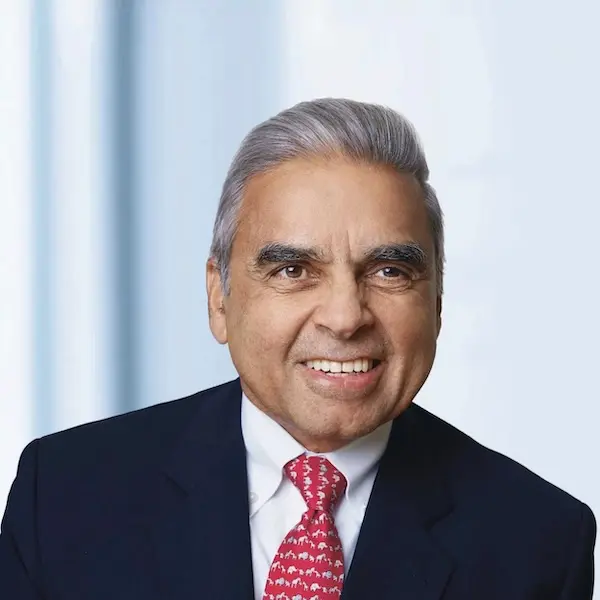
Founding Dean, Lee Kuan Yew School of Public Policy | Former President of the UN Security Council | Bestselling Author & 'Muse of the Asian Century' | Geopolitics Expert
Kishore Mahbubani is one of the world's most respected voices on geopolitics and the rise of Asia, a veteran diplomat turned scholar and author. A former President of the UN Security Council and Founding Dean of the Lee Kuan Yew School of Public Policy, he is the author of ten books and is known as the 'muse of the Asian century.' On stage, he offers candid analysis of US-China relations, global governance, and the shift to a multipolar world.
Want to book Kishore Mahbubani as a speaker for your event? Please provide the info below and we’ll get in touch within 24h:
Global affairs speaker Kishore Mahbubani is one of the world’s most respected voices on geopolitics, global governance, and the rise of Asia. A veteran diplomat turned scholar and author, he has spent more than five decades at the center of world affairs, first representing Singapore on the global stage and later interpreting the great power shifts of our time for governments, businesses, and the public. Today he is a Distinguished Fellow at the National University of Singapore’s Asia Research Institute.
Born in Singapore in 1948 to immigrant parents, Mahbubani joined the Singapore Foreign Service in 1971 and served for 33 years, with postings in Cambodia, Malaysia, Washington, and New York. He was twice Singapore’s Ambassador to the United Nations and twice served as President of the UN Security Council, in January 2001 and May 2002, a rare distinction. As Permanent Secretary of the Foreign Ministry, he helped shape Singapore’s foreign policy for decades, work recognized with the country’s Public Administration Medal (Gold).
In 2004, Mahbubani began a second career in academia as the Founding Dean of the Lee Kuan Yew School of Public Policy at the National University of Singapore, which he built into one of the world’s leading public-policy institutions before continuing as a professor there until 2019. His contributions to global scholarship were recognized in 2019 with election to the American Academy of Arts and Sciences. Foreign Policy and Prospect have named him one of the world’s top public intellectuals, and the Financial Times listed him among the people shaping the debate on the future of capitalism.
Mahbubani is also a prolific author whose ten books have shaped global debate on power shifts and Asia’s resurgence, among them Can Asians Think?, The Great Convergence, Has the West Lost It?, Has China Won?, and The ASEAN Miracle. His open-access book The Asian 21st Century has been downloaded more than three million times, and in 2024 he published a candid memoir, Living the Asian Century, tracing his journey from childhood poverty to the front rows of global diplomacy. His essays appear in Foreign Affairs, the Financial Times, and The New York Times.
As a speaker, Kishore Mahbubani offers candid, historically grounded analysis that few can match. He speaks on the rise of Asia and the shift to a multipolar world, US-China relations, the future of global governance, and what these changes mean for leaders trying to stay resilient amid competition and uncertainty. Audiences value his clarity, his long view of history, and his willingness to challenge conventional assumptions about where power is heading.
Kishore Mahbubani argues that Asia's rise is not a passing trend but a structural shift in the global balance of power, one that is reshaping trade, technology, and politics. Rather than a story of Western decline, he offers a constructive, three-part strategy for how Western governments, companies, and institutions can adapt, regain influence, and build better relationships with a confident Asia. Audiences leave with a realistic, pragmatic roadmap for engaging with the Asian century instead of resisting it.
This keynote examines the most consequential relationship of our era: the rivalry between the United States and China. Mahbubani explores what each side wants, how their worldviews differ, and where their interests still overlap, and how their competition is reshaping alliances, institutions, technology standards, and supply chains. Moving past simplistic "Cold War 2.0" framing, he gives leaders a nuanced way to think through scenarios of confrontation, coexistence, and limited cooperation, so they can make better decisions today.
Mahbubani examines the twin realities of a relatively declining West and a rapidly rising East, and asks how the world can move toward a more stable and legitimate balance of power rather than an inevitable clash. He traces the long-term trends behind Asia's resurgence, from economic growth and demographics to technology and political confidence, while analyzing the structural challenges facing Western societies. He then sketches what a more balanced order could look like, and what reforms in global governance and trade would help get there, without sliding into zero-sum rivalry.
Mahbubani makes the case that the major economic, demographic, and technological trends of our time are all converging toward Asia. With historical depth, he explains how China and India are reshaping the global landscape, why he sees Europe as the past and the United States as the present, and how Asia is emerging as the center of the future. He also examines the risks that could alter the region's trajectory, offering audiences a concise guide to what the Asian century means for strategy, investment, and positioning.
Mahbubani connects geopolitics with one of the defining challenges of our time: protecting human security and advancing health equity amid overlapping crises. From pandemics and climate shocks to food insecurity and fragile supply chains, he shows how today's "polycrisis" exposes deep imbalances between and within countries, and why global health can no longer be treated as a purely technical or domestic issue. He offers a clear framework for how governments, businesses, and institutions can cooperate to reduce vulnerability and share the benefits of progress more fairly.
Former NFL Wide Receiver | Founder & President of the RehabTime Organization | Bestselling Author of The Greatest You & Protect Your Peace | Reaches 60M+ Weekly

Harold Brown Professor of Geology, Caltech | Chief Scientist, NASA Curiosity Rover | Member, National Academy of Sciences

NYT, WSJ & USA Today Bestselling Author | CEO, Ryan Leak Group | Executive Coach to Fortune 100 Companies & NBA Teams | 1M+ People Reached Annually

3x NYT Bestselling Author: Hooked, Indistractable & Beyond Belief | Former Stanford Lecturer | Authority on Behavior Design & Human Potential


© 2026 Aurum Speakers Bureau. All Rights Reserved

| Basic Data Protection Information | |
|---|---|
| Data controller | AURUM SPEAKERS BUREAU S.L. |
| Address | Parc Audiovisual de Catalunya 1, Oficina S11, 08225 Terrassa, Spain |
| Purposes | We will use your data to respond to your requests and deliver our services to you. |
| Marketing | We will only send you marketing correspondence if you have given your prior consent, which you can do by ticking the box for that purpose. |
| Lawful basis | We will only process your data if you have given your prior consent, which you can do by ticking the box for that purpose. |
| Recipients | Generally, only our members of staff who have been duly authorised may access the data that you have provided. |
| Your Rights | You have the right to know what information we hold about you, to rectify it and to erase it, as explained in the additional information available on our website. |
| Additional Information | For more information, please see our "PRIVACY POLICY". |