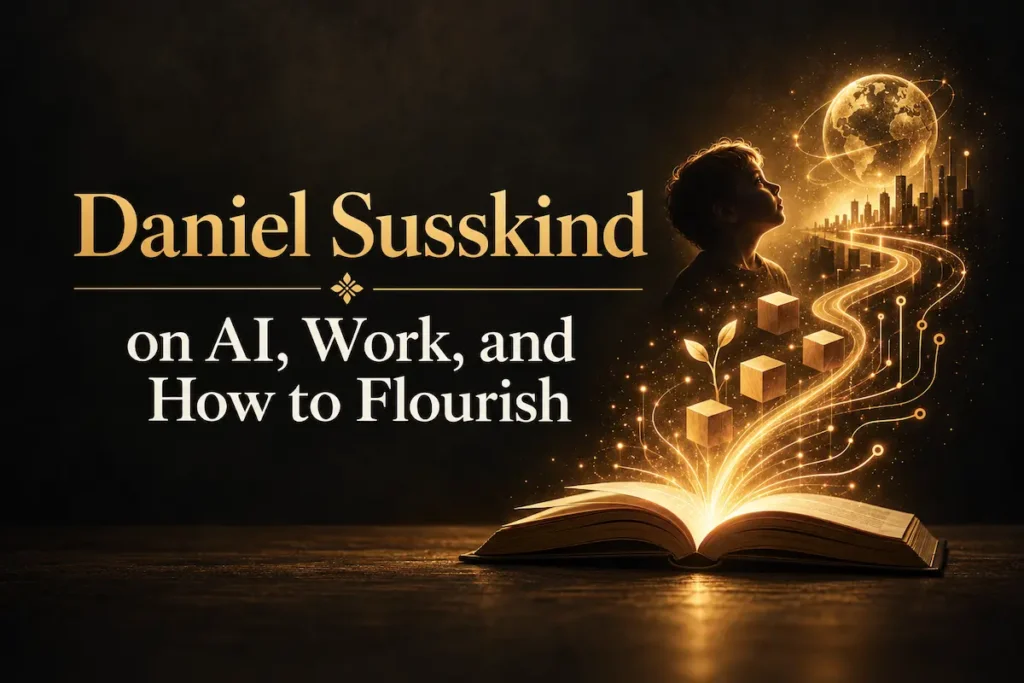

Daniel Susskind is a globally renowned economist who has spent fifteen years studying AI’s impact on work. His new book answers the question he now hears more than any other: what should my children do?
For fifteen years, the economist Daniel Susskind has studied what artificial intelligence does to work, in boardrooms, classrooms, and government. His 2020 book A World Without Work became one of the defining texts on automation, named by The New York Times as required reading for anyone thinking about the economy of the future. But wherever he now speaks, he says, one question is asked more than any other: what should my children do?
His answer, and the subject of his timely new book, reframes the entire anxiety around AI. The task is not to predict which jobs will survive, but to prepare people to flourish in a future about which we understand surprisingly little.
The economist behind A World Without Work
Susskind’s authority is unusually broad.
He is the Mercers’ School Memorial Professor of Business at Gresham College, a Research Professor at King’s College London, a Senior Research Associate at Oxford’s Institute for Ethics in AI, and a Digital Fellow at the Stanford Digital Economy Lab. He sits on the UK Government’s Expert Panel on AI and the Future of Work, and previously served inside government at the Prime Minister’s Strategy Unit and 10 Downing Street.
His books have shaped the global conversation: A World Without Work, the bestselling The Future of the Professions, and Growth: A Reckoning, which Barack Obama named one of his favourite books of 2024.
His TED talk on the future of work has been viewed more than 1.7 million times.
Few speakers can match that combination of academic rigor, policy experience, and a genuine gift for making the future legible.
Why “future-proofing” no longer works
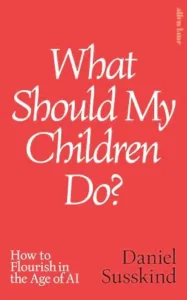
In What Should My Children Do?, Susskind offers an evidence-based, optimistic guide to flourishing in the age of AI, for the next generation and anyone navigating a changing career.
Susskind’s most bracing argument is that the standard response to technological change has quietly broken.
For years, the advice was to “future-proof” people by identifying the skills machines could not do and teaching those. He points to a vivid cautionary tale: in 2013, the UK made it the first country to teach all schoolchildren to code, a policy much of the world copied, on the logic that coding was a durable, protected skill.
A decade later, writing code is one of the things AI does best. Skills meant to protect children for a lifetime were largely redundant before they left school. The lesson, Susskind argues, is that we know only two things about the future: it will contain far more capable technologies, and we know little else.
Rather than pretending to resolve that uncertainty, leaders and educators have to design for it.
For audiences among the most sought-after future of work speakers, that reframing lands with unusual force, because it applies as much to a workforce as to a classroom.
“Teach both, test both”: a usable framework
What makes Susskind valuable on a stage is that he does not stop at diagnosis.
His central proposal draws on a forgotten 1982 British report on how schools should handle the pocket calculator. Its revolutionary answer was to split maths in two: teach students to work with a calculator and without one, and crucially, test both. That principle became the global gold standard.
Susskind argues we should now do the same with AI, in every subject: teach students to use AI in one part, teach them to flourish without it in the other, and examine both. He calls it “teach both, test both,” and it is exactly the kind of concrete, transferable idea that organizations can borrow for their own workforces, keeping human judgment sharp enough to tell, in his words, when AI is being a savant or an idiot.
It is a message that connects naturally to how practitioners like Tsedal Neeley think about building the fluency people need to work alongside AI.
What audiences take away
Susskind speaks with the rare blend of an economist’s evidence and a communicator’s clarity, and his message is refreshingly optimistic without ever trivializing the disruption.
He urges audiences to get back to basics, because advanced skills rest on them; to embrace AI critically rather than ban it; to choose problems, not job titles, because the problems endure even as the jobs transform; and to run toward AI and science, where he believes the century’s best ideas will now emerge.
Whether the room is full of executives rethinking their workforce, educators rethinking the classroom, or leaders navigating their own careers, they leave with a durable framework for acting under deep uncertainty, and with more hope than they walked in with.
As one of the most credible AI voices working today, he is a natural fit for leadership summits, education and technology conferences, and any organization confronting what AI means for its people.
Frequently Asked Questions
Why should organizations book Daniel Susskind?
Because he offers a rare combination: a globally respected economist with deep expertise in AI and the future of work, real government policy experience, and an exceptional ability to make complex change feel navigable and even hopeful. He gives audiences not just analysis but usable frameworks for preparing their people, and their organizations, for an AI-driven future. He is ideal for leadership summits, future-of-work and education conferences, and executive briefings on AI. To check his availability, contact Aurum Speakers Bureau and one of our founders will respond within 24 hours.
What does Daniel Susskind speak about?
Susskind speaks on the impact of AI on work and the economy, the future of the professions, how education must change in the age of AI, and how individuals and organizations can flourish amid deep uncertainty. Drawing on his books A World Without Work, The Future of the Professions, Growth: A Reckoning, and his new book on the next generation and AI, he tailors each talk to the audience, from boardrooms to policy forums.
What is Daniel Susskind’s new book about?
What Should My Children Do? How to Flourish in the Age of AI, published in the UK in 2026 and in the US in November 2026, is an optimistic, evidence-based guide to preparing the next generation, and anyone navigating a changing career, for a world transformed by AI. Rather than predicting which jobs will survive, Susskind argues for mastering the basics, learning to work with and without AI, and choosing problems over job titles. The Guardian called it “at once challenging, compelling and refreshingly optimistic.”
What types of events suit a speaker like Daniel Susskind?
He is a strong fit for leadership summits, future-of-work and HR conferences, education and academic events, and executive or board briefings on AI strategy, especially audiences that want rigorous, evidence-based insight delivered with clarity and optimism rather than hype or alarm.
As AI reshapes work, education, and the choices facing the next generation, the leaders who thrive will be those who stop trying to predict the future and start preparing for uncertainty itself. Daniel Susskind gives audiences the clearest, most hopeful map available for doing exactly that.
To bring his perspective on AI and the future of work to your stage, contact Aurum Speakers Bureau and one of our founders will respond within 24 hours.