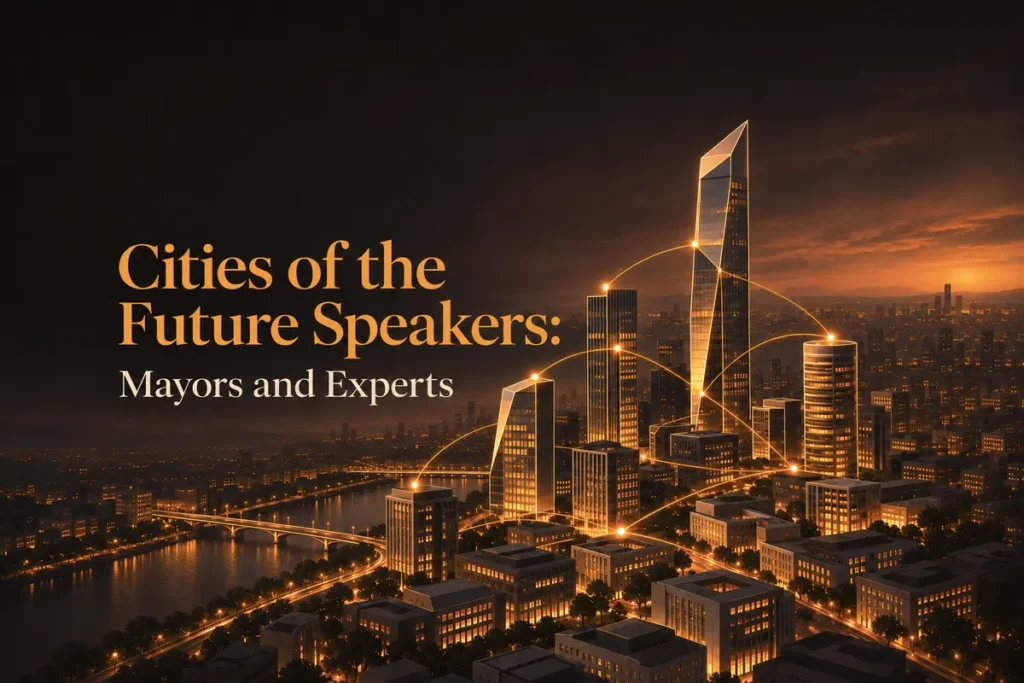
Cities decide how people move, how far daily life reaches from home, and who controls the data that runs the buses. The people best placed to explain those decisions are the mayors who made them and the experts who study them. This guide to cities of the future speakers pairs seven former mayors with five urban experts and organizes them around five questions every city has to answer.
All twelve are available through Aurum Speakers Bureau, and each profile lists topics and sample material for planners building a program on urban leadership, sustainability, or the built environment.
For a wider view of climate voices, see our guide to top sustainability speakers for corporate events.
How should people move?
Enrique Peñalosa, former Mayor of Bogotá, creator of TransMilenio.
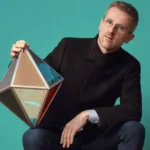
Carlo Ratti, director, MIT Senseable City Lab.
Enrique Peñalosa served as Mayor of Bogotá twice (1998–2001 and 2016–2019) and created the TransMilenio bus rapid transit system, now copied by cities around the world. He added protected bike paths, sidewalks, and parks concentrated in the city’s poorest districts. He also argues that public space and mobility are questions of equality, not luxuries.
Carlo Ratti approaches the same question from the data side. He directs the MIT Senseable City Lab, which has labs on four continents, and studies how sensors and artificial intelligence can make urban life more responsive. His projects include the Copenhagen Wheel, which TIME celebrated among the best inventions of its year, and in 2025 he curated the Venice Architecture Biennale.
How far should daily life reach?
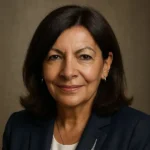
Anne Hidalgo, former Mayor of Paris, former chair of C40.
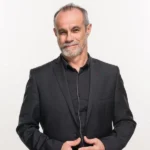
Carlos Moreno, creator of the 15-Minute City, IAE Paris-Sorbonne.
Anne Hidalgo, Mayor of Paris from 2014 to 2026 and the first woman elected to the office, championed the 15-Minute City model of local, walkable neighborhoods. Her decade added hundreds of kilometers of bike lanes, reduced car traffic and air pollution, and included the years-long effort to make the Seine swimmable again, a centerpiece of the 2024 Olympic Games.
Carlos Moreno created the idea. He introduced the 15-Minute City in 2016 and presented it at the Paris COP21 climate summit. It spread to hundreds of cities, especially during the pandemic. A professor at the IAE Paris-Sorbonne Business School, he has broadened it into the concept of “happy proximity,” set out in his 2024 book The 15-Minute City: A Solution to Saving Our Time and Our Planet.
Who controls the data?
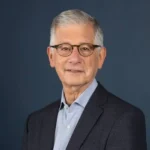
Stephen Goldsmith, former Mayor of Indianapolis, Harvard Kennedy School.
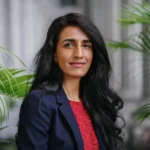
Ayesha Khanna, co-founder and CEO, Addo.
Stephen Goldsmith brings the view from city hall and the classroom. He served as the 46th Mayor of Indianapolis and as Deputy Mayor of New York City for Operations, where he launched the 311 Service Request Map. He now directs Data-Smart City Solutions at Harvard’s Bloomberg Center for Cities, and his current research looks at how agentic AI tools can improve community engagement and government performance.
Ayesha Khanna comes from the technology side. Her PhD focused on digital innovation in smart cities, and as co-founder and CEO of Addo she advises governments and companies on artificial intelligence. She serves on the boards of Johnson Controls, a leader in smart buildings, and NEOM Tonomus, which drives the technology infrastructure behind Saudi Arabia’s ambitious city of the future.
More voices on this theme appear among our big data speakers.
Where should the capital go?
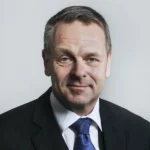
Jan Vapaavuori, former Mayor of Helsinki, chairman, Finnvera.
Greg Clark, urbanist, chair, Connected Places Catapult.
Jan Vapaavuori was the first directly elected Mayor of Helsinki, where he set out to build “the most functional city in the world” and to make it a test bed for start-ups and smart city innovation. Earlier, as Finland’s Minister of Housing and Urban Planning, he launched a Housing First program that cut long-term homelessness by around half. He now chairs the export credit agency Finnvera and co-founded the urban technology ventures Top Urban and Top Urban AI.
Greg Clark has advised more than 400 cities and 50 national governments on urban investment and the sustainable urban transition, and he chairs the Connected Places Catapult, the UK’s innovation accelerator for cities and transport. His definition of a smart city is explored in our profile of smart city sustainability speakers.
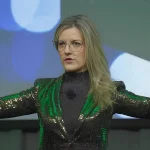
Nikki Greenberg, founder, Real Estate of the Future.
Nikki Greenberg follows the same question from the property side. A real estate futurist, she previously led technology strategy for global real estate at QIC, and her keynotes have headlined events including MIPIM, Cityscape, Smart Cities Expo, and UN-Habitat.
If you are looking for more trend voices, our futurist speakers could help.
How does a city lead through a crisis?
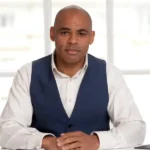
Marvin Rees, former Mayor of Bristol, member of the House of Lords.
Three former mayors answer that one from experience.
Marvin Rees was elected Mayor of Bristol in 2016, the first person of Black African heritage to lead a major European city, and governed through austerity, Brexit, a pandemic, and a climate emergency. His administration launched Bristol City Leap, a billion-pound public-private partnership to decarbonize the city’s energy system, and he now sits in the House of Lords as Lord Rees of Easton.
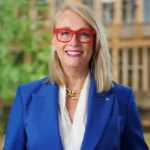
Sally Capp, former Lord Mayor of Melbourne, University of Melbourne.
Sally Capp was Lord Mayor of Melbourne from 2018 to 2024, the first woman directly elected to the role. She led the city through the COVID-19 pandemic and some of the longest lockdowns in the world, with initiatives that included the $300 million Melbourne City Recovery Fund.
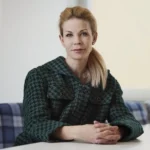
Anna König Jerlmyr, former Mayor of Stockholm, CEO, Arwidsson Foundation.
Anna König Jerlmyr became Mayor of Stockholm in 2018. During her term, the city was named the smartest in the world by the Smart City Expo World Congress. She turned climate targets into municipal policy, including fossil-free transport and procurement rules that used the city’s purchasing power. She also went on to serve as President of Eurocities and Vice Chair of C40.
Audiences who want more political leaders on the program can explore our political speakers. To check the availability of any of these speakers for your event, contact Aurum Speakers Bureau and one of our founders will respond within 24 hours.
Why book a former mayor?
A former mayor has made decisions under public scrutiny, balanced budgets against promises, and lived with the results. That is a different kind of evidence from a consultant’s framework; and audiences of investors, public officials, and executives value it.
The experts above add the map: the research, the data, and the cross-city comparisons that show which decisions travel from one place to the next.
Together, they suit real estate and investment forums, smart city and infrastructure summits, municipal and government conferences, sustainability programs, and corporate events on the future of work and place.
We were proud to help bring Carlos Moreno and Jan Vapaavuori to the fourth Qatar Real Estate Forum in Doha in 2026, and Steve Chen to LIVEX in Abu Dhabi on the same theme, for example.
Booking these speakers
Of course these speakers are available for hire for a multitude of reasons. Whether to enhance corporate culture, rethink how other cities grow and develop, to analyze topics or speak of their experience and expertise, each speaker brings something different to any room or table.
Their fee, if you are wondering, depends on the event date, format, duration, and preparation required. To receive a quote on bringing a particular perspective to your stage, contact Aurum Speakers Bureau and one of our founders will respond within 24 hours. Yet, want to hear the best part?
Thanks to our commercial agreements with the speakers with whom we work, booking through Aurum Speakers Bureau involves no additional cost to you. We earn a commission directly from the speakers for promoting and managing their engagements, so our goal truly is to simplify your life and help organize a great event without any extra fees and especially not any unnecessary complications.
All twelve speakers are also available for virtual keynotes and webinars as well as in-person sessions, and you can find more options among our virtual keynote speakers.
The cities that age well are built on decisions that were explained clearly, and these twelve speakers know how to explain them. Contact us to learn more.