


Bill Benjamin, leadership speaker and emotional intelligence expert, partner at the Institute for Health and Human Potential.
At a certain point in our relationships, whether in the workplace, in our family, and/or with our friends, most of us have experienced having to hold a conversation that only got 90% of the way there, then stopped. Bill Benjamin’s last 8% puts a name to that.
He talks about the final, most consequential part that typically makes up that moment: the direct feedback, the difficult news, the honest answer that changes what happens next. It shapes how people perform, how much they trust each other, and whether the truth arrives in time to be useful.
Benjamin is an emotional intelligence, performance, and leadership expert, a former technology executive, and a partner at the Institute for Health and Human Potential (IHHP). He is listed as part of Aurum Speakers Bureau’s leadership speakers, as well.
In this article, we focus on some of his keynotes’ content, covering that last 8%, specifically, including why everyone faces it and what to do with it during regular business hours.
What the last 8% means
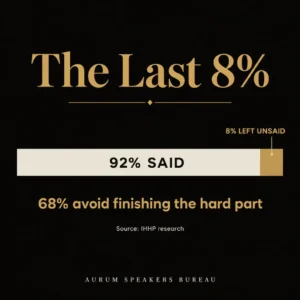
In an IHHP study of 34,000 people, participants left an average of 8% unsaid in difficult conversations.
An IHHP study of 34,000 people, published in Harvard Business Review, found that, on average, people feel they leave 8% unsaid in a difficult conversation. Hence the name.
Benjamin expands on that, noting that most people handle the first 92% of life well. The trouble, he explains, starts in the hardest moments. You are in a difficult conversation with difficult news to deliver, and you get 85, 90, or 95% of the way there. Then the other person reacts as you reach the hard part. Emotions are infectious, so their reaction becomes yours, and the final piece goes unsaid, he describes.
According to IHHP research presented, 68% of people in that situation step back and avoid it. Benjamin points out the quiet cost: we convince ourselves we had the conversation.
The other person believes we had it, too. And then we wonder why nothing changes.
Conversations, decisions, and everyday moments
To move further in the topic, as IHHP workshopped the idea, participants widened it. Difficult conversations are known as one form of the last 8%. Difficult decisions are another: the ones where the outcome is uncertain or someone will be upset.
Benjamin shares that early in his career he sometimes let whoever would complain the loudest influence his decision, because he wanted to avoid dealing with the reaction. Emotion was making the call.
The category reaches into everyday life.
As he notes, public speaking regularly tops surveys of common fears, so for many people any form of it is a last 8% moment.
Receiving difficult feedback is another. We want others to accept our feedback, and modeling that means staying open when it comes our way.
Here, Benjamin’s framing is useful because it applies to leaders, project managers, subject matter experts, and vendors, all trying to sell something in some way.
Watch: Bill Benjamin on the last 8%
Here’s a bit of his Last 8% keynote for you to get a better idea:
Bill Benjamin on the last 8% and the difficult conversations people avoid.
He opens with a simple question: what gets in the way of the conversations that matter most?
Why these moments carry outsized weight
Benjamin furthermore explains the weight of these moments through what he calls the cortisol effect. When tension, uncertainty, or pressure rises, the brain releases cortisol, which causes memories to sear. People remember how you showed up in the difficult moment.
The 92% of moments when everything goes well and everyone gets along fade by comparison.
That is why a single hard conversation can define a reputation. It also explains why preparation helps, a theme that connects with Ruth Gotian’s research on peak performance.
IHHP’s broader research on performing under pressure points the same direction: the brain is wired for self-preservation first and performance second, so skill at managing emotion makes the difference.
High Connection and High Courage
IHHP describes two pillars of a high-performing culture:
High Connection is its term for psychological safety; the sense that people can speak up and be heard.
High Courage is the ability to do hard things skillfully.
According to IHHP, a study of more than 72,000 people published in Harvard Business Review identified these two pillars as what separates high-performing cultures from the rest.
IHHP’s Last 8% Culture System helps organizations build cultures that are both high-care and high-accountability.
On that note, safety creates the conditions, and courage turns those conditions into action. A team can feel safe and still avoid the conversations that matter, because fear keeps people quiet even when trust is present.
These ideas also pair well with our piece on Stephen Covey and the speed of trust, which explains why teams move faster once trust is in place, in case you are interested.
Emotional intelligence as a competitive advantage
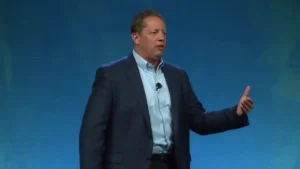
Bill Benjamin pairs stories with science during his keynotes to show how emotional intelligence performs under pressure.
Benjamin brings a rare perspective, however.
He holds advanced degrees in mathematics and computer science, worked as a technology executive, and spent 25 years as a senior business leader.
He is also candid that he struggled early in his career as a leader when under pressure, and in his programs he shares how he applied the same techniques he teaches to become a better leader and build high-performing teams.
A contributor to the New York Times and Amazon bestseller Performing Under Pressure, written by Hendrie Weisinger and J.P. Pawliw-Fry, (also a speaker available at Aurum Speakers Bureau), his keynote on performing under pressure draws on the 12,000-person study behind the book and the 34,000-person study published in Harvard Business Review.
In the shorter video, he cites Warren Buffett with the line: “If you have an IQ of 150, sell 30 points to someone else. You need to be smart, but not a genius.” For an analytical audience, the point lands well.
Intelligence is the entry ticket, and emotional intelligence covers the rest: staying steady, showing empathy, and saying the difficult thing clearly.
His background in sales and his practical, scientific approach help explain why he resonates with surgeons, NASA engineers, and U.S. Marines, and with leadership teams at organizations such as Goldman Sachs, Intel, Microsoft, and the Mayo Clinic.
For readers comparing options, our guide to emotional intelligence keynote speakers shows how this topic fits among related voices.
Putting the last 8% to work
If you’d like to leave this read with actionables, here’s one practical takeaway small enough to try this week:
Before an important conversation, name the 8% you are tempted to skip.
Decide how to say it with clarity and care, and then just say it.
When the other person reacts, notice the reaction and finish the sentence anyway.
People who practice this catch problems while they are still small.
This is a change that spreads team by team, which is why it resonates in programs on corporate culture.
It also fits the way Liz Wiseman’s research on Multipliers asks leaders to look at what their own habits do to the people around them.
Final notes on what a Bill Benjamin keynote looks like
Benjamin’s sessions are interactive and tailored to each audience, mixing stories with science. His keynote topics include “The Secret to Building a High-Performance Culture,” “Winning with AI: The Human Side of Adoption,” “Performing Under Pressure: How to Lead Through Change and Uncertainty,” and “Having High-Impact Last 8% Conversations.” Organizations planning AI adoption can explore our AI speakers alongside him, and teams in transition can look at our change management speakers.
His sessions suit leadership conferences, executive offsites, and company-wide events, in person or virtual.
For organizations focused on performance under demanding conditions, our high performance speakers offer related perspectives.
To explore his topics and availability, start with our Bill Benjamin speaker profile. Let us know if you have comments or questions.
Frequently Asked Questions
Who is Bill Benjamin?
Bill Benjamin is an emotional intelligence, performance, and leadership expert, a former technology executive, and a partner at the Institute for Health and Human Potential (IHHP), an international research and culture-change firm named to PROFIT Magazine’s Fast 100 ranking of fastest-growing companies. He holds advanced degrees in mathematics and computer science, draws on 25 years as a senior business leader, and is a contributor to the New York Times bestseller Performing Under Pressure. He has spoken to audiences including surgeons, NASA engineers, and U.S. Marines.
What is the last 8%?
The last 8% is the final, most consequential part of a difficult conversation, decision, or moment, the part people tend to leave unsaid or undone. In an IHHP study of 34,000 people, participants said they leave 8% unsaid on average, and IHHP research found that 68% of people avoid finishing the hard part once the other person reacts. Closing the gap takes psychological safety, which IHHP calls High Connection, and the skill to do hard things well, which it calls High Courage.
What are Bill Benjamin’s keynote topics?
Benjamin’s keynote topics are “The Secret to Building a High-Performance Culture,” “Winning with AI: The Human Side of Adoption,” “Performing Under Pressure: How to Lead Through Change and Uncertainty,” and “Having High-Impact Last 8% Conversations.” His keynotes are interactive and suit conferences, executive offsites, and company-wide events.
What is Bill Benjamin’s speaking fee?
Bill Benjamin’s fee depends on the event date, format, duration, and preparation required. To receive a quote, contact Aurum Speakers Bureau and one of our founders will respond within 24 hours. For a general view of how pricing works, see our overview of speaker fees.
Is Bill Benjamin available for virtual keynotes?
Yes. Bill Benjamin delivers keynotes virtually as well as in person, with separate fees for virtual engagements. More options are available among our virtual keynote speakers.
How can I book Bill Benjamin to speak at an event?
Bill Benjamin can be booked through Aurum Speakers Bureau for keynotes and corporate events worldwide. To check his availability and fit for your event, contact Aurum Speakers Bureau and we will get back to you quickly.
The last 8% is small, and that is the point of Benjamin’s work: the few sentences people avoid are often the ones that change everything.
To bring that perspective to your stage, contact Aurum Speakers Bureau and one of our founders will respond within 24 hours.