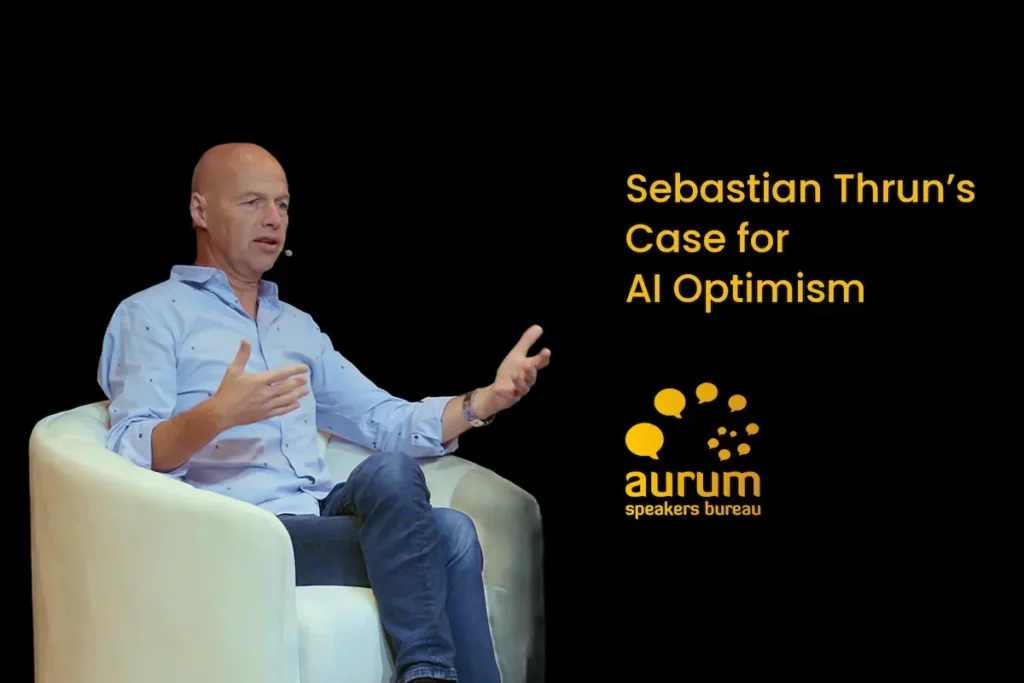

Sebastian Thrun, founder of Google X and of the self-driving car project that became Waymo.
Anything people call hard or impossible today will be easy six months from now. That premise drives Sebastian Thrun’s AI optimism, and the AI keynote speaker brought it to the opening fireside chat of Day 2 at Long Horizon, Encord’s Physical AI summit at Fort Mason in San Francisco, on October 21, 2026. In conversation with CNBC tech reporter Lora Kolodny, he applied that rule to almost every question, from hardware design and media to regulation and the robot that might one day take out his trash. Here, Aurum Speakers Bureau covers the highlights.
Some context on why his optimism carries weight: Thrun started the Google self-driving car project that became Waymo. He also founded Google X, co-founded Udacity, and led Stanford’s team to victory in the 2005 DARPA Grand Challenge with Stanley, the robotic car now held by the Smithsonian.
Few people have watched so many technologies travel from improbable to routine, which gives his optimism a track record.
Why six months is the right clock for AI
Thrun opened by placing today’s AI on a long arc of human tools for storing and sharing knowledge, from the invention of writing and the printing press onward. It is as if, in his view, that arc has now reached something close to a singularity. The first generation of language models was essentially a lookup table for the next word, he expresses, and even that was impressive. Thanks to better data and better tooling built around the models, he believes today’s systems already exceed human intelligence. That confidence comes from experience.
Thrun recalled that in 2009 a self-driving car looked “scary and impossible,” while today it looks trivial and obvious. He described Larry Page, whom he worked alongside for many years, as a master of what he calls nonlinear thinking: ideas that make no sense at first, and later turn out to write history.
His own rule follows from that. Whenever someone tells him a technology will never happen, his answer is simple: just you wait.
An AI engineer for hardware
Thrun’s current startup is still in stealth, and on stage he would only say that the team is closing a round. Our feature on Sebastian Thrun’s new robotics startup covers what is publicly known.
What he did share is the problem he is chasing. AI coding tools have transformed how software gets written; yet designing, building, and manufacturing a robot still takes far longer than writing the code that runs it.
His answer is an AI engineer that carries a hardware project from abstract concept through engineering, manufacturing, sourcing, and tooling. To show what that means, he described designing and engineering a complete drone, verified as correct, in roughly 48 hours.
In a drone, every decision trades against weight, and each change ripples through the rest of the design. Packing that engineering expertise into software that can work through those tradeoffs overnight changes the pace of the entire effort.
He saved his sharpest words for CAD, the tool he has said to hate most by a wide margin.
Today, an engineer with an idea for a car can spend the next six months stuck in CAD. Thrun wants engineering to move a layer above it: state what the drone must do, and get back the architecture, components, cost, sourcing, build plan, test plan, and software, without ever drawing a single hinge or screw.
Why jobs keep expanding
Asked whether these tools will erode engineering skills, Thrun argued the opposite. Through the agricultural and industrial revolutions, humanity kept taking on new skills. None of the jobs held by the people in the room existed 150 years ago, when most of their grandparents worked on farms and the essential skills were milking a cow or planting a crop. He borrowed an example from Jeff Bezos on recalling the role of a massage therapist, which was inexistent centuries ago and is one of the many professions society has added since then. The jobs we have taken on are far better, he argued, so “why would that stop?”
For Thrun’s thinking on how people will learn in this world, see our feature on Sebastian Thrun on AI and the future of learning.
AI and the future of media
Thrun is impressed by AI-generated music and has used it to make personalized songs. He still expects people to want stars they look up to and identify with, but he sees a business waiting to be built around them. At a point in the fireside chat, he mentions Taylor Swift by imagining the capability of licensing her voice for personalized birthday songs at $100 apiece, for example. Streaming feeds are already personalized, chosen from a fixed library of millions of assets, he argues. An example of the next step, in his view, is AI that personalizes down to the single beat, matched to the listener’s mood and situation.
The same logic applies to news and books. Why read an article at the length the writer chose, or a ten-hour audiobook, he says, when you only have two hours? AI can repackage it automatically to fit. As a result, he said, all of media is going to change drastically.
Where Thrun’s AI optimism meets the risk debate
Sebastian Thrun on stage at Long Horizon 2026 in San Francisco.
Thrun is unhappy with the public story about AI. He pushed back on a narrative that, as he put it, tells towns in West Virginia that AI will kill everyone within ten years and that a local data center will only speed things up. Every technology carries risks, he said, and he does not want to downplay them. But historically, for every technology that survived, the benefits far outweighed the risks, and people learned to manage the rest.
Cybersecurity furthermore shows how he weighs the two sides. He acknowledged new threats, citing a PHP vulnerability reported that same day that exposed a large share of the world’s websites. What he sees is a possible golden age for cybersecurity: if defenders keep getting access to better models faster than attackers, security could end up stronger than ever. His point is that the narrative should lead with the opportunity, not the risk.
On catastrophic scenarios, he said he has yet to meet anyone who can explain how such an outcome would actually unfold, and he reminded the audience that predictions of the world ending “on a Tuesday” are as old as humanity itself.
He also addressed equity, a concern he hears from his Stanford students: that a small elite will capture most of the gains. His answer was that a country thrives when everyone does well, not when only a small number of people do.
Regulation: partnership over prevention
On policy, Thrun compared two models.
In his account, the United States is largely willing to wait for something bad to happen before regulating, and even the rules around Waymo were written in partnership with industry rather than against it.
Europe regulates before harm appears. In his view, that has left Europe regulated to death, with 27 different jurisdictions that make it nearly impossible for a tech company to operate across all of them.
His favorite example was the cookie banner. By his estimate, Europe loses around $550 million a year in productivity just on people accepting and rejecting cookies every time they open an app or visit a website, a rule of which he says he cannot see the use.
His advice to technologists is to treat regulators as partners. Regulators want things to be safe, and so does anyone building a company like Waymo. They want to make the world better, and so do technologists.
At Waymo and Kitty Hawk, he made talking to regulators part of the business, which he says leads to a constructive dialogue about the right rules. In AI, he sees very few abuses yet that require government action. When they come, with deepfakes and identity likely first, along with cybersecurity, lawmakers should step in to protect society, he stresses, but only then.
Here’s a different keynote of his if you would like to see Sebastian Thrun deliver on stage:
LiDAR, humanoids, and the household robot
On sensing at Long Horizon, Thrun said vision alone can drive a car in principle, since roads were engineered for human eyes. Today, though, LiDAR-based cars add a layer of safety that camera-only systems have not yet matched. Applying his own rule, he expects cameras to get there eventually, and the open question is when. In the meantime, cost is no longer the obstacle it was: automotive LiDAR now runs about $200, he remarks.
On humanoids (particularly on human shape versus other forms), he moreover described himself as torn, more excited on some days of the week than others. A robot shaped for human spaces gets a head start in a world full of devices built for people. But when an industry scales, the winning technology tends to look nothing like the human body: cars have wheels, airplanes do not flap their wings, and machines can rotate endlessly in a way living organisms cannot.
In warehousing, he pointed to companies such as AutoStore and Nimble, whose robots pick boxes from stacks five or six meters high, more compactly and cost-efficiently than people can.
His own wish list is a household robot that takes on his chores. Expressing he still changes diapers every morning and takes out the trash every week, he set four requirements:
- Affordable, which he put at under about $1,000
- Safe, which he says no humanoid he knows of is today, because they are too heavy and could kill a child if falling over them
- Reliable, including going up and down the stairs of an unfamiliar house
- Functional enough to handle tasks from dishes and laundry to yard clippings and trash
As for when it will arrive, he said it is probably a little further out than some people think.
What Thrun’s conversation means for leaders
The thread running through the conversation is his opening rule: what looks impossible today tends to look easy six months later, and most organizations still plan as if change will move slower than that.
An AI engineer that carries a hardware project from concept to manufacturing changes the pace of the entire effort. A long history of expanding jobs argues for building new skills instead of guarding old ones. AI-driven personalization is set to reshape how media is made and consumed. And early, open dialogue with regulators, the approach he took at Waymo and Kitty Hawk, keeps innovation moving while real abuses get addressed as they appear.
For event planners and leadership teams, the practical question is the one he opened with:
Which of today’s impossible problems will look easy in six months, and is your organization ready for that?
We hope the reminder on this question is helpful. Also, if that is the conversation your audience needs, the next section covers how to bring Thrun to your stage.
If you are weighing speakers for that kind of event, our guide on how to choose a technology speaker for your event can help.
Booking Sebastian Thrun
Thrun brings these ideas to the stage as one of our AI speakers and robotics speakers, with a record that spans Stanford, Google X, Waymo, and Udacity. His keynotes include:
- Physical AI and the Future of Robotics
- Inventing the Future: Lessons from Google X, Waymo, and the AI Frontier
- The Future of AI in Business
- The Future of Education
- Disruptive Innovation & Entrepreneurship
He suits technology and innovation conferences and senior leadership audiences. To check his availability, contact Aurum Speakers Bureau and we will respond within 24 hours.
For more builders in the same league, see our guide to the AI keynote speakers who built the technology.
Frequently Asked Questions
Why should organizations book Sebastian Thrun?
He offers first-hand experience from three decades of turning research into technology that works in the real world, from the self-driving car to Google X to online education. Audiences hear a working engineer with candid views on where AI and robotics are headed. Reach out to Aurum Speakers Bureau to explore availability and fit.
What does Sebastian Thrun say about AI and jobs?
Thrun argues that history points toward expansion. None of the jobs held by the people in his audience existed 150 years ago, when most families worked on farms, and he sees no reason the pattern would stop. He pairs that optimism with a call to tell the public story of AI through its opportunities rather than its risks.
How does Sebastian Thrun think AI will change media?
He expects AI to personalize media far beyond today’s recommendation feeds: music tailored to the listener’s mood, artists licensing their voices for personalized songs, and articles or books repackaged to fit the time a reader actually has.
How does Sebastian Thrun see AI regulation?
Thrun favors partnership between technologists and regulators, built through early and constant dialogue, as he practiced at Waymo and Kitty Hawk. He sees few AI abuses today that require government action and expects deepfakes, identity, and cybersecurity to be the first areas where lawmakers need to step in with action. These are his views, and policymakers weigh the trade-offs differently.
How can I book Sebastian Thrun, and what does it cost?
His fee depends on the event date, format, duration, and preparation required. To receive a quote, contact Aurum Speakers Bureau for a response within 24 hours. Booking through Aurum Speakers Bureau involves no additional cost to you, since we earn a commission directly from the speakers. Let us know if we can help in any way; we look forward to a potential collaboration.