
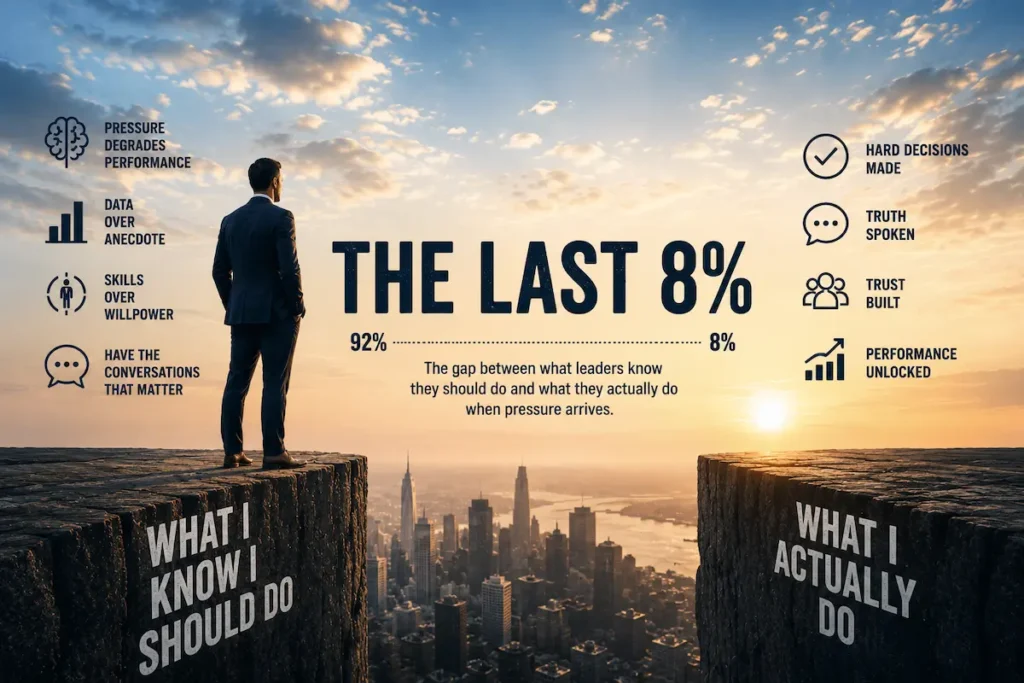
There is a gap inside almost every organization that no strategy deck ever names. It is the distance between what a leader knowsthey should do in a high-stakes moment and what they actually do when the pressure arrives. The difficult conversation gets softened. The hard decision gets postponed. The risk everyone privately knows is worth taking goes untaken. Most companies treat this as a personality problem. JP Pawliw-Fry treats it as a measurable one.

That distinction is what separates JP Pawliw-Fry from the broad field of speakers who talk about resilience and mindset. Co-founder and president of the Institute for Health and Human Potential, co-author of the New York Times bestseller Performing Under Pressure, and host of the Last 8% Morning podcast, he has spent more than two decades turning the neuroscience of pressure into something leaders can actually practice. His work is built on data rather than anecdote, and that empirical grounding is precisely why corporate audiences trust it.
As pressure becomes the defining condition of modern work rather than an occasional spike, his message has only grown more relevant. The question he answers is one every executive eventually faces: why do capable, intelligent people underperform at the exact moments that matter most, and what can be done about it.
The Science That Says Nobody Rises to the Occasion
The central finding behind Performing Under Pressure, the book Pawliw-Fry co-authored with psychologist Hendrie Weisinger, is a quiet demolition of a cherished myth. Despite the sports-movie idea that great performers “rise to the occasion,” the research shows the opposite: pressure reliably degrades judgment, attention, decision-making, and dexterity. No one performs better because the stakes are higher. The best simply learn to lose less of their ability when it counts.
That reframing matters for leaders because it moves the conversation from willpower to method. If pressure predictably diminishes performance, then managing it is a trainable skill rather than a character trait you either have or lack. The book, published in more than 65 countries and named a best business book of the year by Inc. Magazine, lays out concrete strategies drawn from work with elite performers. You can find Performing Under Pressure through major booksellers, and it remains the most accessible entry point to his thinking.
The Last 8 Percent
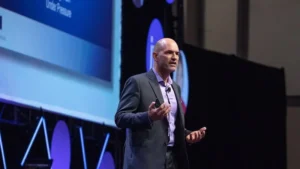
JP Pawliw-Fry shares research-backed insights on performing under pressure, helping leaders close the gap between knowing what to do and taking action when the stakes are highest.
If one idea defines Pawliw-Fry’s work today, it is what he calls the “Last 8%.” His organization surveys tens of thousands of people every month, and a multi-year study of that data, published in Harvard Business Review, identified a quantifiable gap between the risks people know they should take and the risks they actually take. In a difficult conversation, most managers handle the first 92 percent competently, then avoid the final, most important part: the feedback that actually needs to be said, the decision that has been deferred, the truth that feels too risky to voice.
That avoided remainder is the Last 8%, and Pawliw-Fry’s argument is that it is where culture, trust, and performance are actually decided. Organizations do not fail in the easy 92 percent; they fail in the part everyone flinches from. His keynotes give leaders a vocabulary and a set of tools for leaning into those moments rather than around them, which is why his sessions tend to function less like inspiration and more like operational training for leadership speakers audiences and senior teams.
Why a Psychologist’s Lens Changes the Leadership Conversation
Pawliw-Fry’s training in the psychology of performance, including time at Harvard’s Mind/Body Medical Institute and years teaching executive education at the Kellogg School of Management, gives his work a foundation that distinguishes it from instinct-driven motivation. He approaches leadership as a question of how the brain behaves under load, and what specifically can be done to keep it functioning when fear and urgency push it toward self-protection.
This is also where his own story lends weight. He has spoken openly about growing up with ADHD and turning that early difficulty into a lifelong study of attention and self-regulation, the same capacities he now teaches leaders to build. That perspective places him naturally among Aurum’s psychology speakers as well, because his frameworks rest on how people actually think and feel rather than on how we wish they would. The result is guidance that survives contact with real pressure, tested across clients from Goldman Sachs and Johnson & Johnson to the US Marines and Olympic teams.
For organizations weighing which voice can move an audience from understanding to action, he sits comfortably among the best leadership keynote speakers for corporate events. To explore whether his message fits your event, contact Aurum Speakers Bureau to discuss availability and booking options.
Frequently Asked Questions
Why should organizations book JP Pawliw-Fry?
Pawliw-Fry offers something rare among performance speakers: a science-backed, data-driven framework rather than motivation alone. For leadership summits, executive retreats, and events centered on decision-making, culture, or change, he equips audiences with practical tools to perform when the stakes are highest, grounded in research with Fortune 100 companies, the military, and elite athletes. Aurum Speakers Bureau can advise on his availability and manage the entire booking process.
What does JP Pawliw-Fry speak about?
His keynotes focus on performing under pressure, the neuroscience of high-stakes decision-making, emotional intelligence, and building high-performance cultures. His signature concept, the “Last 8%,” addresses the difficult conversations and decisions leaders tend to avoid, and how facing them builds trust and drives results.
What is JP Pawliw-Fry’s background?
He is co-founder and president of the Institute for Health and Human Potential, co-author of the New York Times bestseller Performing Under Pressure, and host of the Last 8% Morning podcast. He trained at Harvard’s Mind/Body Medical Institute and taught executive education at the Kellogg School of Management, and his organization surveys tens of thousands of people monthly to ground his work in current data.
What types of events suit a speaker like Pawliw-Fry?
Pawliw-Fry is well suited to leadership summits, sales kickoffs, executive retreats, and conferences themed around performance, change, or organizational culture. Because his content is interactive and tool-based, it works particularly well for audiences expected to apply what they learn rather than simply be inspired by it.