

David Rogers, Columbia Business School faculty member, wrote the first book on digital transformation and has spent years studying why so many efforts stall.
A chief financial officer can list exactly what the company has spent on AI: licenses, cloud bills, consultants, new hires. The harder question is what came back. The David Rogers AI transformation argument starts with that gap between the investment a company can measure and the financial return it struggles to find.
Rogers is a Columbia Business School faculty member, the founder of the BRITE conference, and the author of The Digital Transformation Playbook, the first book written on the subject.
This guide draws on his Columbia Business School talks on AI transformation and on the five-step method in his book The Digital Transformation Roadmap: Rebuild Your Organization for Continuous Change (Columbia Business School Publishing, 2023).
As a key global digital transformation speaker, he is available for bookings through Aurum Speakers Bureau.
Why AI spending outpaces AI returns
Rogers cites research finding that more than half of CEOs say they have yet to see a financial return from AI. He calls it the AI value gap and describes it in an article he co-wrote with a Columbia colleague. Spending is easy to measure, and value is hard to measure.
He describes five ways the gap shows up:
- solving a friction that annoys leaders but costs the firm little
- adding a customer feature the market does not value
- copying use cases because competitors adopted them
- visualizing data in new ways without changing any decision
- giving employees tools that save individual time the company cannot capture at scale
Fortune’s reporting on McKinsey research points the same way: the 6% of organizations that attribute at least 5% of their earnings before interest and taxes to AI are far more likely to redesign how work gets done than to add AI to existing processes.
Rogers traces the gap to two root causes:
The first is ownership: AI initiatives are often sponsored by IT teams, a new AI office, or an innovation lab, groups disconnected from responsibility for profit and loss.
The second is the starting point: the effort begins with a solution, such as becoming an agentic organization or adopting a particular model, instead of a problem.
Start with the problem, then choose the tool
That second cause is the center of his argument, and it echoes the main theme of his book:
pick the problems that matter most.
He offers two lenses for doing it.
The problem lens: which problem, and whose?
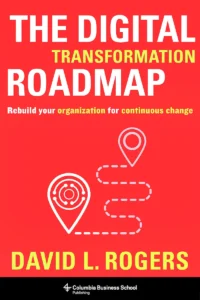
Five steps and eight planning tools: the Roadmap’s blueprint for organizations built to keep changing.
The problem lens asks what problem the company is solving and for whom. Nike offers a business example: predicting demand across thousands of product variations, where excess stock ties up capital and shortages cost sales. Rogers reports that Nike’s AI work on demand prediction cut inventory misalignment by 20% and stockouts by 15%, and lifted sales by 10% in targeted regions launching new products.
Audible, an Amazon company, applied the same lens to a customer problem: finding the next audiobook. Its conversational tool, Maven, lets a listener ask for a beginner’s guide to a subject or a beach read under a set length, instead of browsing categories.
The opportunity lens: what could delight or grow?
The opportunity lens points at something new instead of a current pain point: how might the company delight customers with the unexpected, or grow in a direction it has not tried? Audible again: listeners can ask a book questions mid-chapter and, in one fiction title, speak with a character. ArcelorMittal, a steel producer in a commodity business, uses AI to speed the search for premium specialty steels, and Rogers says the design process has shrunk from years to weeks.
The two lenses work together, and Rogers pairs them in a Roadmap tool called the Problem Opportunity Matrix: customer problems, business problems, customer opportunities, and business opportunities.
Organizations looking for more voices on AI adoption can browse our AI speakers, or start with our guide to the AI keynote speakers who built the technology.
Who owns the problem decides the result
Rogers is direct about who should choose the problems. For him, the leaders responsible for profit and loss should do that, not an IT team or a new AI office.
Once a problem is chosen, he asks for two disciplines before anything gets built.
First, draw a line from the problem to the income statement. If solving it matters, a number there should move.
Second, define the success metric in business terms: the indicator that shifts if the model works, and not only the technical measure.
He adds a point about employee-facing AI. Many of these projects fail because nobody asks employees what is in it for them: how the tool will improve the job, or how it will make them look better in the role.
When that question gets an answer, he says, adoption follows and employees become champions without any badgering.
Lastly, experimentation completes the picture. The first model someone hands over may fall short of a business impact, so teams stay committed to the problem and flexible about the solution.
For the human side of adoption, see our profile of Tsedal Neeley on the digital mindset. To check David Rogers’s availability for your event, contact Aurum Speakers Bureau and one of our founders will respond within 24 hours.
Why the Roadmap still matters for AI
Rogers laid out the Roadmap in person at the BRITE conference in 2023. Here is his presentation:
He cites consulting studies finding that roughly 70% of companies pursuing digital transformation are failing by their own measure, and he names five root causes: a missing shared vision, vague growth priorities, too little experimentation, rigid governance, and legacy technology, talent, and culture. His five steps answer those barriers: define a shared vision, pick priorities, experiment, redesign governance, and build capabilities.
AI changes the tools and leaves the pattern in place. Rogers told that audience that AI, the metaverse, and blockchain are technologies a company may use to pursue opportunities, and none of them is the starting point of a strategy.
He illustrates the cost of skipping experiments with CNN+. The streaming service launched after a detailed plan, outside data, and about $300 million of preparation. It drew fewer than 10,000 daily users and shut down in roughly a month. Walmart took the opposite route in online grocery: it tested delivery memberships, store pickup, and in-home delivery. It also kept what customers used.
Applied to AI, that means proving before scaling: validate the problem, the solution, the product, and the business model in stages before committing the budget.
A Columbia colleague, Rita McGrath, endorsed the Roadmap. See our profile of Rita McGrath on strategic centering.
Try this in your next leadership meeting
Pick one AI initiative already under way and ask four questions:
Can we write the problem as a “how might we” statement?
Name the customer and the outcome they would get. For a business problem, name the role that owns it, not the company.
Where does it show up on the income statement?
If solving the problem will not move a number there, reconsider the priority.
Who owns the profit and loss?
The person accountable for that number should help choose the problem.
What business metric will move first?
Set it before anyone builds, and keep the commitment to the problem even when the solution changes.
The David Rogers AI transformation keynote
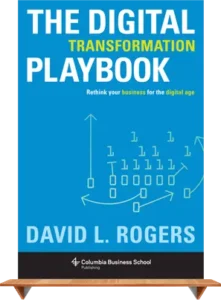
The first book on the subject, it moved the conversation from technology to strategy and leadership.
Rogers’s keynote, AI Adoption Done Right: Strategy Ahead of Technology, takes on the temptation to chase the technology. He argues that the decisive advantage belongs to organizations that lead with strategy, and he offers a clear framework of governance, prioritization, and organizational readiness. Audiences leave knowing how to move beyond pilots and build AI into business models, decisions, and customer experiences.
His other sessions cover rebuilding the organization for constant digital change through the five-step Roadmap, how established companies win in the digital economy with cases from Disney, Mastercard, and John Deere, and activating customer networks. This pertains to his founding idea that digital technology turned customers from an audience into a connected network.
He also draws on The Digital Transformation Playbook, published in 13 languages, and The Digital Transformation Roadmap, shortlisted for the 2024 Best in Business Book Awards. His clients include Google, Microsoft, Citibank, Mastercard, BASF, Toyota, GE, and Procter & Gamble.
The organizations that capture value from AI usually start with a problem worth solving, and David Rogers shows leaders how to find it.
Every topic is listed on his David Rogers speaker profile. To compare voices on organizational change, see our guide to the best change management keynote speakers.
Booking David Rogers
David Rogers’ speaking fee depends on the event date, format, duration, and preparation required. To receive a quote, contact Aurum Speakers Bureau and one of our founders will respond within 24 hours.
Want to hear the best part, however? Thanks to our commercial agreements with the speakers with whom we work, booking through Aurum Speakers Bureau involves no additional cost to you. We earn a commission directly from the speakers for promoting and managing their engagements.
Our goal is to simplify your life and help organize your event without extra fees or complications.
Contact us to learn more.