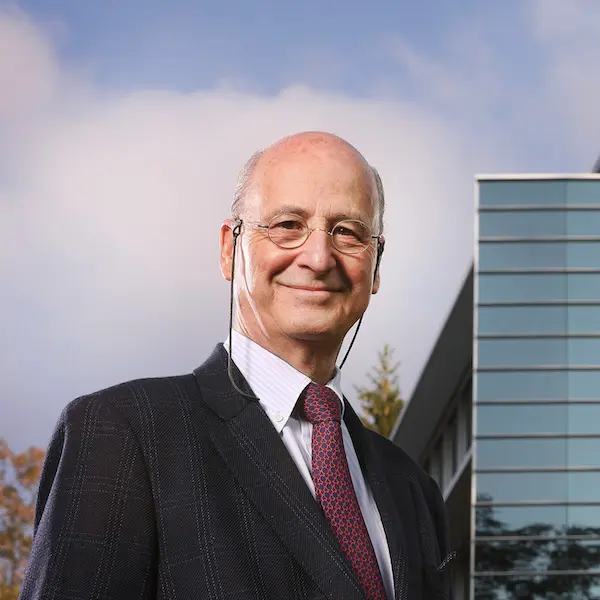
Stephane Garelli
World Authority on Competitiveness | Founder, IMD World Competitiveness Center | Former Managing Director, World Economic Forum | Professor Emeritus, IMD



Co-Founder & CEO, Odyssey | Former VP Product, Cruise | Founder, Voyage | Pioneer of World Models, Autonomous Vehicles & Generative AI
Oliver Cameron has spent a decade at the frontier of AI — from building self-driving cars at Voyage and Cruise to now pioneering world models at Odyssey, backed by GV, EQT Ventures, NVentures, and Samsung Next. He brings rare operator depth to the most consequential AI questions of our time: how intelligent systems learn to understand, predict, and generate the world.
Want to book Oliver Cameron as a speaker for your event? Please provide the info below and we’ll get in touch within 24h:
Oliver Cameron is one of the most credible operator voices in artificial intelligence — a British-born entrepreneur who has spent a decade building real AI systems at the frontier, from self-driving cars to the world models that may define the next era of computing. He is the Co-Founder and CEO of Odyssey, a San Francisco-based AI lab pioneering general-purpose world models: systems that learn to understand, simulate, and generate the physical world from visual data, with applications spanning interactive media, gaming, film, robotics, and AI simulation.
AI speaker Oliver Cameron began his AI journey at Udacity, where as VP of Engineering, Product, and Content he led a 200-person team building one of the world’s most influential online programs in autonomous vehicles, robotics, and deep learning — helping to democratize access to AI education at a time when the field was still largely confined to elite research labs. He then co-founded Voyage in 2017, a self-driving car company with a distinctive approach: rather than chase fully open-road autonomy with billion-dollar budgets, Voyage deployed real autonomous taxi services inside retirement communities, solving genuine mobility problems for senior citizens who could no longer drive. Voyage raised $52 million from Khosla Ventures, Franklin Templeton, Initialized Capital, and CRV before being acquired by Cruise, General Motors’ autonomous vehicle division, in 2021.
At Cruise, Cameron served as VP of Product, leading the product organization for one of the most ambitious and well-funded autonomous vehicle programs in the world. He left to found Odyssey in 2023, alongside co-founder Jeff Hawke, formerly a founding researcher at Wayve. Odyssey has raised $27 million to date from GV (Google Ventures), EQT Ventures, Air Street Capital, NVentures (NVIDIA’s venture arm), and Samsung Next — a investor lineup that reflects the strategic significance of world model technology across the AI landscape.
Odyssey’s core bet is that general-purpose world models — AI systems trained on rich, physics-accurate real-world data rather than scraped internet video — will unlock a new class of applications that today’s generative models cannot reach. The company has deployed its own custom backpack-mounted 360-degree camera system with six cameras, two LiDAR sensors, and an inertial measurement unit to capture high-fidelity real-world environments at scale. Its Odyssey-2 model, launched in late 2025, streams interactive AI-generated video in real time — responding to user inputs every 40 milliseconds, with no game engine — and has attracted researchers previously from OpenAI, DeepMind, and ByteDance. Cameron spoke at TechCrunch Sessions: AI in 2025, addressing how to build and launch frontier AI products against entrenched incumbents.
As a speaker, Oliver Cameron translates the most technically complex developments in AI into strategic intelligence that non-technical leaders can act on. His talks draw on lived experience as a founder, product leader, and operator at the frontier — navigating the gap between research ambition and real-world deployment, raising capital against incumbents, and building teams that attract top AI talent. For organizations grappling with what AI means for their industry, their workforce, and their future, Cameron offers the grounded, operator’s perspective that most AI talks conspicuously lack.
Large language models dominated the first wave of the generative AI revolution. World models — AI systems that learn to simulate, predict, and generate physical reality from multimodal data — may define the next one. Cameron draws on his work building Odyssey-2 to explain what world models are, why they require a fundamentally different approach to data and training than current generative systems, and what they will make possible: from interactive film and game worlds generated in real time to synthetic environments for robot training and AI simulation. A forward-looking, technically grounded keynote that gives senior leaders a genuine head start on what is coming next in AI.
Cameron's career spans the most consequential applied AI programs of the past ten years — Udacity's autonomous vehicle curriculum, Voyage's real-world robotaxi deployments, Cruise's product organization, and now Odyssey's world model research. In this keynote, he draws on that experience to extract the lessons that matter most for leaders building with AI: why constraints generate better innovation than unlimited budgets; how to identify the right problem to solve when the technology is advancing faster than the market; and what separates AI projects that ship from those that remain perpetually in research mode. Practical, story-driven, and grounded in a track record of actually building and deploying AI systems at scale.
How do you build a world-class AI company when Google, Microsoft, NVIDIA, and Meta have structural advantages in data, compute, and talent? Cameron addressed this question directly at TechCrunch Sessions: AI in 2025, and in this keynote he expands on it for executive and entrepreneurial audiences. He covers the strategic logic behind Odyssey's proprietary data approach, how to attract frontier AI researchers when you cannot match Big Tech salaries, and why the most differentiated AI companies are winning on approach and insight rather than scale. An honest, tactical keynote for founders, operators, and innovation leaders navigating a landscape where the incumbents have never been more formidable.
From Waymo's robotaxi expansion to Tesla's FSD ambitions to the fragmentation of the AV stack in 2025, the autonomous vehicle landscape is more complex — and more interesting — than most coverage suggests. Cameron offers a practitioner's assessment: what the past decade of AV development actually taught the industry, why some approaches succeeded and others failed spectacularly, how the technology is evolving in an era of vision-first AI, and what the next five years are likely to bring. A clear-eyed, technically literate keynote for automotive, mobility, logistics, and investment audiences who want to understand the AV transition without the hype in either direction.
World Authority on Competitiveness | Founder, IMD World Competitiveness Center | Former Managing Director, World Economic Forum | Professor Emeritus, IMD

Co-Founder & Former President, The Ritz-Carlton | Founder, Capella Hotel Group | Bestselling Author, Excellence Wins | Service & Leadership Visionary
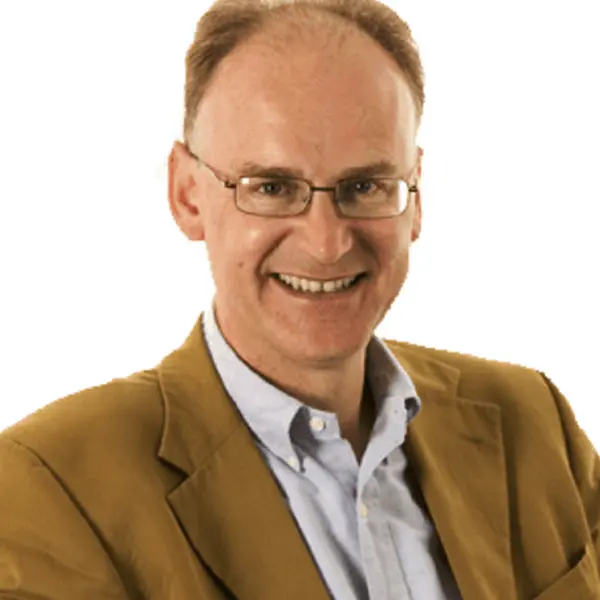
5th Viscount Ridley | Science Writer, Journalist & Businessman | Author of The Rational Optimist & How Innovation Works | Fellow, Royal Society of Literature

World Authority on Pricing | Founder & Honorary Chairman of Simon-Kucher & Partners | Creator of the "Hidden Champions" Concept | Thinkers50 Hall of Fame


© 2026 Aurum Speakers Bureau. All Rights Reserved

| Basic Data Protection Information | |
|---|---|
| Data controller | AURUM SPEAKERS BUREAU S.L. |
| Address | Parc Audiovisual de Catalunya 1, Oficina S11, 08225 Terrassa, Spain |
| Purposes | We will use your data to respond to your requests and deliver our services to you. |
| Marketing | We will only send you marketing correspondence if you have given your prior consent, which you can do by ticking the box for that purpose. |
| Lawful basis | We will only process your data if you have given your prior consent, which you can do by ticking the box for that purpose. |
| Recipients | Generally, only our members of staff who have been duly authorised may access the data that you have provided. |
| Your Rights | You have the right to know what information we hold about you, to rectify it and to erase it, as explained in the additional information available on our website. |
| Additional Information | For more information, please see our "PRIVACY POLICY". |