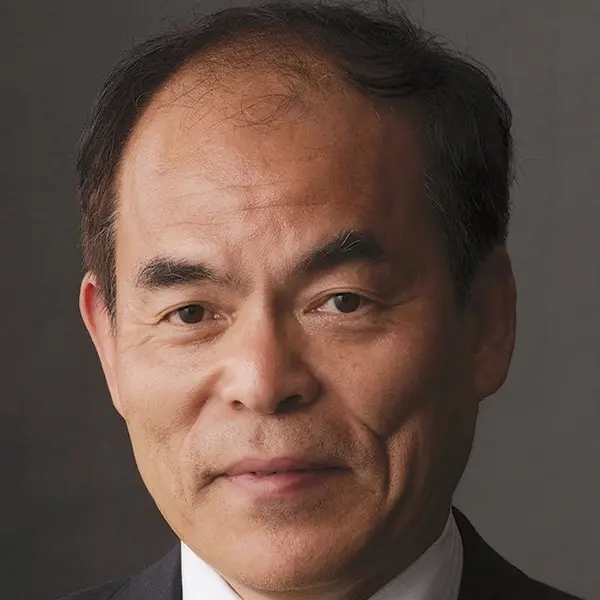
Shuji Nakamura
2014 Nobel Laureate in Physics | Inventor of the Blue LED | Professor, UC Santa Barbara | Founder & CEO, Blue Laser Fusion



Professor of Globalisation & Development, Oxford | Founding Director, Oxford Martin School | Former World Bank VP | Advisor to Nelson Mandela
Ian Goldin is Oxford's leading authority on globalization, systemic risk, and the future of work, and one of the few thinkers who predicted both the 2008 financial crisis and the COVID-19 pandemic in print. A former World Bank Vice President, economic advisor to Nelson Mandela, and author of 25 books, he turns frontier research into strategic clarity on the forces reshaping the global economy for the world's most demanding audiences.
Want to book Ian Goldin as a speaker for your event? Please provide the info below and we’ll get in touch within 24h:
Globalization speaker Ian Goldin is one of the world’s most sought-after thinkers on globalization, systemic risk, and the forces reshaping economies and societies in the 21st century. Professor of Globalisation and Development at the University of Oxford and Professorial Fellow at Balliol College, he combines the rare distinction of a leading academic career with hands-on experience at the highest levels of global policy, as Vice President of the World Bank and personal economic advisor to President Nelson Mandela.
Ian Goldin is best known for his ability to identify macro-level risks before they become headline crises. In his 2014 book The Butterfly Defect, he warned explicitly of the systemic fragilities of hyper-connected global supply chains and the conditions that would allow a pathogen to become a pandemic, six years before COVID-19 confirmed his analysis. Earlier, his work on financial contagion anticipated the dynamics of the 2008 global financial crisis. This track record of rigorous foresight, grounded in real institutional experience rather than speculation, is what sets him apart from his peers.
Goldin’s career is itself a masterclass in the relationship between ideas and power. Educated at the University of Cape Town, the London School of Economics, and Oxford, where he earned his doctorate, he served as Principal Economist at the European Bank for Reconstruction and Development, Program Director at the OECD Development Centre in Paris, and Chief Executive of the Development Bank of Southern Africa. As economic advisor to President Mandela, he accompanied the President on major international engagements and served as Finance Director for South Africa’s Olympic Bid.
From 2003 to 2006 he was Vice President of the World Bank and the Group’s Director of Development Policy, before returning to Oxford in 2006 to found the Oxford Martin School, which he built over a decade into a leading centre for interdisciplinary research into critical global challenges, bringing together more than 500 academics from over 100 disciplines across 45 research programmes. He currently leads Oxford Martin research programmes on Technological and Economic Change, the Future of Work, and the Future of Development.
The author of 25 books and more than 60 peer-reviewed articles, Goldin’s recent titles include Age of the City, The Shortest History of Migration, and Terra Incognita: 100 Maps to Survive the Next 100 Years. He has presented three major BBC documentary series and contributes regularly to the Financial Times, The Guardian, and Foreign Affairs. He has keynoted Google Zeitgeist, the Microsoft CEO Forum, and TED, and has appeared at the World Economic Forum in Davos for more than two decades.
As a speaker, Ian Goldin delivers something exceptional in an era crowded with futurists and trend-watchers: intellectual authority earned through decades of research, policy-making, and institutional leadership at global scale. His keynotes give audiences a rigorous, evidence-based map of the forces shaping geopolitics, technology, migration, urbanization, and the future of work, and equip senior leaders with the strategic frameworks they need to make sense of radical uncertainty. Audiences leave not merely informed, but better equipped to make consequential decisions.
The world order that underpinned growth and stability for decades is fracturing — and the forces driving that fracture, from US-China rivalry to deglobalization, democratic erosion, and technological disruption, are accelerating simultaneously. Goldin maps the new global landscape with the clarity of someone who has operated at its center — as a World Bank executive, a Mandela advisor, and a leading Oxford researcher — and provides senior audiences with a framework for understanding what the current shifts mean for their organizations, their strategies, and their exposure to systemic risk.
The very interconnections that generate prosperity — global supply chains, financial networks, digital infrastructure, international travel — also create the transmission channels for catastrophic shocks. Drawing on his prescient pre-COVID warnings and his decades of research into financial contagion and systemic fragility, Goldin examines the anatomy of global risk: how shocks propagate, why institutions consistently underestimate tail risks, and what organizations and policymakers can do to build genuine resilience rather than the illusion of it.
AI and automation are not simply changing jobs — they are transforming the relationship between skill, productivity, labor markets, and economic value at a pace and scale that institutions are not yet equipped to manage. Drawing on Oxford Martin School research programmes on Technological and Economic Change and the Future of Work, Goldin examines what the evidence actually shows about displacement and augmentation, which sectors and roles face the most profound change, and what leaders in business, government, and education must do now to navigate a labor market in structural transition.
Migration is one of the most politically charged and intellectually misunderstood forces in the modern world — and also one of the most consequential drivers of innovation, demographic resilience, and economic growth. Drawing on his most recent book The Shortest History of Migration and decades of policy experience, Goldin reframes the migration debate with evidence, nuance, and historical perspective: what migration has always meant for human progress, why current political narratives distort more than they illuminate, and what businesses and governments need to understand about demographic change in the decades ahead.
2014 Nobel Laureate in Physics | Inventor of the Blue LED | Professor, UC Santa Barbara | Founder & CEO, Blue Laser Fusion

Global Urban Expert, CBE | Chair, Connected Places Catapult | Chair, Cities Commission for Climate Investment | Author of 10 Books | TfL Board Member

Mathematician, Broadcaster & Best-Selling Author | Professor of the Public Understanding of Mathematics, University of Cambridge | President, IMA

Founder of KIND Snacks | Shark on ABC's Shark Tank | Founder of Camino Partners & the Builders Movement | NYT Bestselling Author of Do the KIND Thing


© 2026 Aurum Speakers Bureau. All Rights Reserved

| Basic Data Protection Information | |
|---|---|
| Data controller | AURUM SPEAKERS BUREAU S.L. |
| Address | Parc Audiovisual de Catalunya 1, Oficina S11, 08225 Terrassa, Spain |
| Purposes | We will use your data to respond to your requests and deliver our services to you. |
| Marketing | We will only send you marketing correspondence if you have given your prior consent, which you can do by ticking the box for that purpose. |
| Lawful basis | We will only process your data if you have given your prior consent, which you can do by ticking the box for that purpose. |
| Recipients | Generally, only our members of staff who have been duly authorised may access the data that you have provided. |
| Your Rights | You have the right to know what information we hold about you, to rectify it and to erase it, as explained in the additional information available on our website. |
| Additional Information | For more information, please see our "PRIVACY POLICY". |