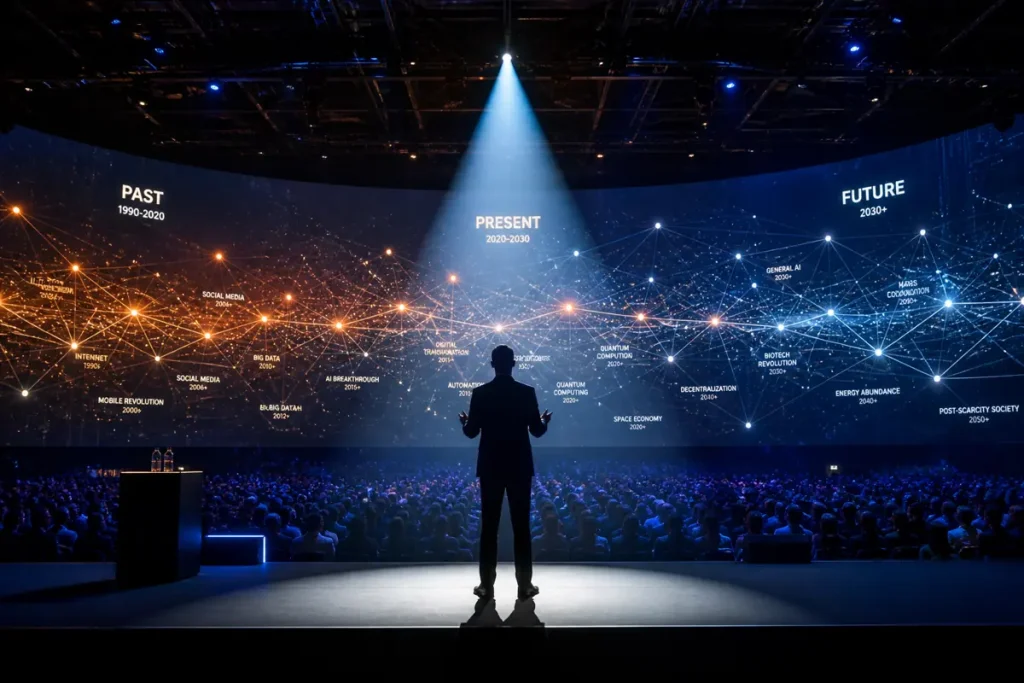
The most valuable thing a futurist keynote speaker brings to an event is not prediction. It’s a framework for thinking, a structured way to read emerging signals, challenge comfortable assumptions, and help a leadership team act before the disruption arrives rather than after.
Demand for futurist keynote speakers has climbed sharply as organizations face compressing technology cycles, geopolitical volatility, and the realization that strategic planning built on last year’s assumptions is already obsolete. The speakers on this list represent the sharpest minds working at that intersection of rigorous foresight and actionable insight for business audiences.
Amy Webb
Few figures in professional futures work combine academic rigor, methodological discipline, and genuine business fluency the way keynote speaker Amy Webb does. She is the founder and CEO of the Future Today Strategy Group, one of the most respected applied futures research organizations in the world, and a professor of strategic foresight at NYU Stern School of Business. The Thinkers50 global ranking of management thinkers currently places her at #4 worldwide.
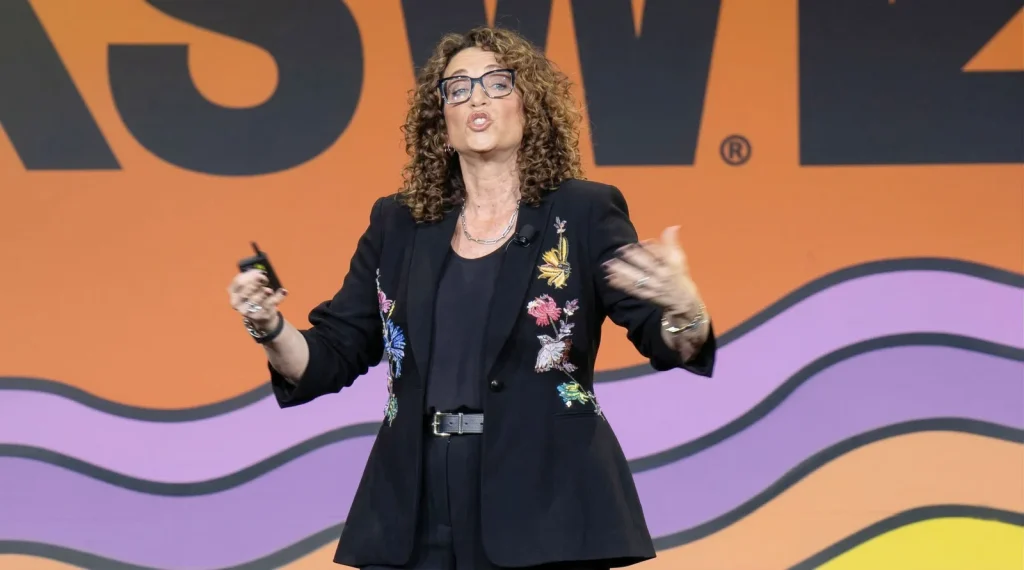 Every year, FTI publishes its Tech Trends Report — a research document that has grown to cover hundreds of emerging technology trends across dozens of industry sectors. It is used by Fortune 500 boards, government agencies, and military planners. Webb’s keynotes translate that research infrastructure into accessible, evidence-based presentations designed for senior leadership audiences who need to make decisions, not just understand trends. Her SXSW 2026 session made a significant departure: rather than presenting trend forecasts, she introduced her Convergence Outlook framework — the argument that the most consequential disruptions of the next decade will come from the intersections between technologies, not from any single one.
Her books — including The Signals Are Talking and The Big Nine, which examines the concentration of AI power among a small group of corporations — remain foundational texts in the field. She speaks frequently on artificial intelligence strategy, emerging technology policy, and how organizations can build internal foresight capacity.
Webb consistently brings intellectual precision to a field that too easily drifts into speculation. For organizations navigating AI strategy, she is one of the most credible voices available.
Ian Beacraft
Among the newer generation of futurists commanding major stages, speaker Ian Beacraft has built a reputation for making complex emerging technology genuinely accessible — without sacrificing depth.
Beacraft is the CEO and Chief Futurist at Signal and Cipher, a Chicago-based futures and foresight consultancy whose clients include Samsung, Intel, Coca-Cola, Google, Microsoft, and Nike. His work centers on helping organizations understand not just what technologies are emerging, but what behavioral and cultural shifts will accompany them — and how to position ahead of both. His Skill Flux framework, introduced at SXSW 2025, argues that the half-life of a technical skill has collapsed to roughly 2.5 years — and that most enterprise reskilling programs are structurally too slow to keep pace. That framing has made him one of the most urgently relevant voices on workforce strategy.

His keynote style is notably engaging: high-energy, visually driven, and anchored in real-world examples rather than abstract theory. He integrates live technology demonstrations and extended reality elements that make AI’s implications tangible in the room — he was the first person to host a globally syndicated news segment as a synthetic human. That combination has made him a strong fit for technology conferences, financial services forums, and company all-hands events where audiences need both urgency and a practical vocabulary.
For event organizers looking for a futurist who energizes a room while leaving attendees with concrete frameworks, Beacraft delivers both.
Audrey Tang
There are futurists who study how technology reshapes governance — and then there is keynote speaker Audrey Tang, who spent eight years actually doing it.
Tang served as Taiwan’s Digital Minister from 2016 to 2024, one of the longest-serving and most internationally recognized digital ministers of any government. During that period, she led Taiwan’s response to COVID-19 misinformation using radical transparency tools, developed participatory democracy platforms that gave citizens genuine input into policy, and established Taiwan as a global reference point for how democratic governments can work with technology rather than against it.
 Since leaving office, Tang has continued working on the intersection of technology, democracy, and collective intelligence — including as a co-author of Plurality: The Future of Collaborative Technology and Democracy alongside economist Glen Weyl. The book argues for a vision of digital infrastructure that strengthens democratic participation rather than fragmenting it.
For audiences in technology speakers programming, government affairs, or any event exploring the future of institutions, Tang brings a perspective that no other futurist can offer: a track record of putting these ideas into practice at national scale.
Parag Khanna
Where most futurists work forward from emerging technologies, speaker Parag Khanna works from geopolitical and demographic first principles — a different and highly complementary vantage point.
Khanna is the founder and managing partner of FutureMap, a data and scenario-based strategic advisory firm that works with governments, sovereign wealth funds, and global corporations on long-range strategic planning. His analytical framework draws on deep expertise in geopolitics, connectivity, and the movement of people, capital, and trade across the world’s shifting power structures.
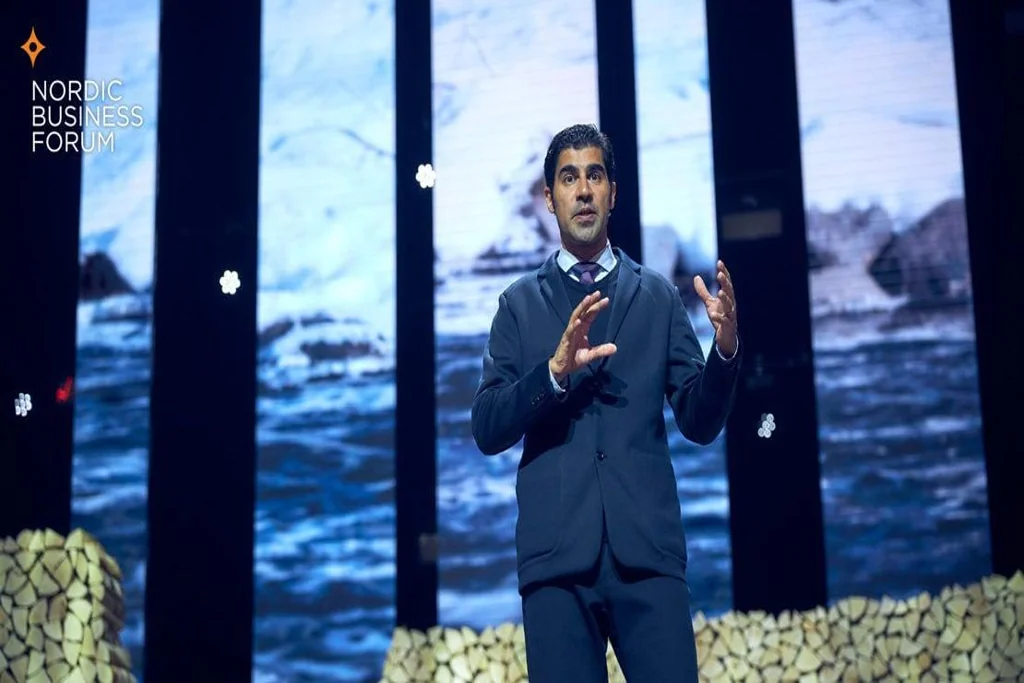 His books have made him one of the most internationally recognized voices on global strategy. Connectography mapped how infrastructure — ports, pipelines, fiber cables — is quietly redrawing the world’s political map. Move examined the largest human migration shifts of the coming decades and what they mean for where talent, investment, and economic activity will concentrate. Named one of Esquire’s 75 most influential people of the 21st century, Khanna brings a genuinely global scope that domestic-focused futurists rarely match.
For multinational leadership teams, boards assessing geographic risk, or any audience grappling with the next 10 to 20 years of global economic order, Khanna delivers some of the most substantive strategic content available on any keynote stage. For a broader look at the speakers helping organizations navigate geopolitical uncertainty, see Aurum’s top geopolitics speakers.
Mike Walsh
Most futurists describe what is coming. Keynote speaker Mike Walsh goes further — he helps leaders understand what they need to become before it arrives.
Walsh is the CEO of Tomorrow, a global consultancy on designing companies for the 21st century, and a regular columnist for the Harvard Business Review. Over two decades of working with Fortune 500 leadership teams, he has developed a distinctive approach: rather than cataloguing technological trends, he examines how AI and algorithmic systems are fundamentally changing what good leadership looks like — and what it demands of the people at the top of organizations. His books The Algorithmic Leader and The Dictionary of Dangerous Ideas (which presciently mapped developments including remote work, digital biology, and self-driving vehicles years before they reached mainstream attention) have been translated into more than a dozen languages. His forthcoming book, Abundant Intelligence, co-authored with Deloitte’s global head of AI, builds the case for what happens when thinking itself becomes cheap and scalable through AI agents.
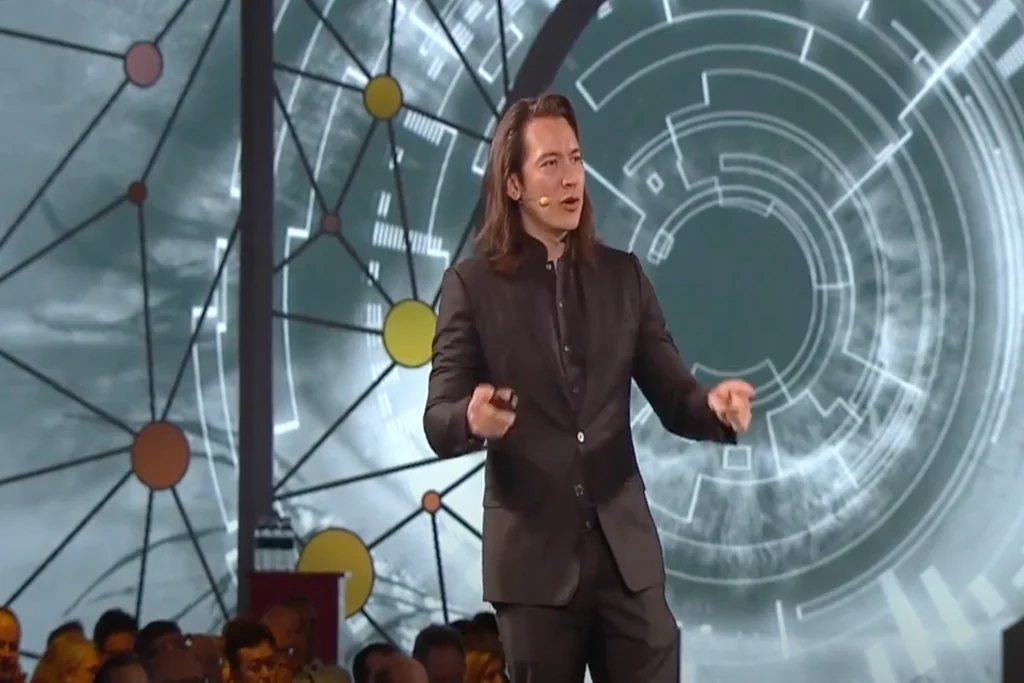 Walsh has delivered more than 1,000 keynotes across more than 60 countries, appearing alongside world leaders and addressing audiences as large as 25,000. For business speakers programming — particularly at organizations navigating AI transformation and looking for a speaker who can move a senior team from conceptual understanding to strategic action — Walsh is one of the most globally experienced voices available.
Ray Kurzweil
If the other speakers on this list help organizations prepare for the next five to ten years, keynote speaker Ray Kurzweil operates on a different horizon entirely — and has spent three decades proving that his long-range predictions deserve to be taken seriously.
Kurzweil is a principal researcher and AI visionary at Google, co-founder of Singularity University, and the originator of the Law of Accelerating Returns — his framework for understanding why technological progress compounds exponentially rather than linearly. Over more than 30 years, that framework has yielded an 86% prediction accuracy rate, a track record no other futurist can match. PBS named him one of the sixteen revolutionaries who made America. He has received the National Medal of Technology, more than 20 honorary doctorates, and recognition from three U.S. presidents. His inventions — the first flatbed scanner, the first text-to-speech synthesizer, the first OCR system capable of reading any typeface — are not predictions. They are a portfolio.
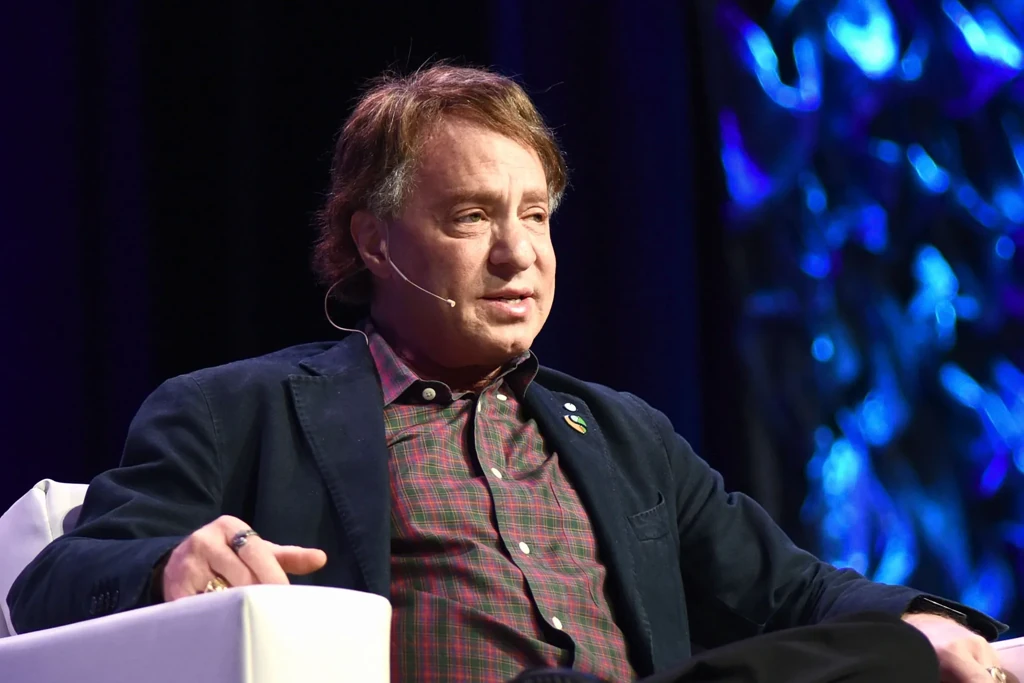 His bestselling books The Singularity Is Near and its 2024 sequel The Singularity Is Nearer lay out the evidence for a profound merger of human and machine intelligence by 2045. For audiences, the value is not whether they accept that specific timeline — it is the framework itself: learning to think about technological change as a compounding force rather than a series of isolated disruptions, and understanding what that means for strategy, investment, and organizational design over a 10- to 20-year horizon.
For boards, long-range planning sessions, and any audience that needs to stress-test its assumptions about how far and how fast AI will actually go, Kurzweil brings an intellectual authority that is genuinely irreplaceable.
How to Choose the Right Futurist for Your Event
The most common mistake event planners make when booking a futurist is treating the category as monolithic. These speakers share a discipline — foresight — but they come from radically different intellectual traditions and speak to different organizational needs.
Technology-focused audiences seeking rigorous analytical frameworks benefit most from Amy Webb, whose quantitative methodology gives leadership teams tools rather than just trends. Organizations grappling with geopolitical uncertainty or global expansion get more value from Parag Khanna’s geographic and demographic lens. Events exploring governance, democracy, or the ethics of digital infrastructure will find Audrey Tang’s real-world experience irreplaceable. And for organizations that need a speaker who directly bridges AI strategy with leadership transformation, Mike Walsh operates in a space few futurists occupy. For boards and leadership teams that want to stress-test assumptions about the long-range trajectory of AI — not just the next planning cycle but the next two decades — Ray Kurzweil brings a framework and a track record that stands apart.
The strongest programs often pair a macro-level strategic thinker with a more operationally focused practitioner — creating a sequence that moves from understanding the landscape to acting within it.
Contact Aurum Speakers Bureau to explore which of these speakers fits your event’s goals, audience, and format.
Looking for speakers at the intersection of foresight and technology? Explore Aurum’s full roster of futurist speakers.