
Applause is a poor metric. It measures how a room felt in the moment, not whether anything changed because of what happened in it. Event teams that rely on post-event applause and a satisfaction score are essentially measuring entertainment, not impact. And the distinction matters, because the budget conversation for next year’s speaker will be built on whatever evidence you can show.
Measuring keynote impact is not complicated, but it requires deciding what you are trying to measure before the speaker ever steps on stage, not after.
Start with the Outcome, Not the Speaker
The most common mistake in keynote evaluation is working backwards. A team
books a speaker they admire, runs a great event, collects feedback, and then tries to retrofit a success story onto whatever numbers they have. The result is always thin.
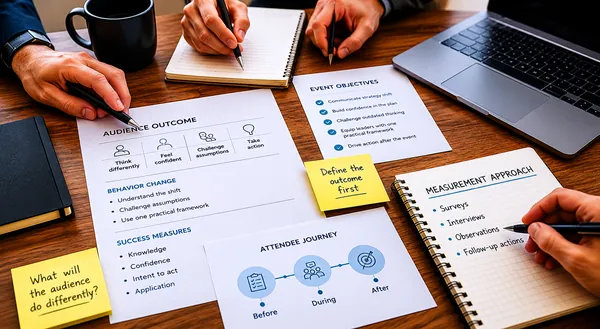
The more useful approach begins at the brief. When you contact a speakers bureau or start shortlisting speakers, the first question to answer is: what do we want the audience to think, feel, or do differently after this keynote? That question has a specific answer for every event. It is never “be inspired.” It might be: understand why our strategy is shifting and feel confident about it. Or: challenge their assumption that incremental change is enough. Or: leave with one framework they will actually use in their next leadership conversation.
Once that outcome is defined, you can choose a speaker capable of delivering it, brief them properly, and build a measurement approach around it. Without it, you are evaluating the wrong thing.
What to Measure, and When
Impact does not happen at a single moment. It unfolds across three windows, each requiring a different kind of attention.
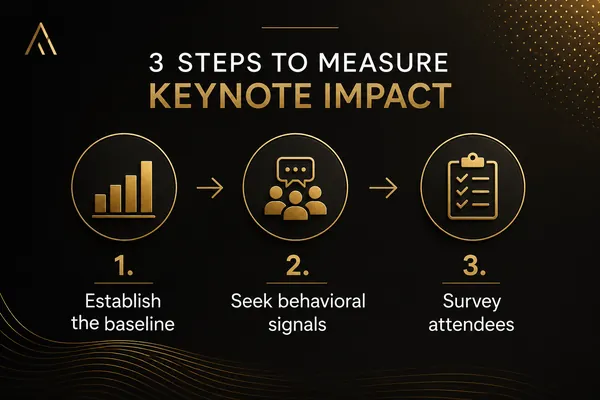
Before the event, the measurement work is about establishing a baseline. If you want to know whether the keynote shifted howyour leadership team thinks about innovation, you need to know how they think about it going in. A short pre-event pulse (three to five questions sent to attendees in the week before) gives you that reference point. It does not need to be sophisticated. It needs to be honest.
During the event, the most reliable signals are behavioral, not numerical. Is the room quiet in the way attentive rooms are quiet, or in the way checked-out rooms are quiet? Are people writing things down? Are questions in the Q&A substantive, engaging with the speaker’s ideas rather than asking for clarification on basics? These observations matter and they are worth capturing. A debrief with two or three people from your team immediately after the session, while impressions are fresh, is often more valuable than any survey.
After the event, two time horizons are worth tracking. The first is immediate: a short survey sent within 24 hours captures sentiment while the experience is still vivid. Ask what resonated, what attendees plan to do differently, and what they would share with a colleague. The second is the 30-day mark. By then, the energy has faded and what remains is what actually stuck. A brief follow-up asking whether attendees have applied anything, referenced any ideas, or changed any behaviors gives you a far more honest picture of whether the keynote delivered lasting value.
The Brief Is the Foundation of Measurement
None of this works if the speaker does not know what they are being measured against. A speaker who arrives without a detailed understanding of your audience, your organization’s current moment, and the specific outcome you are working toward will deliver a good talk. A speaker who is fully briefed will deliver the right talk.
This is one of the clearest advantages of working with a speakers bureau throughout the process. Aurum structures the content call (the direct conversation between you and the speaker before the event) around exactly this: what does the audience need to leave with, and how does the speaker calibrate their material to produce that outcome. The content call is where measurement becomes possible, because it is where the speaker commits to a specific destination for the room.
If you are working from a detailed brief and a well-structured content call, you can tell the speaker what you will be tracking. Most experienced speakers welcome that clarity. It focuses their preparation and gives them a frame for customizing their material that goes beyond demographic information.
What Good Impact Looks Like in Practice
Across different event types, the signals of genuine impact tend to look similar, even if the specifics differ.
For internal leadership events (annual summits, offsites, transformation kickoffs), the signal is language. When the ideas from a keynote show up in how leaders talk in the weeks that follow, in presentations, in team conversations, in the way a strategic challenge gets framed, the keynote did its job. The reverse is also true: a keynote that produces no new language, no new reference points, no new way of framing familiar problems had no lasting effect regardless of how well it was received in the room.
For external events (conferences, industry gatherings, client summits), the signal is conversation. Did the keynote give attendees something to discuss, debate, or share? Did it reframe a topic in a way that created new questions rather than settled old ones? The best keynotes generate friction in the best sense: they disturb comfortable assumptions and leave audiences productively unsettled.
For sales and commercial events, the signal is behavior. Did the team leave with a framework they used? Did the keynote shift how they talk about their own work, their clients, or their competitive position? Thirty-day pulse surveys with specific behavioral questions, not satisfaction ratings, are the most reliable instrument here.
Using the Data You Collect
Measurement without follow-through is wasted effort. The data you collect is only valuable if it informs two things: the debrief with your internal stakeholders, and the brief for your next event.

The stakeholder debrief should happen within a week of the event. Bring together whoever was involved in the booking decision, the event team, and two or three attendees with different perspectives. Walk through what you measured against what you intended. Where the gap is large, that is a brief or selection problem, not necessarily a speaker problem. Where the impact exceeded expectations, understand why. It is usually because the brief was precise and the content call was substantive.
The brief for your next event should build directly on that conversation: what worked, what the audience responded to most strongly, what fell flat, and what you would do differently in the selection process. Organizations that treat each keynote as a data point in an ongoing process consistently make better booking decisions than those that start from scratch each time.
Contact Aurum Speakers Bureau to discuss how to structure your speaker selection and briefing process around outcomes that are worth measuring.
Frequently Asked Questions
Why should organizations measure keynote speaker impact?
Keynote speakers represent a significant investment in event quality, audience experience, and organizational development. Measuring impact shifts that investment from a line item into a strategic decision with traceable outcomes. It also builds the internal case for future keynotes: organizations that can demonstrate what a keynote produced consistently secure stronger event budgets. Beyond budget justification, measurement forces the clarity of intent that makes keynote selection more precise in the first place.
What is the best time to measure keynote speaker impact?
Three moments matter: before the event (to establish a baseline), immediately after (to capture peak sentiment), and 30 days later (to assess what actually stuck). The 30-day mark is the most honest indicator of lasting impact. Immediate post-event surveys measure how the room felt; 30-day follow-ups measure whether anything changed. Both are worth collecting, but if you can only do one, the 30-day survey is more useful for the decisions that follow.
What should a post-event survey for a keynote speaker include?
Keep it short and specific. Ask what resonated most, what the attendee plans to do differently, what they would share with a colleague, and whether the content was relevant to their current challenges. Avoid generic satisfaction scales, which measure entertainment rather than impact. The most useful surveys connect directly to the outcome you defined before the event, so responses can be evaluated against an actual intention rather than a vague sense of success.
How does briefing the speaker affect the measurability of impact?
Significantly. A speaker who understands the specific outcome you are working toward can calibrate their material to that destination. When the destination is clear and the content call is substantive, you can tell the speaker what you will be measuring, which sharpens their preparation and gives your post-event data a specific frame of reference. Impact is hardest to measure when the brief was vague, because neither the organizer nor the speaker had a clear picture of what success looked like.