

The precision with which a speakers bureau sends you recommendations is almost directly related to the quality of whatever request and information you send to them first. This is not a criticism of bureaus, it is a structural reality. A bureau recommendation is only as precise as the brief that produced it. When an event organizer sends a detailed, thoughtful brief, the proposals that come back are targeted and immediately actionable. When the brief is thin — a date, a topic, and a vague sense of budget — the bureau is forced to make more educated guesses, and those can likely have a higher margin for improvement.
Understanding what a strong brief contains, and why each element matters, changes what you get back. So, let’s study how to get those done greatly from the very first try with today’s guide.
A Brief Is Not the Same as An Inquiry
There is a distinction worth drawing early. An inquiry is the first contact — the email or form submission that begins the conversation. The brief is the full picture: the complete set of context a bureau needs to make recommendations that are genuinely fit for your event.
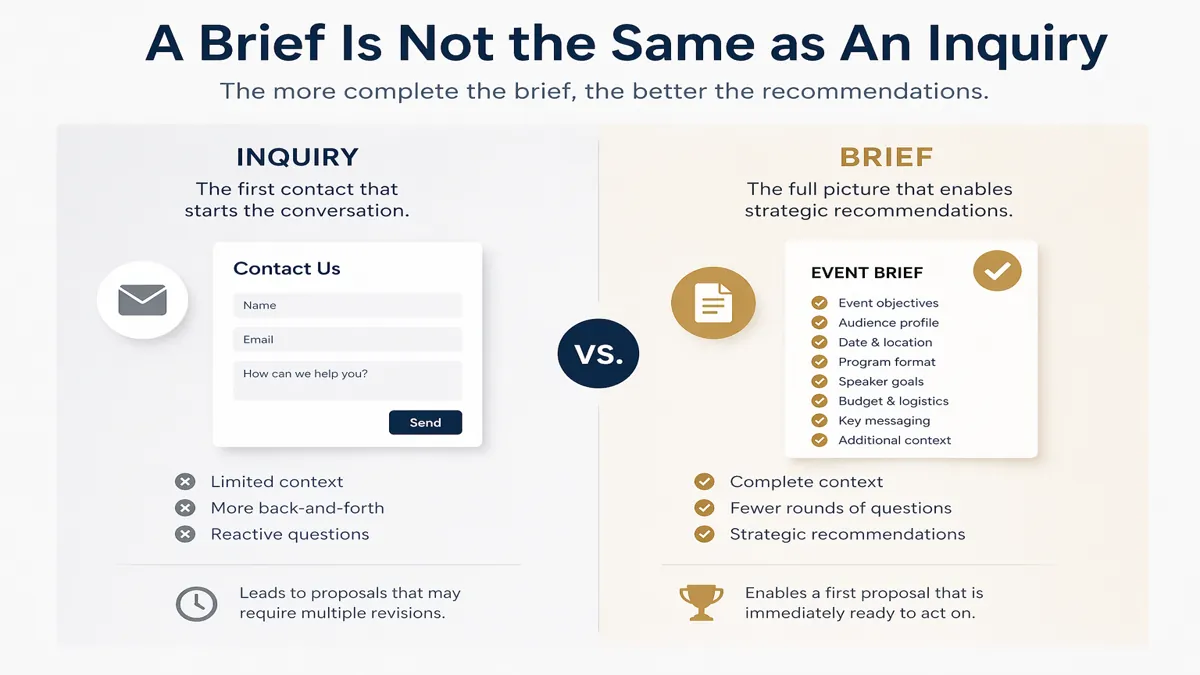
A simple inquiry starts the conversation. A complete brief shapes the outcome.
Some organizations treat these as the same thing. They fill out a contact form, wait for a call, and expect the bureau to extract the necessary information through questions. That approach works, but it adds time and rounds of back-and-forth that a well-constructed brief can eliminate. More importantly, a bureau that receives a complete brief from the outset can do something qualitatively different: it can think strategically before it responds, rather than gathering information reactively.
At Aurum Speakers Bureau, the difference between a brief inquiry and a full brief is often the difference between a first proposal that requires one revision and a first proposal that is immediately ready to act on.
What a Strong Event Brief Contains
The Event in Concrete Terms
 Dates, city, format (in-person, hybrid, or virtual), and expected attendance are the structural facts. They determine logistical feasibility before anything else — whether a speaker’s calendar can accommodate your timeline, what travel and preparation commitments are realistic, and whether a virtual format changes the speaker profile you need.
Beyond the basics: is this a recurring annual event or a new one? A long-running conference with an established audience creates different expectations than a first-edition gathering. Speakers calibrate their material differently depending on whether they are being introduced to an audience for the first time or performing in front of people who have seen four previous editions of the same event.
The Audience, in Depth
This is the element most briefs underinvest in — and the one that most directly affects recommendation quality.
 Headcount matters, but it is the least useful piece of audience information a bureau receives. What matters more: the seniority level of attendees, their industry or function, the geographic and cultural mix if the event is international, and — critically — the audience’s existing relationship with the topic you want the keynote to address.
An executive audience that has spent two years navigating an AI transformation needs a speaker who will challenge their existing frameworks, not introduce them to the concept. A cross-functional leadership team at the start of a culture initiative needs a speaker who can make a room feel something, not just learn something. A board offsite has different energy requirements than a 2,000-person annual sales conference. These distinctions determine which speaker belongs on your stage — and a bureau can only draw them if you give them the material.
If there are strong existing opinions in the room — a technically sophisticated audience skeptical of keynote generalism, or a senior team that has already heard the standard transformation narrative — say so. That information filters out half the roster immediately and sharpens what remains.
The Outcome You Are Working Toward
 Not “inspire the team.” Not “energize the audience.” The specific shift you want to produce.
The best briefs describe a tension the organization is navigating: a strategic pivot the leadership team wants the keynote to reinforce, a cultural challenge the event is designed to address, a decision the audience needs to move toward. When a bureau understands the destination, it can recommend leadership speakers who will function as a vehicle for that outcome — not just a well-reviewed talk, but the right talk for that moment in that organization’s history.
If there is internal context that matters — a merger, a restructuring, a product launch, a difficult trading environment — include it. Speakers adapt their material to match an organization’s moment, but only when that moment is described to them.

Format and Slot
How long is the keynote? Where does it sit in the agenda? Is there a Q&A? Does the speaker participate in anything beyond their session — a panel, a private dinner with leadership, a breakout?
A 45-minute opening keynote in front of a cold audience requires a different speaker profile than a 30-minute closing address to a room that has been in sessions for two days. Some speakers build slowly and reward an attentive room; others open at full intensity and are exactly right for a crowd that needs to be pulled in from the start. A bureau that knows your slot can match accordingly. Without that information, it cannot.

Constraints and Prior Speakers
Topics or angles the organization wants to avoid. Speaker profiles that would create a conflict — a competitor’s former executive, a public figure associated with a position the organization does not want amplified. Language requirements. Diversity considerations. Prior keynote speakers the audience has already seen, whether at this event or elsewhere.
These are not minor details. A constraint surfaced in the brief saves a round of proposals. Without it, a bureau may invest time building a recommendation around a speaker who would immediately be disqualified.

Budget Range
A precise number is not required. A general sense of the level — an emerging voice, an established expert, a globally recognized figure — is enough to calibrate the shortlist. Speaker fees vary significantly based on geography, preparation requirements, format, and schedule. Business speakers at the top of their category book years in advance at fees that reflect their demand; earlier-career voices can deliver exceptional keynotes at a fraction of the cost. The bureau can work across any tier, but needs a signal to know which tier you are in.
What the Bureau Does with Your Brief
A complete brief does not just speed up the process — it changes what the bureau can do.
When Aurum receives a detailed brief, the first step is not searching a database. It is thinking about the event: what the audience needs to feel, understand, or decide differently; which of the 800+ speakers on the roster have delivered in analogous contexts; which voices might not be obvious candidates but whose profile matches the moment precisely. That thinking takes time, and it only produces strong results when the raw material is there to work with.
At Aurum, we typically deliver a tailored proposal within 24 hours of receiving an inquiry. A complete brief means that proposal is built on real insight into your event — not on assumptions we’ve had to make in the absence of information. You can review our full guide on what a speakers bureau does if you want to understand the complete process from first contact through event day.
When You Do Not Have Everything
Event plans evolve. Themes shift. Audience composition changes as registration fills. None of that is a reason to wait until every detail is locked before reaching out to a bureau.
The right approach is to share what you know and flag what is still uncertain. A bureau that understands which elements are fixed and which are still fluid can sequence its work accordingly — beginning with the parameters that are confirmed and building from there. The content call that happens after booking is confirmed is where the final calibration takes place anyway. What the brief needs to contain is enough to make the recommendation; not every detail that will eventually go into the keynote itself.
For the day-of logistics that come after a speaker is confirmed, Aurum’s guide on the keynote speaker day-of-event checklist covers what your team needs to manage from arrival through final applause.
FAQ
Why does the brief matter so much for speaker recommendations?
A bureau recommendation is built from the brief. The more precisely a bureau understands the audience, the event’s strategic context, and the intended outcome, the more it can narrow its recommendations to speakers who genuinely fit — rather than producing a general shortlist of well-regarded names. The brief is the input; the quality of the proposal is the output. One determines the other.
How specific does my audience description need to be?
More specific than most briefs currently are. Seniority level, function, industry, and the audience’s existing relationship with the keynote topic are all useful. If there are strong existing opinions, technical depth, or cultural factors at play, include those. The more a bureau understands who is in the room and what they already know, the more precisely it can match a speaker to that specific audience rather than to a general event category.
Can I send a brief before I know my exact budget?
Yes. A general sense of the tier — emerging voice, established expert, or globally recognized figure — is enough to calibrate recommendations. Exact figures are helpful but not required at the brief stage. If budget is still being finalized, say so. A bureau can work with ranges and adjust once a number is confirmed.
How does briefing a bureau differ from briefing a speaker directly?
When you brief a bureau, you are providing the context that drives speaker selection — who you need, why, and for what moment. When you brief the speaker after they are booked, you are providing the context that drives keynote customization — what the audience knows, what the organization is navigating, and how to calibrate the talk for that specific room. Both briefs matter. The bureau brief comes first and determines which speaker arrives. The speaker brief comes after and determines how well they perform.
Contact Aurum Speakers Bureau to discuss your event — the more context you share, the sharper the recommendations you receive.