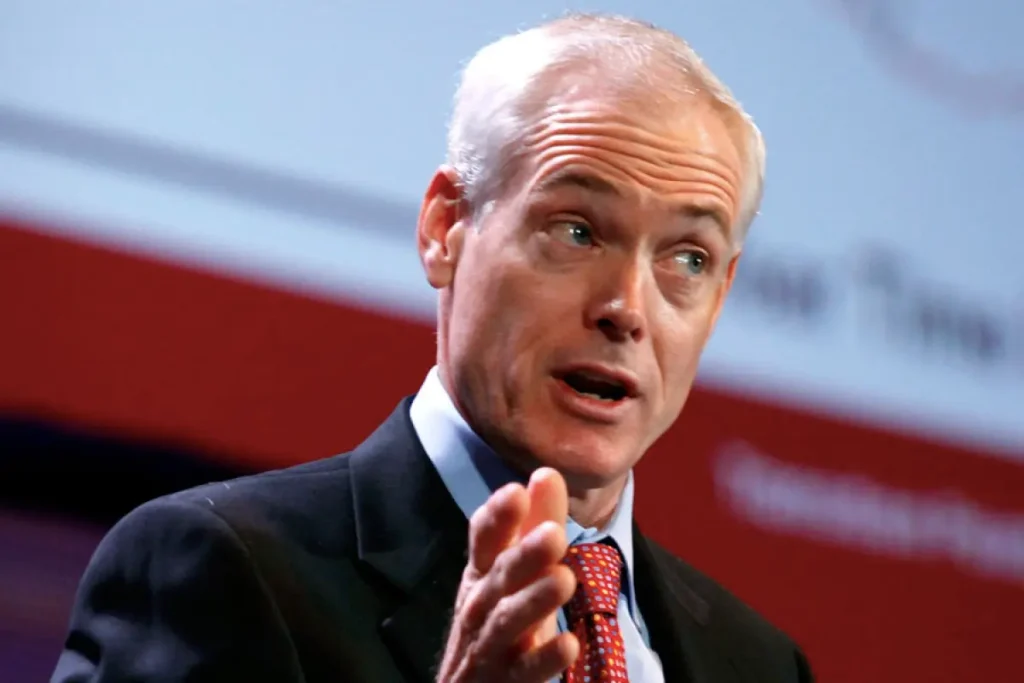

Jim Collins delivers keynotes on why disciplined leadership, not dramatic moments, drives lasting business greatness
Most companies that fail were not doing badly when they started to decline. They were doing fine – profitable, recognized, often celebrated. That is precisely what makes Jim Collins’s research so unsettling, and so indispensable.
For more than three decades, Collins has studied one of the most difficult questions in business: why do some organizations make the leap to sustained greatness while others, equally capable and well-resourced, never do? His answer is not what most executives expect. Greatness, he found, is rarely the result of a single dramatic decision, a visionary CEO, or a lucky moment. It is the cumulative result of disciplined people making disciplined choices over time.
That insight has made Jim Collins one of the most sought-after voices in business today – and one of the most requested leadership speakers among companies navigating uncertainty.
The Research Behind Good to Great
Collins did not begin with a theory. He began with a question: can a good company become a great one, and if so, how? To answer it, his research team spent five years analyzing 28 companies, identifying the 11 that made a sustained leap from good performance to great results – and holding them against direct industry comparisons that did not.
The resulting book, Good to Great (2001), sold over four million copies and has never gone out of print. It introduced a vocabulary now embedded in the language of corporate leadership: Level 5 Leadership, the Hedgehog Concept, the Flywheel, First Who Then What.
What made the findings credible was the method. Collins didn’t interview successful CEOs about their philosophy. He compared actual company performance data over 15-year periods – then worked backward to identify what the great ones did differently.
Level 5 Leadership: Humility as a Competitive Advantage
The finding that surprised audiences most was also the most counterintuitive: the leaders who drove the most dramatic and lasting transformations were not charismatic, self-promoting visionaries. They were, almost without exception, quietly ambitious for the institution rather than themselves.
Collins called them Level 5 Leaders – executives who combined fierce professional will with personal humility. They took responsibility when things went wrong and shared credit generously when things went right. They built organizations that did not depend on their presence to keep functioning.
In an era of founder mythology and celebrity CEOs, this finding carries particular weight. Boards seeking business speakers who can challenge leadership teams on their deepest assumptions find Collins uniquely equipped to do so – because his argument is grounded in data, not opinion.
First Who, Then What: Building for Uncertainty
One of the most-cited frameworks from Collins’s work is deceptively simple: before deciding where you want to take a company, get the right people on the bus. Get the wrong people off. Then figure out where to drive it.
The logic matters most in moments of disruption. When the environment shifts – as it has with AI, remote work, and geopolitical volatility – a strategy built around a specific market bet becomes fragile. A team built around disciplined, adaptable people remains durable.
This is why Collins’s keynotes resonate particularly with executive audiences grappling with transformation. The question is not which technology to adopt or which market to enter next. The question is whether you have the people capable of navigating whatever comes next. For event planners thinking through which type of speaker fits this kind of challenge, our guide to top leadership keynote speakers offers useful context on the broader landscape.
The Flywheel: Why Sustained Momentum Beats Breakthrough Moments
Ask most executives to describe a great business transformation, and they will describe a moment: a product launch, a pivot, a new leader’s arrival. Collins’s research found no such moment in any of the great companies he studied.
Instead, there was a flywheel – a consistent, patient building of momentum in which each success generated the conditions for the next. The breakthrough, when it came, was recognized by outsiders as sudden. To those inside the company, it was the result of years of steady, unglamorous effort.
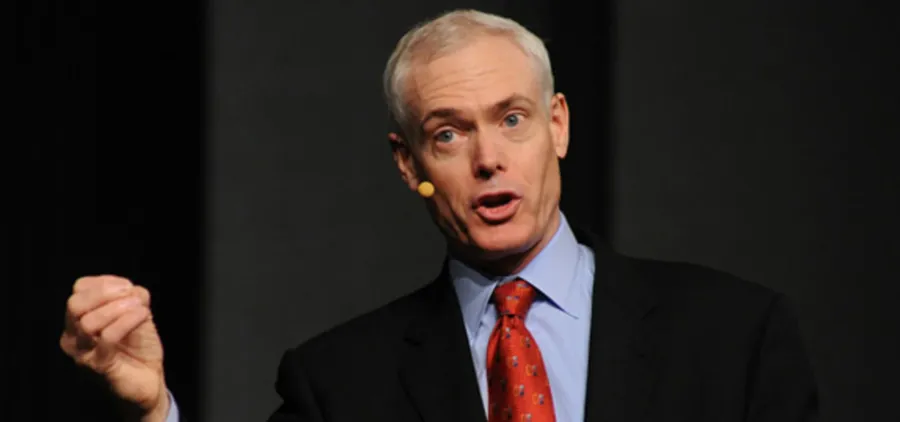
Jim Collins explaining how Level 5 leadership and disciplined thinking underpin sustained business greatness
Collins expanded the flywheel concept in a subsequent monograph, Turning the Flywheel (2019), applying it across industries from Amazon to a social sector organization. The concept has since been adopted by leadership teams worldwide as a framework for strategy that outlasts individual decisions.
Why Event Organizers Book Jim Collins
Collins is not a motivational speaker. He is a researcher who presents findings with the force of well-documented evidence. That distinction matters for event design – if you’re new to the booking process, our post on what is a keynote speaker covers the fundamentals of what to look for.
Executive audiences that have heard dozens of keynotes on leadership are often skeptical of inspiration without rigor. Collins meets them where they are – with data, with specific case studies, with frameworks they can apply the following week. His sessions work equally well as conference keynotes for large audiences and as workshop formats for senior management speakers programs and leadership retreats.
He has delivered programs for Fortune 500 companies, private equity portfolio companies, nonprofits, government institutions, and military organizations. The breadth reflects the universality of his core finding: the principles of enduring greatness are not industry-specific.
Frequently Asked Questions
Why should organizations book Jim Collins as a keynote speaker?
Jim Collins offers something rare: business research with the depth of academic rigor and the accessibility of a master communicator. His frameworks – Level 5 Leadership, the Flywheel, First Who Then What – give leadership teams a common language and a practical methodology for building lasting performance. Organizations that book Collins typically anchor his keynote to strategy retreats, leadership development programs, or moments of significant organizational transition. Contact Aurum Speakers Bureau to discuss availability and whether his program fits your event goals.
What topics does Jim Collins cover in his keynotes?
His keynote programs draw on the full body of his research: the discipline of great companies (Good to Great), building visionary organizations (Built to Last), understanding early-stage decline (How the Mighty Fall), and performing under uncertainty (Great by Choice). He frequently tailors content for specific audiences – family businesses, nonprofits, military and government – and incorporates discussion formats for senior teams.
What is the Hedgehog Concept?
The Hedgehog Concept is one of the central frameworks from Good to Great. It holds that great companies find the intersection of three circles: what they are deeply passionate about, what they can be the best in the world at, and what drives their economic engine. Collins draws the concept from philosopher Isaiah Berlin’s distinction between hedgehogs (who know one big thing) and foxes (who know many). He uses it to argue that sustained greatness requires clarity and focus, not versatility.
What types of events and organizations is Jim Collins suited for?
Collins is best suited for senior audiences: C-suite leadership teams, board retreats, executive conferences, and programs where participants carry strategic responsibility. His work translates across sectors – private, public, nonprofit, and military – and his keynotes are particularly effective for organizations at inflection points: post-merger integration, succession planning, strategy reset, or sustained underperformance despite good intentions.
Jim Collins’s body of work is among the most rigorously researched in the history of management writing. More than two decades after Good to Great was published, the frameworks hold – not because Collins marketed them well, but because they describe something true about how organizations work.
Reach out to Aurum Speakers Bureau to explore how Jim Collins’s keynote can anchor your next leadership event.