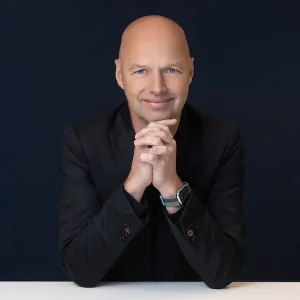
Sebastian Thrun, founder of Google X and Waymo, has made his boldest bet yet on physical AI, a stealth startup called Dulo applying foundation models to hardware design.
Sebastian Thrun, the engineer who built Google’s self-driving car project into what became Waymo, has a new venture, and its focus says a great deal about where technology is heading next.
At the Actuate robotics conference in San Francisco, Thrun revealed that he is building a stealth robotics startup called Dulo. He offered only a sentence of detail, describing it as small, early, and focused on robotics, but for anyone tracking the technologies that will define the next decade, the signal is loud: one of the most consequential builders in AI has turned his attention to the physical world.
What we know about Dulo
Details are deliberately sparse. Speaking to the Actuate audience, Thrun said plainly that it was not yet time to describe the company: “It’s under stealth, it’s very small. But it’s in robotics.” What little is public comes from a Stanford-hosted page indicating that Dulo is developing foundation models for hardware design, aimed at enabling what it calls manufacturing at lightspeed.
The team reportedly includes alumni from Waymo, Google Brain, and the Stanford Artificial Intelligence Laboratory, which Thrun once directed.
In other words, Dulo is not trying to build another humanoid robot; it appears aimed at the layer beneath, the AI that designs and manufactures hardware itself.
That is a characteristically Thrun move: rather than compete in the crowded race to build robots, target the tools that everyone building robots will need.
Why the timing matters: the physical AI boom
 To understand why this matters, you have to understand the wave Thrun is stepping into.
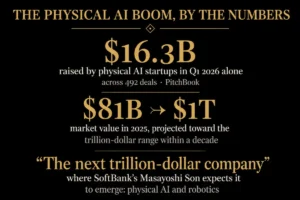
Physical AI, artificial intelligence that perceives, reasons, and acts in the real world, has become the defining technology theme of 2026. The numbers are striking. Physical AI startups raised a record 16.3 billion dollars across 492 deals in the first quarter of 2026 alone, according to PitchBook.
The broader physical AI market was valued at roughly 81 billion dollars in 2025 and is projected to grow toward the trillion-dollar range within a decade.
SoftBank’s Masayoshi Son has said publicly that physical AI and robotics are where he expects the next trillion-dollar company to emerge.
When a founder with Thrun’s record enters that market, it is the kind of move investors and operators watch closely.
The shift beneath the headlines: from software to the physical world
Dulo is a single data point in a much larger structural shift, and that is the real story for business leaders. For two decades, the biggest returns in technology came from software: code that scaled infinitely at near-zero marginal cost.
The frontier is now moving into atoms, robots, manufacturing, and the physical economy, driven by falling hardware costs, persistent labor shortages, and mounting pressure to reshore production.
Tesla began mass production of its Optimus humanoid in early 2026; Boston Dynamics, under Hyundai, is integrating foundation models into its all-electric Atlas; Chinese maker Unitree priced a roughly 9-billion-dollar IPO.
Thrun’s focus on the design and manufacturing layer fits the pattern exactly: the value is shifting from writing software to teaching machines to act, build, and move in the real world.
For any organization planning five years out, that shift is the headline, and Dulo is one more sign of how fast it is arriving.
Thrun’s track record, and why it matters here
Few technologists have a record that makes a stealth robotics startup this notable. Thrun led the Stanford team that won the 2005 DARPA Grand Challenge, the race that effectively launched the autonomous-vehicle era. He founded Google’s self-driving project (now Waymo), co-founded Google X and Google Brain, launched the online-education pioneer Udacity, and led the flying-car venture Kittyhawk.
His pattern is consistent: he tends to arrive at the frontier of a field just before it breaks into the mainstream.
That history is exactly why a one-sentence announcement about a small, stealthy company drew coverage across the technology and financial press.
It is also why he anchors our roundup of the AI keynote speakers who actually built the technology, the practitioners who created the field rather than commenting on it from the sidelines.
What this means for events and audiences
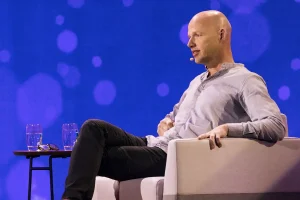
Sebastian Thrun on stage, where his read on robotics and physical AI draws boards weighing how automation reshapes their industries.
For organizations planning conferences and leadership events, Dulo is a useful reminder that the physical AI conversation has moved from speculation to strategy. Boards are now asking concrete questions about automation, reshoring, and where to place capital as robotics matures, and they want speakers who can connect the frontier of research to real business decisions. Thrun sits alongside a small group of authorities who can do exactly that.
His fellow roboticist Marc Raibert, founder of Boston Dynamics, brings the hardware and locomotion perspective; together they represent the two halves of the robotics story, the machines themselves and the intelligence that designs and drives them.
Both rank among the robotics speakers most in demand as the field moves from labs to factory floors, a shift we explore further in our look at the future of humanoid robots.
Booking a robotics voice while the topic is hot
Interest in robotics and physical AI speakers is rising faster than availability, and the most sought-after voices are booked well ahead, particularly around major product launches and industry milestones.
If your event is built around the future of automation, planning early makes the difference between securing a frontier voice and settling for whoever is free.
For a sense of how far ahead to plan, our guide on how far in advance to book a keynote speaker lays out the timeline by event type.
Frequently Asked Questions
Who are the best speakers on robotics and physical AI to book in 2026?
Two of the most sought-after are Sebastian Thrun and Marc Raibert. Thrun founded Google’s self-driving project (now Waymo), co-founded Google X, and is now building the robotics startup Dulo, giving him a frontier view of AI-driven hardware and manufacturing. Marc Raibert founded Boston Dynamics, the company behind the Atlas humanoid and Spot robots. Together, they cover both halves of the field: the machines themselves and the intelligence that designs and drives them. Both can be booked through Aurum Speakers Bureau.
How do you book Sebastian Thrun as a robotics or AI keynote speaker?
Sebastian Thrun can be booked through Aurum Speakers Bureau for keynotes on robotics, physical AI, autonomous systems, and the future of work. Because demand for frontier robotics voices is high and rises around major industry milestones, early booking is advisable. Contact Aurum Speakers Bureau with your date and event goals, and we will respond within 24 hours.
What is Sebastian Thrun’s new startup, Dulo?
Dulo is a stealth robotics company Sebastian Thrun revealed at the Actuate conference in San Francisco in August 2026. Public details are limited, but a Stanford-hosted page indicates Dulo is developing foundation models for hardware design, aimed at faster manufacturing, with a team drawn from Waymo, Google Brain, and Stanford’s AI Lab. It reflects Thrun’s move into the physical AI wave reshaping robotics and manufacturing.
Why is physical AI such a major trend in 2026?
Physical AI, artificial intelligence that operates in the real world through robots and machines, has become 2026’s defining technology theme because of converging forces: falling hardware costs, labor shortages, and pressure to reshore manufacturing. Physical AI startups raised a record 16.3 billion dollars in the first quarter of 2026, and the market is projected to grow toward the trillion-dollar range within a decade.
Can you book Sebastian Thrun or Marc Raibert to speak about robotics?
Yes. Both are among the most sought-after voices on robotics, AI, and the future of work, and both can be booked through Aurum Speakers Bureau. Because demand for frontier robotics speakers is high, early planning is advisable. To check availability and fit, contact Aurum Speakers Bureau and we will be in touch within 24 hours.
Dulo may be small and stealthy today, but its focus tells you where one of technology’s sharpest builders believes the future lies: not in more software, but in machines that design, build, and act in the physical world. As that shift accelerates, the leaders who understand it early will have the advantage, and the voices who can explain it will be in rare demand.
To bring a frontier perspective on robotics and physical AI to your stage, contact Aurum Speakers Bureau and one of our founders will respond within 24 hours.