
For most events, you should book a keynote speaker six to twelve months in advance. That window secures your first-choice speaker, gives you room to negotiate, and leaves enough time for the speaker to tailor the talk to your audience. Smaller or internal events can often be arranged in three to six months, and experienced bureaus can place a speaker in a matter of days when needed, though the earlier you start, the more choice and preparation time you have, and the more a strong bureau can do on a short timeline when you don’t.
That single question, how far ahead to book, is one of the most common we hear, and the honest answer depends on three things: the size and profile of your event, the tier of speaker you want, and the time of year. Here is how the timeline actually works.
The short answer, by event type
Lead time scales with how central the speaker is and how in-demand they are. As a working guide:
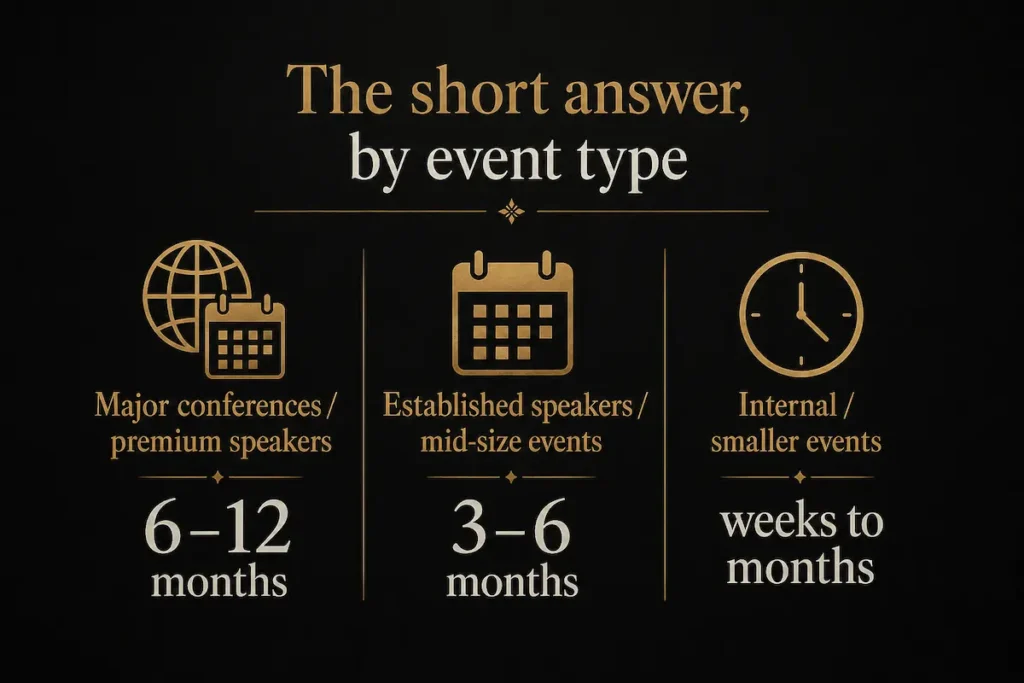 For major annual conferences, leadership summits, and flagship customer events, especially those built around a premium or globally recognized speaker, plan six to twelve months ahead. The most sought-after speakers fill their calendars this far out, particularly for prime dates.
For established professional speakers at mid-size corporate events, three to six months is often enough to secure strong options and still customize well.
For internal meetings, smaller sessions, and team events, a few weeks to a few months can work, with availability becoming the main constraint the closer you get.
For last-minute needs, a cancellation, a sudden event addition, a late budget approval, booking is still possible within weeks or even days. A good bureau can sometimes place a speaker on 48 to 72 hours’ notice, though selection at the top tier narrows, and customization moves faster and leans more on the bureau’s coordination.
Why booking early is worth it
Booking early is not simply about securing a date; it is about everything the extra time makes possible.
You get your first choice rather than your third.
You have room to negotiate fee and terms rather than working with the pressure of a close deadline.
You give the speaker time for a real discovery conversation, so they can learn your organization and build something specific rather than deliver a talk they have given a hundred times.
And you can feature the speaker with plenty of time in your event marketing’s calendar, which could help drive further registration and ticket sales.
When you have that runway, use it. A keynote signed six months out gives everyone room to prepare.
And when you don’t, that gap is exactly what the right bureau closes. A keynote signed three weeks out simply puts more of the work on your partner, and the best ones absorb it, reaching speakers whose availability is never publicly listed, moving in hours rather than weeks, and coordinating the briefing and customization at a pace that makes even a short-notice booking feel considered rather than rushed.
Time is an advantage, but it is not the only one. Deep relationships and fast, expert coordination can stand in for a long lead time more often than most planners expect.
When you can book later, and how a bureau helps
As expressed, none of the usual late rush means that a late booking is a lost cause.

When time is short, a bureau’s access and coordination can carry a booking the calendar no longer can.
On the contrary, cancellations happen, events get added, and approvals come through at the last minute. This is also a natural part of how our industry works, why many excellent speakers keep flexible calendars, and precisely where a speakers bureau earns its value:
A bureau can often see availability that is not publicly listed, move faster than an independent search, and tell you honestly within hours what is realistic for your date.
A professional bureau turns a short timeline into a non-issue. There is a reason why this is the work we do every single day of the year for years on end.
If you are working on a short runway, the first step is to ask.
Also, understanding what a speakers bureau does makes it clear why the right partner can compress a timeline that would otherwise be impossible on your own.
How to use the time once you have it
Early booking only pays off if the time is used well.
The strongest bookings begin not with a name but with a goal:
What do you need the audience to think, feel, or do differently by the time they leave the room?
Defining that first makes every later step easier.
From there, a clear event brief gives your bureau what it needs to match the right speaker to your audience, and reviewing a speaker proposal becomes far more productive when there is time to compare options rather than grab whoever is left.
For a fuller walkthrough of matching the speaker to your event, our guide on how to choose the right keynote speaker covers the selection itself.
A simple planning timeline
For a major event, a reliable rhythm looks like this:
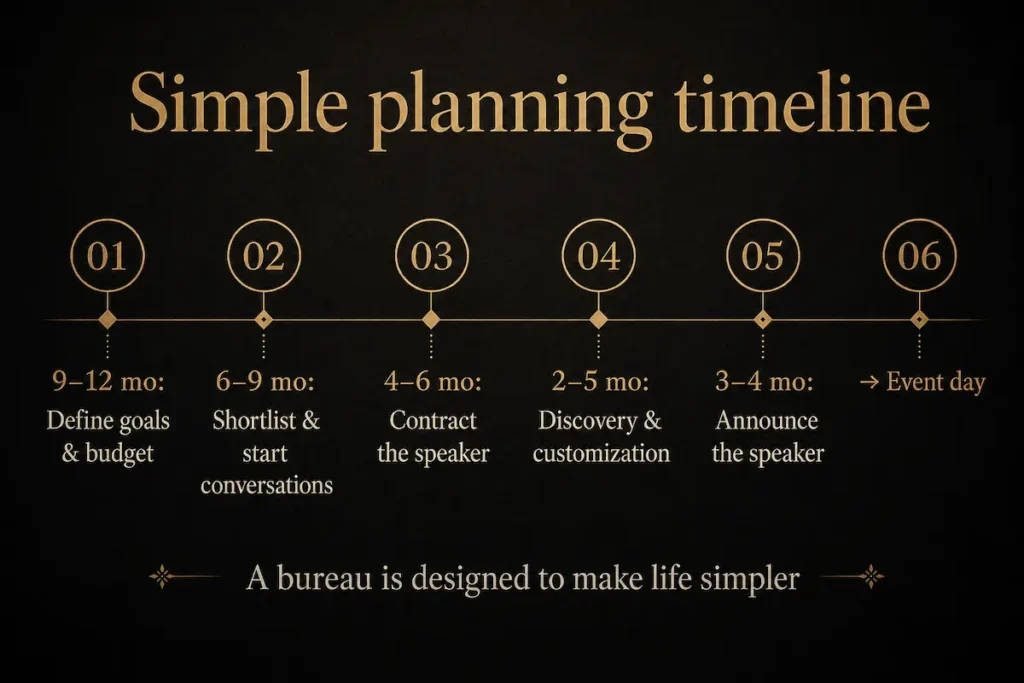 Nine to twelve months out: define what the keynote needs to accomplish and set the budget range.
Six to nine months out: build a shortlist and start conversations through your bureau.
Four to six months out: aim to have the speaker contracted.
In the months that follow: focus on the discovery calls and customization that turn a booking into a tailored keynote.
Roughly three to four months before the event: announce the speaker to maximize registration momentum.
The exact numbers flex with the speaker’s demand and the season, but the sequence usually holds.
Frequently Asked Questions
How far in advance should you book a keynote speaker?
For most events, six to twelve months in advance. Major conferences and high-demand or globally recognized speakers sit at the twelve-month end, while established speakers for mid-size corporate events can often be booked three to six months out.
Internal or smaller events can be arranged in a few weeks to a few months, and last-minute bookings are still possible, though options narrow.
Can you book a keynote speaker at the last minute?
Yes. While it is not ideal, experienced speakers bureaus regularly place speakers on short notice, sometimes within 48 to 72 hours.
With the right bureau, the main variable is availability at the very top tier; the coordination and customization simply move faster.
If you are on a tight timeline, contact a bureau immediately with your date and goals, and they can tell you quickly what is available.
When is the busiest season for booking speakers?
Spring (roughly March to June) and fall (roughly September to November) are peak conference seasons, and the best speakers at every tier fill those dates first.
If your event falls in one of these windows, start earlier, six to twelve months out, rather than assuming your preferred speaker will be free.
Does booking early affect the speaker fee?
Booking early rarely lowers a fee on its own, but it gives you negotiating room that a last-minute booking does not, because you are not negotiating against a deadline. It also lets you compare options and value across several speakers rather than paying for whoever happens to be available.
The pattern behind all of this is simple: the earlier you start, the more choice and leverage you hold in your own hands. And when time is short, that advantage shifts to your bureau, whose access and speed can carry a booking the calendar no longer can.
Either way, the move is the same, start the conversation now, whether your event is twelve months out or three weeks away. To check speaker availability for your event, contact Aurum Speakers Bureau and one of our founders will respond within 24 hours. We deliver that personally with absolute excellence.