
The hardest part of booking an economics speaker is not finding one. It is knowing which kind of economic thinking your organization actually needs right now — and matching that to the right voice.
A board navigating sovereign debt exposure needs something different from a leadership team designing a five-year innovation investment strategy, which needs something different again from an executive audience trying to understand why their supply chain costs are not coming down. Economics covers all of this. But no single economist covers all of it with equal depth or authority.
This guide does something the standard list of “top economics speakers” does not: it frames each speaker by the specific corporate event context where they deliver the most value, so you can build the right case internally and arrive at the booking decision with confidence.
The economics speakers in this guide — and how to read it
The speakers below represent genuinely different areas of economic expertise. They are not interchangeable. After each profile, you will find an event fit note that summarizes the event types, audience profiles, and strategic moments where that speaker’s thinking will land with the most force.
For organizations that regularly commission Nobel Prize keynote speakers for major corporate events, it is worth noting that three of the economists on this list — Aghion, Duflo, and Romer — are Nobel laureates, a credential that carries distinct weight in certain board and investor contexts.
Philippe Aghion — Innovation, growth, and competitive strategy
Philippe Aghion won the Nobel Prize in Economic Sciences in 2025, jointly recognized for foundational work explaining why innovation-driven competition (not consolidation nor protection) is the mechanism through which economies sustain long-run growth. For the full context of what the Royal Swedish Academy recognized and why it matters for business strategy, see our analysis of the 2025 Nobel Laureates in Economics. He holds the Chair in Innovation and Growth at INSEAD and a professorship at the Collège de France, and has previously taught at Harvard, MIT, and Oxford.
His framework, built on decades of mathematical modeling and empirical testing, produces a finding with direct strategic implications: companies and sectors that suppress competition in the name of protecting their position tend to erode the very conditions that made their position worth protecting. The policy analog, that state-backed incumbency kills the innovation it claims to nurture, is equally relevant for regulated industries navigating Brussels or Washington.
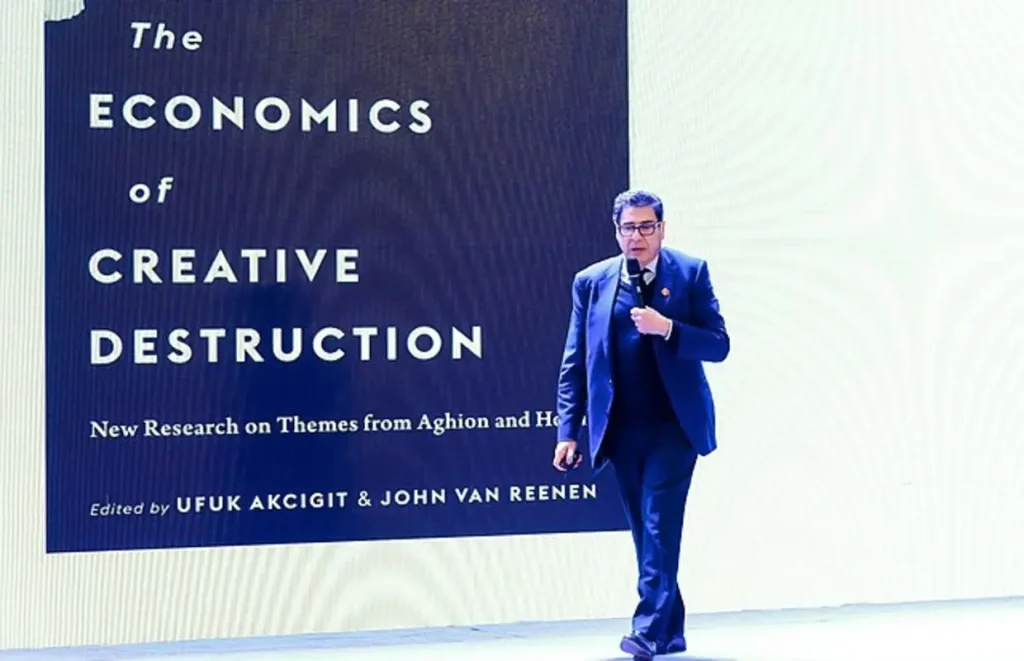
Philippe Aghion explains why sustained innovation, competitive pressure, and creative destruction remain the defining drivers of long-term economic growth in the AI era.
For corporate audiences, Aghion’s most valuable contribution is what his research reveals about AI. He has argued that artificial intelligence, if governed and deployed well, could be the most powerful creative-destruction event in modern economic history, one that reshapes entire productivity curves rather than simply automating existing processes. That framing gives executive teams something more durable than an AI hype session: a growth-theory lens for evaluating where and how to commit. A deeper exploration of his frameworks is available in our post on Philippe Aghion’s ideas on innovation and growth.
Event fit: Board and C-suite strategy days; innovation investment forums; financial services and private equity audiences evaluating long-cycle bets; policy-adjacent leadership events where the economics of industrial strategy is on the agenda. Strongest at moments when an organization is deciding whether to compete or consolidate.
Nouriel Roubini — Global macro risk and scenario planning
Nouriel Roubini‘s precise public forecast of the 2008 financial crisis, made years before the collapse and dismissed by most of his peers at the time, established him as the most credible systemic risk analyst available on the speaking circuit. Professor Emeritus at NYU Stern School of Business and founder of Roubini Macro Associates, he has since developed one of the most comprehensive frameworks for anticipating how financial, geopolitical, and technological risks interact.
His book MegaThreats identifies ten overlapping structural forces; from sovereign debt spirals and dollar dominance erosion, to AI-driven labor displacement and geopolitical decoupling. He argues they are converging into a sustained stagflationary pressure unlike anything the post-war global economy has experienced. It is uncomfortable reading for most boards, and that is the point. The detailed analysis behind MegaThreats is explored in our dedicated post on Roubini’s framework.
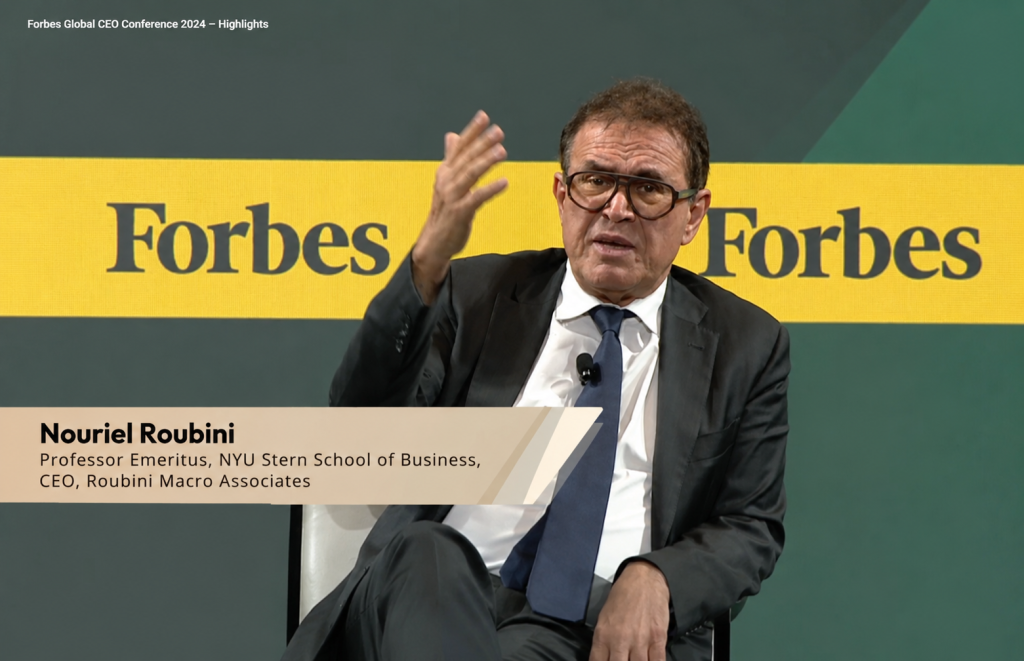
Nouriel Roubini challenges executive teams to stress-test strategy against inflation shocks, geopolitical fragmentation, sovereign debt risk, and long-term macro instability.
Roubini speaks with sustained depth on emerging market fragility, currency crises, the fiscal limits of central bank intervention, and the strategic implications of US-China decoupling for multinationals with distributed supply chains. His sessions are not designed to reassure. They are designed to surface the assumptions in a board’s existing strategy that have not been stress-tested against realistic downside scenarios.
Event fit: Financial institutions and asset managers; multinational leadership events focused on geopolitical or macroeconomic scenario planning; investor days where the audience needs macro context for capital allocation decisions; C-suite offsites where the goal is stress-testing strategy rather than confirming it. Strongest when an organization knows something is changing in the macro environment but has not yet articulated what.
Mariana Mazzucato — Value creation, mission economy, and public-private strategy
Mariana Mazzucato is Professor of the Economics of Innovation and Public Value at University College London and the founding director of the UCL Institute for Innovation and Public Purpose. In 2025, she was appointed Commander of the British Empire for services to economics. She advises the European Commission, multiple national governments, and multilateral institutions on long-term investment strategy.
Her central argument is that virtually every transformative technology of the past century, from the internet to GPS to mRNA vaccines, was initiated by public investment before private capital recognized its potential. This main thought has reshaped the policy conversation about innovation funding in ways that directly affect how corporations negotiate with governments and position their R&D commitments.
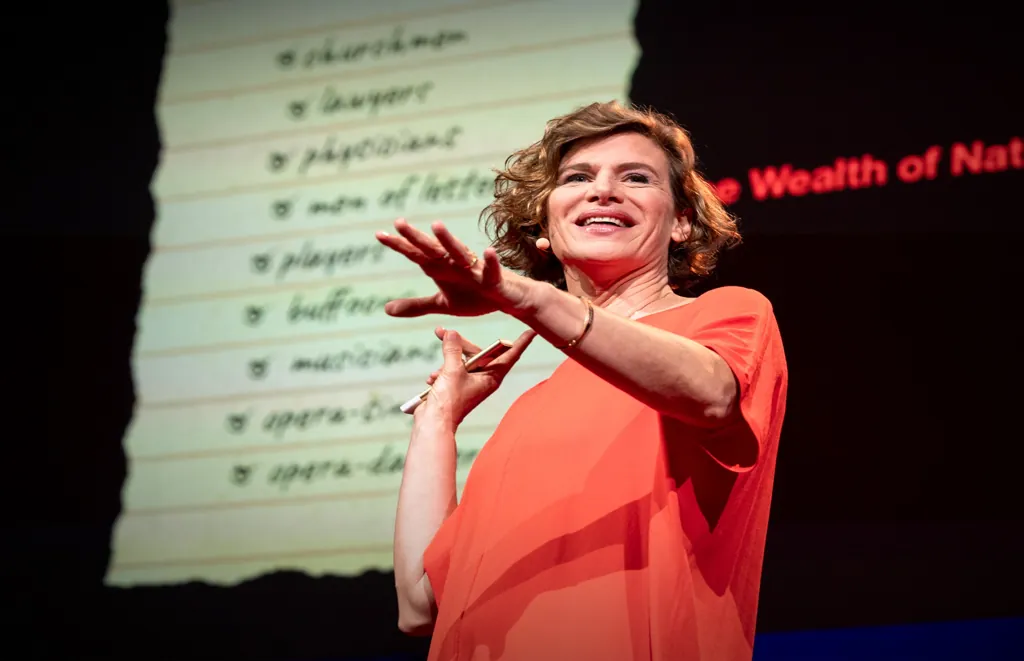
Mariana Mazzucato reframes innovation as a partnership between public investment and private enterprise, challenging organizations to rethink how value is created and measured.
Mission Economy, her blueprint for goal-oriented public-private collaboration modeled on the Apollo program, has become essential reading for organizations designing ESG strategy with genuine ambition rather than compliance intent. The Value of Everything addresses something more operationally relevant: the confusion, embedded in modern accounting and financial reporting, between extracting value and creating it, and how that confusion distorts executive incentives and resource allocation. Her books are available on Amazon.
Event fit: ESG investor days; sustainability leadership summits; organizations navigating government relations, regulatory strategy, or public-private partnerships; leadership teams building long-cycle investment cases for boards skeptical of short-termism; policy forums where the economics of innovation funding is contested. Strongest when an organization needs to reframe its own role in the broader economic ecosystem, not just its operational efficiency.
Further economics speakers on the Aurum roster — matched by context
The three speakers above cover the highest-demand positions: growth and innovation strategy (Aghion), macro risk (Roubini), and mission-driven value creation (Mazzucato). But Aurum’s economics speakers roster extends considerably further, and the right fit depends on the specific angle your event requires.
Xavier Sala-i-Martin brings global competitiveness and development economics together with a stage presence that is notably accessible for mixed executive audiences. Former Chief Economist of the World Economic Forum’s Global Competitiveness Report, he is one of the few economists who can hold a room of non-economists without sacrificing rigor. Best for: global leadership conferences, multinational strategy events, audiences that need economic substance without academic density.

Esther Duflo, Nobel laureate and co-founder of J-PAL, brings the most rigorous evidence-basedframework on inequality, poverty economics, and the measurable impact of policy interventions. She is not primarily a corporate speaker; her natural audience is foundations, social impact organizations, universities, and government forums. But for corporations with genuine ESG commitments who want to move beyond narrative into measurement, her work on what actually changes outcomes is without peer.
Jean Tirole , Nobel laureate and the world’s leading authority on market power and regulation, is the right choice for events where antitrust, Big Tech regulation, or platform economics are the primary concern. His analysis of how regulators should think about two-sided markets is the intellectual foundation of most current debate on digital competition policy, directly relevant to any organization navigating regulatory scrutiny.
Dambisa Moyo covers global capital flows, emerging market investment, and corporate governance at board level, a profile particularly valuable for multinationals with significant exposure to Sub-Saharan Africa, or for boards under pressure to improve governance architecture. Her combination of macroeconomics and board-level experience is rare.
How economics keynote speakers fit into a corporate event program
The question most event planners face is not whether to include an economics perspective; it is where in the program it lands most effectively.
Economics speakers tend to work best as opening keynotes at strategy-level events, where the macro framing they provide sets the context for every subsequent session. Roubini’s risk analysis before a capital allocation discussion. Aghion’s growth theory before an innovation investment decision. Mazzucato’s value framework before an ESG strategy review.
They are less effective as closing speakers or at events where the primary goal is motivation and culture. For those moments, leadership speakers and business speakers are better positioned.
For organizations where economic analysis is the event’s entire purpose (investor days, financial industry conferences, board strategy retreats) a single high-authority economics keynote can anchor the whole program, with panel discussions or breakouts built around the frameworks they introduce.
Contact Aurum Speakers Bureau to discuss which economics speaker fits your event’s specific strategic moment, audience, and objectives.
FAQ
Why should organizations book an economics keynote speaker for a corporate event?
Economic conditions shape every major strategic decision: capital structure, hiring plans, geographic expansion, supply chain architecture, pricing strategy. Yet, most leadership teams lack the tools to pressure-test their assumptions against serious macroeconomic analysis. A world-class economics keynote speaker translates complex global dynamics into frameworks an executive team can act on. Aurum Speakers Bureau represents Philippe Aghion, Nouriel Roubini, Mariana Mazzucato, and others, and works with you to match the right voice to your event’s specific strategic objectives. Reach out at https://aurumbureau.com/contact/ to discuss options.
What is the difference between the economics speakers on this list?
Each speaker occupies a distinct area of economic expertise. Aghion focuses on the growth theory of innovation and competition most relevant for strategy and investment decisions. Roubini focuses on systemic risk and macro scenario planning most relevant for financial institutions and boards navigating uncertainty. Mazzucato focuses on value creation, public-private collaboration, and mission-oriented strategy most relevant for ESG, policy-adjacent, and long-cycle investment contexts. Tirole specializes in regulation and market power. Duflo in development economics and impact measurement. The choice depends on where your organization’s most pressing challenge sits.
How do economics speakers differ from business or strategy speakers?
Economics speakers work from the outside in; they start with the structural forces shaping markets (monetary policy, trade flows, innovation cycles, demographic shifts) and help leadership teams understand what those forces mean for their strategic context. Business and strategy speakers typically work from the inside out, focusing on culture, execution, and leadership. For events where the goal is to reframe the external environment before working on internal strategy, economics speakers provide the most durable starting point.
What event formats work best for economics keynote speakers?
Opening keynotes at strategy-level events, board offsites, investor days, and annual leadership conferences are the strongest formats. Economics keynotes tend to generate the most value when the audience will spend subsequent sessions making decisions, because the economic framing becomes a shared reference point. They are less suited to purely motivational formats or events where the primary goal is team culture rather than strategic clarity.