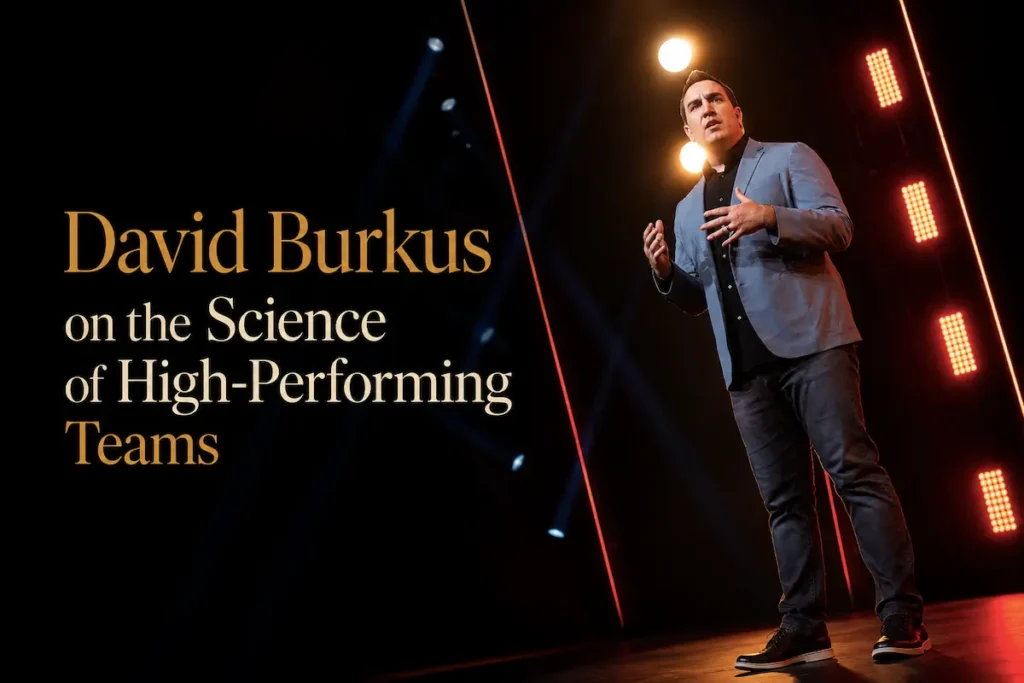
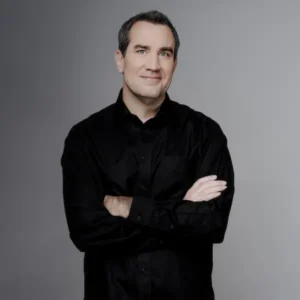
Organizational psychologist, Columbia professor, and Thinkers50-ranked author David Burkus has spent his career proving what every martial artist already knows: skill is trained, not inherited, and the right environment is what brings it out.
No one is born a black belt. The belt is earned through years of showing up, drilling the same movements until they become instinct, and testing them against a live opponent who does not care about your potential. David Burkus knows this firsthand: alongside his career as an organizational psychologist, he is a black belt who still competes in martial arts. It is a fitting discipline for a man whose life’s work rests on the same principle.
David Burkus has spent his career proving, with peer-reviewed evidence rather than locker-room clichés, that great performance is trained, not innate, and that the environment around a person shapes their output far more than their raw talent.
On a mat or in a boardroom, the lesson holds: the team makes the talent, not the other way around.
Talent doesn’t make the team
That single, counterintuitive idea about talent not making a team, but a team making the talent, is the spine of Burkus’s work. It is also what separates him from the crowded field of team-building speakers.
He is an organizational psychologist by training, a professor at Columbia University, and he builds his keynotes on behavioral science rather than anecdote.
Ranked by Thinkers50 among the world’s leading business thinkers every cycle since 2017, he treats the stage the way a good scientist treats a paper: a claim is only worth making if the evidence supports it.
For audiences tired of speakers who inspire for an hour and do not change much, that rigor is the whole appeal. This is also why he sits comfortably among the most credible high-performance speakers working today.
A body of work built on overturning conventional wisdom
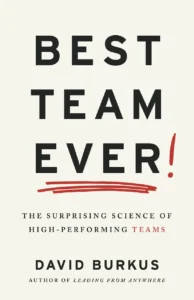
In Best Team Ever, Burkus distills decades of research into one practical finding: the highest-performing teams are built on shared understanding, psychological safety, and purpose, not on stockpiling star talent.
Look across Burkus’s five books and a pattern emerges: each one takes a piece of accepted business wisdom and shows, with data, why it is wrong.
The Myths of Creativity dismantled the romantic idea of the lone genius.
Under New Management argued that many revered management practices actively harm the organizations that cling to them.
Friend of a Friend overturned nearly everything conventional networking advice tells you to do.
Leading from Anywhere arrived as a definitive guide to remote and hybrid teams right when the world suddenly needed one.
And his most recent book, Best Team Ever, distills decades of research into a simple finding: the highest-performing teams run on shared understanding, psychological safety, and a sense of purpose that feed one another.
His books have won awards, been translated into dozens of languages, and put him in the Harvard Business Review, The New York Times, and on CBS Mornings.
That record is also why he belongs among the field’s most respected Thinkers50 speakers.
Frameworks a leader can use on Monday

Burkus turns behavioral science into tools leaders can use the next morning, frameworks like the Trust Loop and the clarity-plus-empathy formula behind teams that click.
What keeps Burkus in demand with organizations like PepsiCo, Fidelity, Adobe, and NASA is that the science always resolves into something usable. His frameworks are built to survive contact with a real workweek.
In “The Trust Loop,” he reframes trust not as something given or earned but as something reciprocated, a cycle that every interaction either strengthens or erodes, and shows leaders how to keep it turning.
In “Click,” he distills fast, effective collaboration into two ingredients, clarity and empathy: people need to understand both their own roles and the teammates they depend on.
And in his work on purpose, he confronts an uncomfortable statistic, that most employees say purpose matters yet fewer than half feel it in their actual work, and hands leaders the specific behaviors that close the gap.
It is the same culture-first, evidence-led instinct that runs through our feature on Jim Collins and the discipline of great companies, and it makes Burkus as valuable to a corporate culture program as to a leadership one.
Building teams in the age of AI
Burkus’s most current work takes the question every leader is now asking, what does AI do to my team?, and answers it without hype.
His argument is bracingly simple: the fundamentals of a high-performing team, clarity, connection, trust, have not changed; the context has. The best teams, he shows, are not merely using AI as another tool but learning to work with it as a teammate, redesigning how they collaborate rather than bolting software onto old habits.
It is a grounded, human-centered read on the technology that places him naturally alongside the top leadership keynote speakers helping organizations navigate the shift, and it keeps a speaker known for teams firmly relevant to the most forward-looking events.
What audiences take away
Burkus is that rare combination of a genuine scientist with the timing and energy of a performer, which is exactly what his martial-arts discipline would predict: substance drilled until it looks effortless.
Audiences do not leave with generic motivation; they leave with a clear model of how their team’s culture drives its performance and a short list of things to change the next morning.
He is a strong fit for leadership summits, corporate culture and team-focused programs, executive offsites, and any event where the goal is a measurably better team rather than a temporary lift.
Frequently Asked Questions
Why should organizations book David Burkus?
Because he delivers what few team-building speakers can: rigorous behavioral science translated into practical tools, with the energy to make it land.
As an organizational psychologist and Thinkers50-ranked thinker, he gives leadership teams an evidence-based blueprint for higher performance rather than a motivational high that fades by Monday.
To check his availability and fit, contact Aurum Speakers Bureau and we will gladly respond to you swiftly with a tailored proposal.
What does David Burkus speak about?
His keynotes center on building high-performing teams, fast and effective collaboration, trust, purpose, and how teams can thrive alongside artificial intelligence.
Drawing on his books, including Best Team Ever, he tailors each talk to the organization’s specific challenges.
What makes David Burkus different from other team-building speakers?
He is an organizational psychologist who builds his talks on peer-reviewed research rather than anecdote, and he has been ranked among the world’s top business thinkers by Thinkers50 every cycle since 2017.
His signature idea, that the team makes the talent rather than the reverse, reframes how leaders think about performance, and every framework he shares is designed to be applied immediately.
What types of events suit a speaker like David Burkus?
He is a strong fit for leadership summits, corporate culture and team-development programs, executive offsites, sales kickoffs, and conferences on the future of work.
He works with audiences from frontline managers to senior executives, both in person and virtually.
Great teams are not lucky accidents of talent; they are built, the way a black belt is earned.
If you want an expert who can show your leaders exactly how, tell us about your event and we at Aurum Speakers Bureau will most certainly help you bring David Burkus to your stage at all possible. We look forward to your contact.