The data on emotional intelligence has become impossible to dismiss. Organizations with high-EQ leadership outperform on retention, productivity, and revenue growth. Teams that communicate with emotional awareness navigate conflict faster and adapt more readily to change. And in an era when AI is absorbing cognitive work at scale, the human capacity to sense, connect, and respond with empathy has quietly become a strategic differentiator.
The five speakers below are not simply advocates for emotional intelligence — they are the researchers, authors, and practitioners who defined the field, then spent decades proving it works.
Top 5 emotional intelligence speakers
1. Daniel Goleman
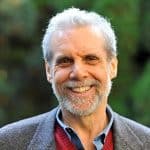
Daniel Goleman is the psychologist who put emotional intelligence on the map. His 1995 book Emotional Intelligence: Why It Can Matter More Than IQ spent more than 18 months on the New York Times bestseller list, has sold over five million copies, and has been translated into 40 languages. The Harvard Business Review called its central idea “a revolutionary, paradigm-shattering concept” and placed his article “What Makes a Leader” among its ten all-time essential reads. TIME Magazine named the book one of the 25 most influential business management books ever published.
Three decades on, the framework Goleman built — five domains of emotional intelligence: self-awareness, self-regulation, motivation, empathy, and social skill — remains the dominant model in leadership development globally. His subsequent books, including Primal Leadership (co-authored with Richard Boyatzis and Annie McKee) and Optimal (2023), have extended the research into team performance, organizational culture, and the neuroscience of peak states. He co-directs the Consortium for Research on Emotional Intelligence in Organizations at Rutgers University and is a founding member of the Mind & Life Institute.
As a keynote speaker, Goleman translates decades of research into direct, practical guidance. His sessions help leaders understand how to decode emotions as information, build psychologically safe cultures, and develop the self-awareness that separates good managers from great ones.
Keynote topics include: emotional intelligence and leadership effectiveness, EI and the future of work, building the emotionally intelligent organization, focus as a leadership skill.
2. Susan David

Speaker Susan David is a Harvard Medical School psychologist and the creator of emotional agility — one of the most widely adopted frameworks in organizational psychology. Her TED Talk on the subject has been viewed more than 12 million times. Harvard Business Review named emotional agility a Management Idea of the Year. Thinkers50 awarded it a Breakthrough Idea Award and has named David among the world’s most influential management thinkers.
Her #1 Wall Street Journal bestselling book, Emotional Agility: Get Unstuck, Embrace Change, and Thrive in Work and Life, defines the central skill of our moment: the ability to step back from difficult thoughts and emotions without being controlled by them, and to act with intention from a place of core values. It is, as Brené Brown put it, a book for anyone who wants to stop running from their inner experience and start leading from it.
David’s current work frames emotional agility as the essential counterbalance to AI. As she argues in her keynotes, AI will out-compute us — but it will never out-human us. The capacity to hold complexity with clarity, to lead through ambiguity with empathy, to make values-driven decisions under pressure: these are precisely the skills that automation cannot replicate, and the ones David has spent her career teaching. Her clients include the World Economic Forum, Google, Microsoft, Ernst & Young, the United Nations, and Nasdaq.
Keynote topics include: building emotional agility in turbulent times, the human skills AI cannot replace, navigating organizational change with resilience, emotional agility for well-being and leadership.
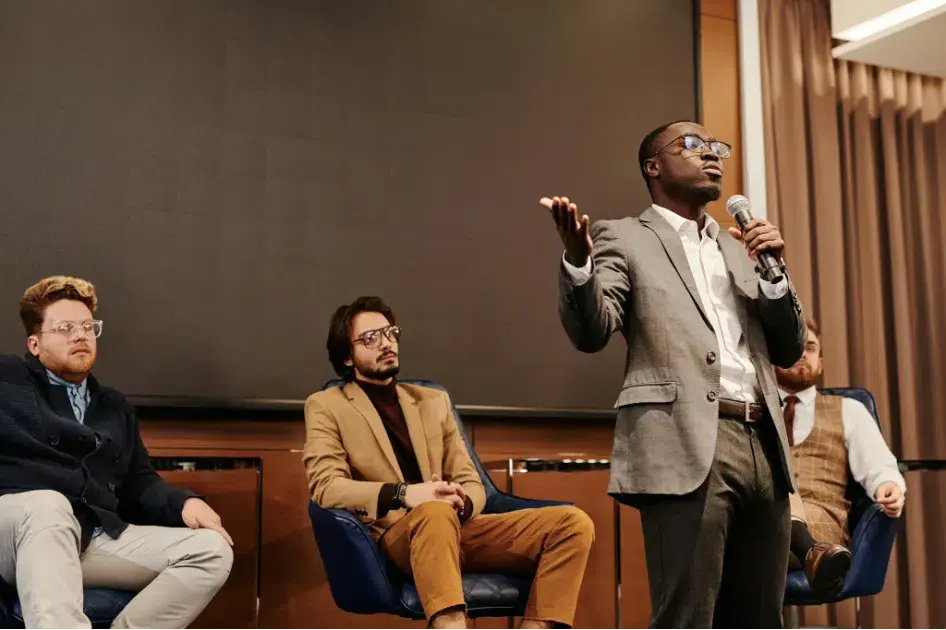
[IMAGE: Body language / human connection in a workplace setting] AI Image Prompt: “Wide-angle view of a modern open-plan office with several small groups of colleagues in genuine conversation, one person gesturing expressively while others listen, warm natural light from large windows, candid documentary style, sense of authentic human connection and psychological safety, no faces clearly identifiable, 1200×800 pixels landscape orientation high resolution” Alt text: Professionals connecting through emotional intelligence in the workplace | Aurum Speakers Bureau Caption: Emotional agility — the capacity to move through difficult emotions with clarity and intention — is fast becoming the defining leadership skill of the AI era.
3. Daniel Gilbert

Daniel Gilbert is the Harvard psychologist who turned the science of happiness into one of the most watched conversations of the 21st century. His TED Talk, “The Surprising Science of Happiness,” has been viewed over 20 million times — one of the most watched in TED’s history. His book Stumbling on Happiness topped the New York Times bestseller list and has been translated into more than 35 languages.
Gilbert’s research centers on a concept he calls affective forecasting: the systematic ways in which we mispredict what will make us happy, and why our emotional responses to outcomes — good and bad — tend to be far more moderate and short-lived than we expect. His findings are counterintuitive, thoroughly documented, and immediately applicable to decision-making, leadership, and organizational culture. Understanding how people actually experience outcomes — rather than how they imagine they will — changes the way smart leaders structure choices, incentives, and change management.
Where most happiness researchers offer prescriptions, Gilbert offers a mirror. His keynotes are intellectually rigorous, genuinely funny, and reliably produce a specific kind of productive discomfort — the feeling of having had a cherished assumption dismantled in the best possible way.
Keynote topics include: the science of happiness and decision-making, affective forecasting and its implications for leadership, how to make better choices by understanding your emotional future self.
4. Tal Ben-Shahar

Tal Ben-Shahar taught two of the most popular courses in Harvard’s history — Positive Psychology and The Psychology of Leadership — drawing over a thousand students a semester. He went on to teach Happiness Studies at Columbia University and has since done something no one else in the field has managed: built happiness studies into a fully accredited academic discipline.
At Centenary University, Ben-Shahar now leads both the world’s first Master of Arts in Happiness Studies and the world’s first PhD in Happiness Studies, launched in fall 2025. The first MA cohort graduated in 2024, with students from 13 countries. His Happiness Studies Academy, which he co-founded, has trained professionals in over 100 countries through its Certificate in Happiness Studies program. The framework at the center of all of it is his SPIRE model — integrating Spiritual, Physical, Intellectual, Relational, and Emotional dimensions of well-being — a genuinely interdisciplinary approach that goes well beyond positive psychology.
As a keynote speaker, Ben-Shahar does not simply describe the research — he engineers the conditions for it to land. His sessions are immersive, combining scientific rigor with the kind of practical, personal tools audiences can apply the same day. Martin Seligman, the father of positive psychology, has called him “the master teacher of happiness.”
Keynote topics include: positive psychology and the science of happiness, positive leadership and resilience, leading in uncertain times, the SPIRE model of whole-person well-being.
5. Vanessa Van Edwards

Vanessa Van Edwards approaches emotional intelligence from an angle no one else occupies: behavioral science applied to the mechanics of human communication. As founder of Science of People — a human behavior research lab in Austin, Texas — she has conducted original studies on micro-expressions, vocal patterns, first impressions, and the nonverbal cues that determine how trust, authority, and charisma are perceived in real time.
Her TEDxLondon talk, “You Are Contagious,” has surpassed 70 million views. Her two books — Captivate: The Science of Succeeding with People (translated into 18 languages) and Cues: Master the Secret Language of Charismatic Communication (WSJ instant bestseller, 2022) — have together sold millions of copies and established her as the leading popularizer of behavioral science for professional audiences. She is now also an instructor at Harvard University. Her clients include Google, Microsoft, Dove, and Amazon.
The distinction that makes Van Edwards genuinely useful in a corporate context: she does not teach charisma as a personality trait. She teaches it as a learnable set of specific, observable behaviors — cues that can be identified, trained, and deployed. For organizations navigating hybrid work, high-stakes presentations, and the increasing pressure to communicate with authenticity in an age of distraction, her frameworks are directly applicable.
Keynote topics include: charismatic communication and presence, communication in leadership, sales and marketing cues, the science of connection and trust.
Why Emotional Intelligence Is No Longer Optional
The demand for EI expertise in corporate events has grown steadily for two decades, but recent years have shifted the framing. Emotional intelligence used to be positioned as the complement to technical competence — the “soft skills” that accompanied hard results. That framing is now outdated.
As AI absorbs more of the cognitive workload — data analysis, content generation, process optimization — the capabilities that remain distinctly human become the capabilities that determine organizational performance. Self-awareness, empathy, emotional regulation, the ability to build trust in ambiguous situations: these are not soft skills. They are the skills that define leadership when everything else has been automated.
The five speakers above have spent their careers building the science and the tools to develop those skills at scale. Any organization investing in leadership development, talent retention, or culture change will find a compelling case in each of them.
Contact Aurum Speakers Bureau to check availability and discuss which emotional intelligence speaker is the right fit for your event, audience, and objectives. Explore our full category of psychology speakers for additional options. Several of these speakers also appear among our top wellbeing and mental health speakers.
FAQ
Why book an emotional intelligence speaker for a corporate event?
Emotional intelligence drives measurable outcomes at every level of an organization: leadership effectiveness, team cohesion, conflict resolution, and retention. A keynote on EI gives participants a shared vocabulary and practical tools they can apply immediately — and it signals that the organization takes the human dimensions of performance seriously. The speakers on this list are not motivational in the generic sense; they are researchers and practitioners whose methods have been validated across thousands of organizations. Reach out to Aurum Speakers Bureau to discuss which speaker best fits your audience and goals.
What is the difference between emotional intelligence and emotional agility?
Emotional intelligence, as defined by Daniel Goleman, is a set of competencies: self-awareness, self-regulation, motivation, empathy, and social skill. Emotional agility, Susan David’s contribution, is a process — specifically, the ability to observe your own thoughts and emotions with curiosity and compassion, rather than being controlled by them or suppressing them. The two frameworks are complementary: EI describes what skills to develop; emotional agility describes how to engage with your inner experience in a way that makes those skills accessible under pressure.
Which of these speakers is best suited for a leadership conference?
All five speak regularly to C-suite and senior leadership audiences, but each addresses a distinct need. Daniel Goleman is the strongest fit when the event theme is culture transformation or leadership effectiveness at the organizational level. Susan David is particularly powerful when the audience is navigating significant change, uncertainty, or burnout. Tal Ben-Shahar is ideal for events focused on well-being and sustainable high performance. Vanessa Van Edwards delivers outstanding ROI at sales conferences, marketing summits, and any event where communication skills have a direct commercial application. Daniel Gilbert is the ideal choice when the goal is to shift how leaders think about decision-making and outcomes.
Are emotional intelligence keynotes effective for hybrid or virtual audiences?
Yes — and arguably more so than many other keynote topics. The challenges of hybrid work have made emotional intelligence a pressing practical concern rather than an abstract ideal: maintaining trust and connection across distances, reading colleagues through screens, managing the emotional load of constant context-switching. All five speakers on this list offer both live and virtual formats. Discuss format options and recommendations with Aurum Speakers Bureau when inquiring about availability.