
Jordan Belfort
The Real Wolf of Wall Street | Creator of the Straight Line Selling System | Bestselling Author & Master of Sales | Ethical Persuasion Speaker


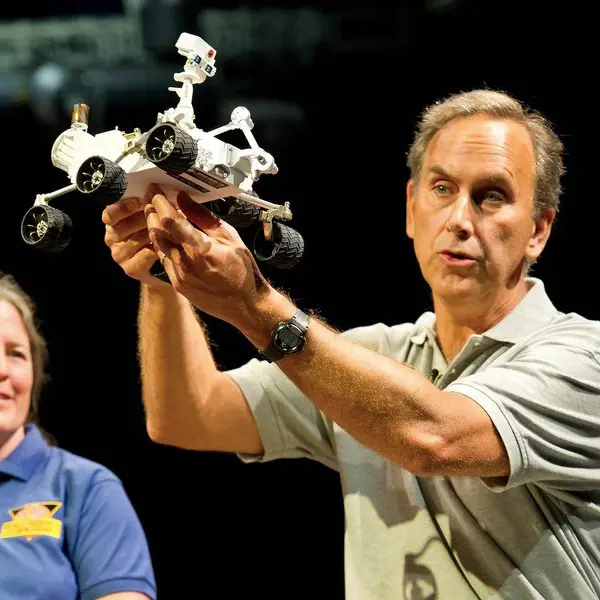
Harold Brown Professor of Geology, Caltech | Chief Scientist, NASA Curiosity Rover | Member, National Academy of Sciences
John Grotzinger led the most complex Mars mission in history as Chief Scientist of NASA's Curiosity rover, proving the Red Planet once harbored conditions capable of supporting life. Now Harold Brown Professor of Geology at Caltech and a member of the National Academy of Sciences, he brings the inside story of planetary exploration to executive audiences seeking lessons in high-stakes leadership, scientific discovery, and managing the unknown.
Want to book John Grotzinger as a speaker for your event? Please provide the info below and we’ll get in touch within 24h:
John Grotzinger is one of the world’s foremost planetary geologists, best known for leading the scientific mission that changed humanity’s understanding of Mars. He is the Harold Brown Professor of Geology at the California Institute of Technology, where he has been a faculty member since 2005, and a member of both the National Academy of Sciences and the American Academy of Arts and Sciences. Before Caltech, he spent nearly two decades at MIT, rising to the Robert E. Shrock Professor of Geology and serving as Director of the Earth Resources Laboratory.
Science speaker John Grotzinger served as Chief Scientist of NASA’s Mars Science Laboratory — the Curiosity rover mission — from 2006 to 2015. Under his scientific leadership, Curiosity landed in Gale Crater in August 2012 in what remains one of the most technically audacious spacecraft landings ever attempted, using a sky crane system to lower a 900-kilogram rover directly onto the Martian surface. Within its first two years, the mission achieved its primary scientific objective: Curiosity discovered ancient mudstone sediments in what had once been a freshwater lake, providing the first direct geologic evidence that Mars harbored an environment chemically and physically suited to support microbial life. The results were published in Science and reframed the global conversation about Mars, astrobiology, and the search for life beyond Earth.
Grotzinger’s scientific contributions extend well beyond Mars. His Earth research centers on the chemical evolution of early oceans and atmospheres, the environmental context of early animal evolution, and geobiology — the interaction between ancient microorganisms and the rock record they leave behind. He documented the Shuram Excursion, the largest carbon isotope anomaly in Earth history, which immediately preceded the rise of complex animal life during the Ediacaran period. He has conducted field research in northwest Canada, Siberia, southern Africa, Oman, the Turks and Caicos, and the American West. He served as Co-Director of the Simons Collaboration on the Origins of Life and remains an active team member on the Mars 2020 Perseverance mission.
His honors include the Charles Doolittle Walcott Medal from the National Academy of Sciences, the NASA Outstanding Public Leadership Medal, the Roy Chapman Andrews Explorer Award, the Halbouty Award from the American Association of Petroleum Geologists, and the Lawrence Sloss Award from the Geological Society of America.
As a speaker, John Grotzinger delivers something rare on any stage: the inside account of a mission that required coordinating hundreds of scientists and engineers across 13 countries, operating under extreme pressure and public scrutiny, with no margin for error 560 million kilometers from home. His keynotes draw on this experience to illuminate how extraordinary teams are built, how scientific uncertainty is managed in real time, and what the search for life on another planet reveals about our own. Senior audiences consistently describe his talks as equal parts awe-inspiring and operationally relevant — a combination few scientists can achieve.
In 2012, a one-ton rover traveling at 13,000 miles per hour had to slow to a complete stop and land gently on Mars — with a seven-minute communications delay making human intervention impossible. Grotzinger takes audiences inside the NASA Curiosity mission: the engineering audacity, the scientific stakes, the management of hundreds of experts across 13 countries, and the moment Curiosity confirmed Mars had once been capable of supporting life. This is a keynote about what it takes to lead at the absolute frontier — where the cost of failure is total, the team is global, and the mission is unprecedented.
Few questions have captured human imagination more persistently than whether life exists elsewhere in the universe. Grotzinger traces the scientific journey from early speculation to the hard evidence Curiosity uncovered in the ancient lakebeds of Gale Crater — and explains what it means for the future of planetary exploration, astrobiology, and our understanding of life itself. This talk bridges cutting-edge planetary science with the deeper question of what it means to be alive, and why answering it may be the most important scientific project of the coming century.
The Curiosity mission required making irreversible decisions with incomplete information, managing distributed teams under sustained pressure, and sustaining scientific rigor in the face of operational urgency. Grotzinger draws on nine years as Chief Scientist to offer a framework for leaders who operate in environments where the unknowns outnumber the knowns. This session focuses on risk culture, scientific thinking as a management discipline, and how the principles NASA uses to land spacecraft on other planets translate directly into building organizations capable of navigating uncertainty on Earth.
The rock record is the longest-running data set in existence. Grotzinger uses his dual expertise in Earth and Martian geology to offer a perspective on change, resilience, and the long arc of complex systems that no business school teaches. From the Ediacaran oceans that gave rise to animal life, to the ancient lakes of Gale Crater, to the resource and climate pressures reshaping the modern economy, this keynote reframes how senior leaders think about time horizons, systemic risk, and the signals hidden in long-term data.
The Real Wolf of Wall Street | Creator of the Straight Line Selling System | Bestselling Author & Master of Sales | Ethical Persuasion Speaker

Professor at ETH Zurich | Chief Scientist, Walt Disney Studios & Director of DisneyResearch|Studios | Two-Time Academy Award Winner (Technical Achievement)

Author, Mad World | Founder, Fordham Global Foresight | Wall Street's First Chief Global Political Analyst | Geopolitics & PQ Expert

Award-Winning Harvard Professor of Management | Expert on Teaming, Psychological Safety & Collaboration | Creator of the '4 Ups' Model | Thinkers50 Radar


© 2026 Aurum Speakers Bureau. All Rights Reserved

| Basic Data Protection Information | |
|---|---|
| Data controller | AURUM SPEAKERS BUREAU S.L. |
| Address | Parc Audiovisual de Catalunya 1, Oficina S11, 08225 Terrassa, Spain |
| Purposes | We will use your data to respond to your requests and deliver our services to you. |
| Marketing | We will only send you marketing correspondence if you have given your prior consent, which you can do by ticking the box for that purpose. |
| Lawful basis | We will only process your data if you have given your prior consent, which you can do by ticking the box for that purpose. |
| Recipients | Generally, only our members of staff who have been duly authorised may access the data that you have provided. |
| Your Rights | You have the right to know what information we hold about you, to rectify it and to erase it, as explained in the additional information available on our website. |
| Additional Information | For more information, please see our "PRIVACY POLICY". |