
Erik Weihenmayer
First Blind Person to Summit Mount Everest & Complete the Seven Summits | Bestselling Author & Co-Founder of No Barriers | Creator of the No Barriers Mindset

2022 Nobel Laureate in Physics | First Experimental Proof of Quantum Entanglement | Co-Creator of the CHSH Inequality | Inventor & Patentee, Quantum Sensing
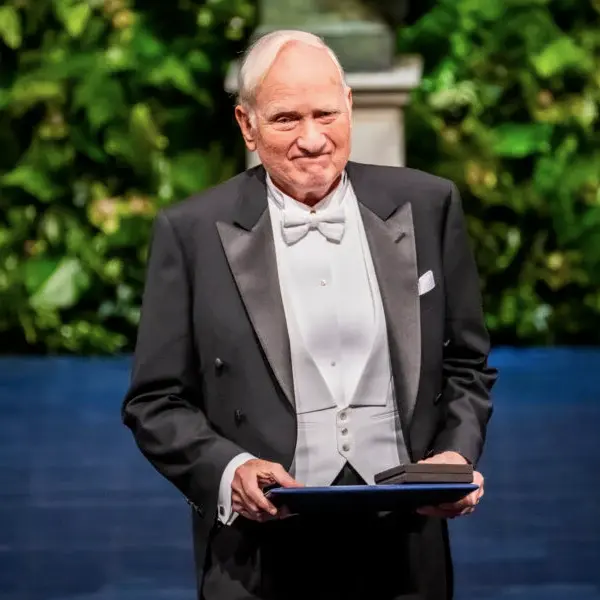
The physicist who first proved quantum entanglement is real, John F. Clauser pursued a career-defining experiment that Feynman dismissed and the field ignored, then won the Nobel Prize fifty years later. Co-creator of the CHSH inequality and inventor of patented quantum sensing technologies, he gives audiences a first-person account of the discovery that launched the quantum information revolution, and a rare view of what comes next.
Want to book John Clauser as a speaker for your event? Please provide the info below and we’ll get in touch within 24h:
Quantum physics speaker John F. Clauser is the 2022 Nobel Laureate in Physics who pursued an idea that nearly every senior physicist dismissed as a career-ending distraction, and in doing so produced the first experimental proof that quantum entanglement is real. A graduate of Caltech (B.S., 1964) and Columbia University (Ph.D., 1969), Clauser spent most of his career as an independent research physicist at Lawrence Berkeley National Laboratory, Lawrence Livermore National Laboratory, and UC Berkeley. He never held a tenured professorship, yet he reshaped the foundations of modern physics from a sub-basement laboratory with almost no budget.
Nobel physicist speaker John F. Clauser is best known for three interlocking contributions that together triggered the quantum information revolution. In 1969, he co-developed the Clauser-Horne-Shimony-Holt (CHSH) inequality, a rigorous and experimentally testable version of Bell’s theorem that finally gave physicists a practical tool for distinguishing quantum mechanics from classical local hidden-variable theories. In 1972, working with graduate student Stuart Freedman, he carried out the world’s first experimental violation of a Bell inequality, using entangled photon pairs produced by calcium atom decay. Their result, published in Physical Review Letters, was the first direct demonstration that non-local quantum entanglement is a physical reality rather than a philosophical abstraction. In 1974, he and Michael Horne formulated the broader theory of Local Realism.
The early reception to this work was hostile. Clauser has recounted that Richard Feynman threw him out of his office, and the prevailing advice was to go and do “some real physics.” The Nobel Committee recognized him roughly fifty years after his decisive experiment, one of the longest gaps between discovery and award in the prize’s history. His later career showed the range of a restless experimental mind: he proposed and patented atom interferometers as ultra-sensitive inertial and gravity sensors, invented the Talbot-Lau interferometer, and patented its application to high-resolution X-ray imaging of soft tissue. The Freedman-Clauser experiment has since been replicated hundreds of times and is now standard in undergraduate physics curricula.
As a speaker, John F. Clauser offers something rare: a first-person account of a discovery that changed the course of science, told with the candor of a physicist who chased the truth when no one else would. His talks illuminate the nature of scientific courage, the counterintuitive foundations of quantum mechanics, and what the entanglement revolution means for computing, cryptography, and sensing. For senior audiences weighing the promise and the hype of quantum technology, Clauser supplies both the foundational context and a clear-eyed view of where the real breakthroughs still lie.
Clauser recounts in the first person the long journey from a graduate student's library discovery to a basement experiment that the physics establishment largely dismissed, and that the Nobel Committee ultimately recognized as a founding moment of quantum information science. The talk blends clear scientific explanation with a deeply human story of intellectual conviction, giving audiences both a working understanding of quantum entanglement and a lesson in scientific courage and long-horizon thinking.
Building on his foundational role in establishing entanglement as physical fact, Clauser examines what the quantum revolution means in practice: quantum-secured communications, quantum computing, and ultra-sensitive quantum sensors. He offers a candid, expert assessment of which quantum technologies are genuinely transformative, which are overhyped, and what a realistic path to deployment looks like, invaluable perspective for leaders making technology and investment decisions.
An accessible exploration of the questions at the heart of quantum mechanics. Clauser traces the arc from Einstein's insistence on a deterministic universe, to Bell's mathematical challenge, to his own experiments, showing how physics settled a century-old debate about the nature of reality and what that resolution implies for causality and the limits of classical thinking.
First Blind Person to Summit Mount Everest & Complete the Seven Summits | Bestselling Author & Co-Founder of No Barriers | Creator of the No Barriers Mindset

2012 Nobel Laureate in Physics | Pioneer of Cavity Quantum Electrodynamics | Chair of Quantum Physics, Collège de France | CNRS Gold Medal

Bestselling Author | Customer Experience & AI Expert | Professor, Vlerick Business School | Co-Founder, Nexxworks

Co-Founder & Founding CTO of YouTube | Emmy Award Winner | PayPal Mafia Member | Digital Media Pioneer & Silicon Valley Icon


© 2026 Aurum Speakers Bureau. All Rights Reserved

| Basic Data Protection Information | |
|---|---|
| Data controller | AURUM SPEAKERS BUREAU S.L. |
| Address | Parc Audiovisual de Catalunya 1, Oficina S11, 08225 Terrassa, Spain |
| Purposes | We will use your data to respond to your requests and deliver our services to you. |
| Marketing | We will only send you marketing correspondence if you have given your prior consent, which you can do by ticking the box for that purpose. |
| Lawful basis | We will only process your data if you have given your prior consent, which you can do by ticking the box for that purpose. |
| Recipients | Generally, only our members of staff who have been duly authorised may access the data that you have provided. |
| Your Rights | You have the right to know what information we hold about you, to rectify it and to erase it, as explained in the additional information available on our website. |
| Additional Information | For more information, please see our "PRIVACY POLICY". |