
Adam Savage
MythBusters Co-Host & Executive Producer | NYT Bestselling Author | Board Member, Smithsonian Air & Space Museum | Innovation & Creativity


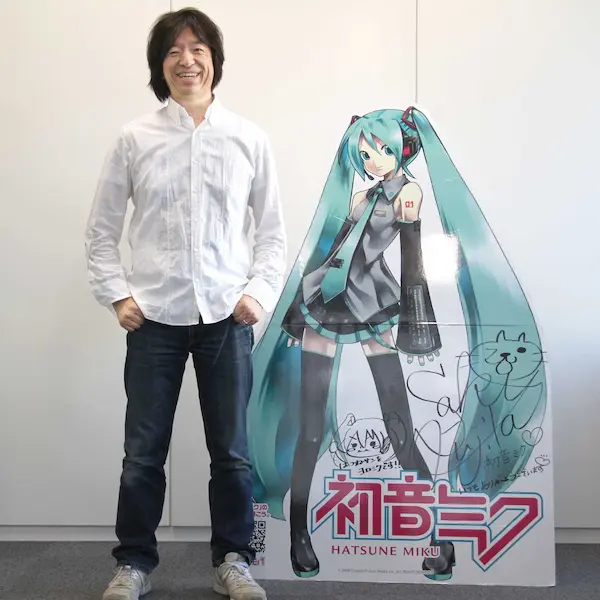
Creator of Hatsune Miku | Founder & CEO, Crypton Future Media | Professor, Kyoto College of Graduate Studies for Informatics | On Creativity, Virtual Artists & Co-Creation
Hiroyuki Itoh is the creator behind Hatsune Miku, the virtual singer who grew from music software into a global icon with sold-out holographic concerts and 170,000+ fan-made songs. As founder and CEO of Crypton Future Media, he turned an open, fan-driven model into a creative revolution, treating a character like a shared instrument rather than guarded IP. On stage, he reveals how technology is reshaping creativity, fandom, and culture.
Want to book Hiroyuki Itoh as a speaker for your event? Please provide the info below and we’ll get in touch within 24h:
Hiroyuki Itoh is the founder and CEO of Crypton Future Media and the entrepreneur behind Hatsune Miku, the turquoise-haired virtual singer who grew from a piece of music software into a global cultural icon. A self-described “sound seller,” Itoh turned a personal passion for computer music into a company that helped pioneer an entirely new form of participatory, creator-driven entertainment.
Technology speaker Hiroyuki Itoh founded Crypton Future Media in Sapporo, Hokkaido, in 1995, beginning as an importer and developer of sound libraries and music-production software. In 2007, the company released Hatsune Miku, a singing-voice synthesizer built on Yamaha’s VOCALOID technology and given a distinctive character design and persona. Rather than a finished pop star, Miku was conceived as an instrument: a voice anyone could compose for. That simple but radical idea, combined with the rise of YouTube and Niconico, turned her into a phenomenon, inspiring more than 170,000 fan-made songs and sold-out holographic concerts around the world.
The decision that defined Miku’s success was Itoh’s choice to let fans create freely. Through the company’s Piapro platform and Creative Commons–based licensing, Crypton encouraged users to write songs, draw illustrations, and build on the character without seeking permission, treating Miku less like protected intellectual property and more like a musical instrument. This open, collaborative model turned a software product into a living creative community and made Itoh an influential voice on the future of culture, technology, and co-creation. He is also a professor at the Kyoto College of Graduate Studies for Informatics, and in 2025, marking Crypton’s 30th anniversary, he published a book on the origins of Hatsune Miku and the future of creativity.
As a speaker, Hiroyuki Itoh offers a singular perspective on how technology is reshaping creativity, fandom, and business. He speaks on building participatory communities, the power of open and collaborative models over tightly controlled IP, the rise of virtual artists and digital characters, and how the information revolution is still only beginning to transform how people create and connect. Audiences come away with fresh thinking about creativity as a shared platform rather than a finished product.
Hiroyuki Itoh tells the firsthand story of how a singing-voice synthesizer from Sapporo became a worldwide cultural phenomenon. He shares the decisions, philosophy, and lucky timing behind Miku's rise, and what her success reveals about creativity, technology, and the unpredictable nature of cultural breakthroughs.
Crypton chose to treat Hatsune Miku like an instrument rather than a tightly controlled property, inviting fans to compose, illustrate, and remix freely. Itoh explores how this open, Creative Commons–based model built one of the most active creative communities in the world, and what businesses can learn about co-creation, community, and letting go of control.
From holographic concerts to fan-made music, Hatsune Miku helped pioneer a new category of virtual performer. Itoh examines the technology and culture behind virtual artists, where digital characters and synthetic voices are heading, and what their popularity means for entertainment, branding, and the future of fandom.
Itoh believes the changes brought by digital technology are still in their earliest stages, comparable to the start of the agricultural or industrial revolutions. He shares his vision for how creativity, the internet, and emerging tools, including AI, will transform how people make and share culture in the decades ahead.
MythBusters Co-Host & Executive Producer | NYT Bestselling Author | Board Member, Smithsonian Air & Space Museum | Innovation & Creativity

Youngest Nobel Peace Prize Laureate in History | UN Messenger of Peace | Co-Founder & Executive Chair, Malala Fund

Founder & CEO of Change Enthusiasm® Global & Creator of the Framework | Bestselling Author | Former Fortune 100 Innovation Leader & Chemical Engineer

CMO, VaynerX | Founder, Vayner3 | AI, Digital Marketing & Brand Strategy Expert | Salesforce AI Council


© 2026 Aurum Speakers Bureau. All Rights Reserved

| Basic Data Protection Information | |
|---|---|
| Data controller | AURUM SPEAKERS BUREAU S.L. |
| Address | Parc Audiovisual de Catalunya 1, Oficina S11, 08225 Terrassa, Spain |
| Purposes | We will use your data to respond to your requests and deliver our services to you. |
| Marketing | We will only send you marketing correspondence if you have given your prior consent, which you can do by ticking the box for that purpose. |
| Lawful basis | We will only process your data if you have given your prior consent, which you can do by ticking the box for that purpose. |
| Recipients | Generally, only our members of staff who have been duly authorised may access the data that you have provided. |
| Your Rights | You have the right to know what information we hold about you, to rectify it and to erase it, as explained in the additional information available on our website. |
| Additional Information | For more information, please see our "PRIVACY POLICY". |