For roughly five weeks every four years, the entire planet watches the same set of people make decisions under the heaviest pressure their profession can produce. A manager rebuilds a team’s shape at halftime with the tournament on the line. A captain holds a dressing room together after conceding late. A referee makes a call that millions will replay in slow motion before he has finished blowing the whistle. The World Cup is, among other things, the largest live experiment in high-stakes leadership the world ever runs.
That is why it is worth studying beyond the scorelines. The leadership lessons from the World Cup are not metaphors stretched to fit a conference theme. The mechanics are genuinely the same as those facing any executive: deciding with incomplete information, sustaining a culture through adversity, and performing while being judged in real time. Football simply makes them visible in a way the boardroom never does.
As the 2026 tournament unfolds across the United States, Canada, and Mexico, here is what the competition reveals about leading well, and why so many organizations now bring voices from elite football onto the corporate stage.
Decisions Are Made With Incomplete Information and No Undo Button
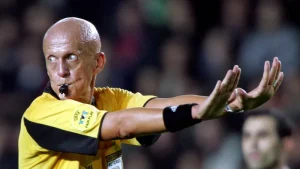
Pierluigi Collina, legendary FIFA referee and former World Cup official, demonstrates the decisive judgment and composure required when making high-stakes decisions under intense scrutiny.
The cleanest leadership lesson football offers is about the nature of the decision itself. On the pitch, the information is never complete, the clock never stops to let you deliberate, and almost nothing can be reversed. A leader can usually revise a strategy over a quarter. A referee cannot un-award a penalty, and a manager cannot recall a substitution.
Few people embody this better than Pierluigi Collina, regarded as the finest referee in the sport’s history and today Chairman of the FIFA Referees Committee. His authority was never built on volume; it was built on preparation so thorough that most of his decisions had been rehearsed before the match began. The lesson for leaders is uncomfortable but durable: composure in the moment is not a personality trait, it is the visible surface of work nobody saw. The instinct that separates strong decision-makers is the willingness to commit fully to a judgment in the instant it is required, and to own it publicly afterward. We explore this in depth in our look at Collina on decision-making under pressure.
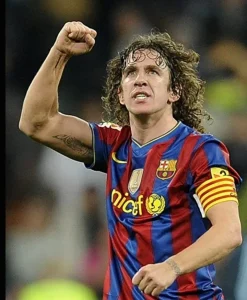
Spain and FC Barcelona captain Carles Puyol exemplifies how culture, accountability, and collective standards form the foundation of sustained team success.
Culture Is the One Thing a Rival Cannot Copy
Tactics are public. Any team can study another’s formation, and any company can read a competitor’s strategy deck. What cannot be copied is the internal culture that determines whether people hold their standards when no one is enforcing them. Tournaments are won and lost on that difference, usually in the moments after something goes wrong.
This is the territory Carles Puyol speaks to most powerfully. As captain of the Spain side and the FC Barcelona team that dominated an era, Puyol embodied the unglamorous machinery of a winning culture: shared standards, individual sacrifice for the collective, and the understanding that the captain is a custodian of values rather than a star. For organizations attempting transformation or integration, where the genuine difficulty is getting people to row together, that perspective lands directly. The trophy is the output; the culture is the system that produced it, and it is built in the moments no highlight reel captures.
Teams Are an Idea Before They Are a Result
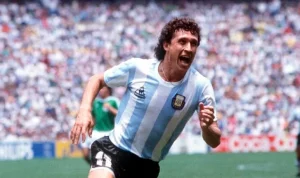
World Cup winner, author, and former Real Madrid executive Jorge Valdano argues that great teams are built through shared vision, thoughtful design, and leadership of ideas.
The most underrated leadership insight in football is that elite performance is, at root, intellectual. The best football minds treat a squad as a system to be designed, not a collection of talent to be managed, and they think about it with a seriousness most industries reserve for engineering.
Jorge Valdano is the clearest example. A 1986 World Cup winner who scored in the final, he went on to build Real Madrid’s Galácticos era as general manager and founded one of the first consultancies to translate sports leadership into corporate practice. Nicknamed “the philosopher of football,” his core idea is that “a team is a state of mind,” and his framework of eleven distinct leadership qualities, set out in his book The 11 Powers of the Leader, is a structured model rather than a motivational story. His argument reframes what a leader is actually responsible for: not directing talented individuals, but constructing the shared vision and conditions in which they become a team.
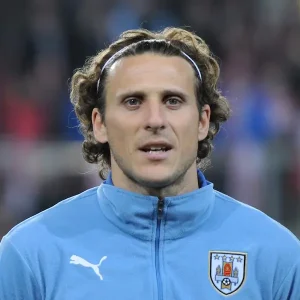
Uruguay legend Diego Forlán shows how purpose beyond personal achievement can sustain motivation, resilience, and peak performance over the long term.
Purpose Is the Most Durable Source of Drive
The deepest motivation rarely comes from the prize. It comes from a reason that predates the competition entirely. Diego Forlán, the Uruguayan striker named best player of the 2010 World Cup, began his career not chasing trophies but trying to help his family: after his sister Alejandra was paralyzed in a 1991 car accident, the teenage Forlán turned from a promising tennis path to football in part to help fund her treatment. Years later, the two co-founded the Fundación Alejandra Forlán, a road-safety and disability-rights foundation she leads to this day.
His story reframes a question every leader eventually confronts: what keeps people going when the external rewards run dry. Forlán’s answer was that he was never only playing for himself, and the performances that defined his career were powered by a purpose no scoreboard could grant or take away.
His reinvention didn’t stop when he retired. Read our full feature on Diego Forlán.
Why Organizations Bring Football Leaders Into the Boardroom
The reason these voices work on the corporate stage is that the translation step is already done. An executive does not have to strain to see the parallel between a contested refereeing call and a consequential business decision, or between a dressing room and a department under strain. The pressure is real, the stakes are public, and the lessons were tested in front of the largest audiences on earth rather than theorized in a workshop.
That immediacy is also why timing matters. With the tournament underway, football leadership resonates more than at any other moment in the cycle, which is why event planners increasingly look to Aurum’s sports speakers and leadership speakers during these weeks. The players, managers, and officials who lived these tournaments first-hand are profiled in our roundup of the top World Cup speakers for 2026, and the broader question of which voices redefine leadership today runs through our guide to the best leadership keynote speakers for corporate events.
The deeper point is that none of this is borrowed glamour. Football’s value to business is not the celebrity of its names but the clarity with which it stages the problems every leader actually faces. To explore which of these voices fits your audience and goals, contact Aurum Speakers Bureau to discuss availability and shape a shortlist for your event.
Frequently Asked Questions
What can business leaders actually learn from the World Cup?
The most transferable lessons concern decision-making under pressure, building a culture that holds up in adversity, and performing while being publicly judged. Football stages these challenges in their most extreme and visible form, which is why managers, captains, and officials translate so naturally to leadership, governance, and high-performance corporate audiences.
Why are football figures effective as corporate keynote speakers?
Because the parallels require no translation. A contested refereeing call mirrors a consequential business decision; a dressing room under strain mirrors a team in crisis. These speakers tested their judgment in front of global audiences, so their insight carries a credibility that theoretical frameworks rarely match, and audiences engage with it immediately.
Which World Cup-linked speakers suit a leadership audience?
For decision-making and authority, Pierluigi Collina offers a referee’s unmatched perspective on irreversible calls. For team culture and the captain’s role, Carles Puyol speaks from the heart of a dominant era. For strategy and the intellectual side of leadership, Jorge Valdano brings a structured model built across playing, coaching, and executive roles. And for purpose and motivation forged through adversity, Diego Forlán shows how a reason beyond the scoreboard sustains performance.
Is the World Cup period a good time to book a sports speaker?
Yes. Audience attention to football peaks during a World Cup, and content or events that connect to the tournament tend to see stronger engagement. Booking early in the cycle is advisable, since the most sought-after football voices are in high demand throughout the competition. Aurum Speakers Bureau can advise on availability and timing.