
Innovation is one of the most requested topics on the corporate keynote circuit and one of the most poorly served. The speakers on this list take a different approach. The reason is simple: most speakers approach it as a subject to describe rather than a discipline to teach. They catalog why disruption is happening, why most companies fail to respond, and why the future belongs to the bold. Audiences leave inspired and return to the same organizational conditions that were suppressing good ideas before they walked into the room.
Each speaker on this new list we give you today has built frameworks for how innovation actually happens — inside large organizations, inside markets, inside governments, and inside the behavioral patterns of individuals. Together they represent five genuinely distinct schools of innovation thinking, which is why they appear on the same list rather than five versions of the same one.
What Event Planners Should Know Before Booking an Innovation Speaker

Choosing the right innovation speaker starts with defining the problem your organization is trying to solve, not simply selecting the most well-known name.
The first question worth asking is not “who is the best innovation speaker?” but “what problem are we trying to solve?” Innovation speakers serve very different functions depending on where an organization is in its journey.
A company that has ideas but cannot execute needs someone who understands organizational culture and the internal conditions that kill creativity. A company navigating AI adoption needs a strategist who can make that transition concrete and non-threatening. A board designing long-term growth strategy needs someone who can situate their decisions inside the economics of competitive advantage. A government or institution needs a practitioner who has actually built innovation infrastructure from scratch.
Matching the speaker to the actual need — rather than booking the biggest name — is what separates high-impact conferences from forgettable ones. The profiles below are designed to help event planners make that distinction.
Duncan Wardle — Making Innovation a Repeatable Discipline
The most common innovation failure is not a shortage of ideas. It is an organizational culture that eliminates good ideas before they can take root. Duncan Wardle spent 25 years inside that problem at one of the most brand-protective companies in the world.

From Disney’s most protected brand to your organization’s next bold idea — Duncan Wardle teaches creativity as a system, not a personality trait.
As Head of Innovation & Creativity at The Walt Disney Company, Wardle was responsible for embedding creative capability across Pixar, Marvel, Lucasfilm, Disney Parks, and Disney Animation — not as an outside consultant, but as an internal leader navigating the same hierarchies, risk committees, and brand approval processes that his audiences face every day. That operational credibility is what distinguishes his keynotes from the inspirational-but-abstract format that dominates innovation programming.
His framework, the Theory of Creativity, addresses the specific organizational behaviors that suppress innovation — fear-based decision-making, single-right-answer thinking, hierarchy as a filter for ideas — and replaces them with practical tools teams can apply immediately. His book The Imagination Emporium extends this work into a structured daily practice for leaders. He teaches innovation masterclasses at Yale and Harvard, and keynoted Iterable’s Activate Summit in Los Angeles in April 2026, where he led sessions on turning creativity into a repeatable organizational capability.
For a deeper look at Wardle’s approach and how he helps organizations move from inspiration to execution, see Aurum’s feature on why innovation fails in large organizations.
Keynote topics: Embedding innovation culture, Design Thinking for enterprises, AI and human creativity, customer experience transformation, breaking organizational inertia. Best for: Large enterprises, corporate culture transformation, innovation leadership programs, mixed executive and operational audiences.
Jonah Berger — The Science of Why Ideas Spread
Most organizations understand that innovation requires generating new ideas. Fewer understand that ideas have to travel — through teams, up leadership chains, across functions, and into markets — and that this process follows discoverable patterns. Jonah Berger has spent two decades mapping those patterns with scientific rigor.

Wharton’s most-cited voice on why things catch on — and why most good ideas never do.
A Marketing Professor at The Wharton School at the University of Pennsylvania, Berger is the author of four internationally bestselling books: Contagious, Invisible Influence, The Catalyst, and Magic Words. His research — published in over 80 peer-reviewed papers and recognized with the Sheth Foundation Award for long-term contribution to marketing in 2025 — examines why some ideas, products, and behaviors catch on while others, equally good on their merits, disappear. He consults for organizations including Apple, Google, Nike, Amazon, and the Gates Foundation, and regularly keynotes Cannes Lions and SXSW.
What makes Berger particularly valuable for innovation programming is that his work operates at the intersection of organizational behavior and market dynamics. He can explain why a promising internal initiative failed to gain traction, why a technically superior product lost to an inferior competitor, and what language and framing choices determine whether a new idea gets adopted or ignored. His sessions translate directly into how innovation teams pitch ideas internally and how go-to-market teams position new products externally.
Keynote topics: Word of mouth and idea contagion, the science of influence and persuasion, language and behavior change, how to make ideas travel through organizations and markets. Best for: Marketing and innovation teams, product launches, organizational change programs, audiences where the challenge is adoption rather than ideation.
Ian Beacraft — Designing Organizations That Can Innovate with AI
There is a gap between organizations that have implemented AI tools and organizations that have redesigned their operations to capture value from them. Ian Beacraft, CEO and Chief Futurist of Signal and Cipher, works in that gap.
The strategist companies call when AI stops being a pilot program and starts being a competitive liability.
Beacraft built his career leading innovation and emerging technology at some of the world’s largest agencies before founding Signal and Cipher, a strategic foresight firm whose clients include Samsung, Intel, Coca-Cola, Google, Microsoft, and Nike. He is known as a “Gonzo Futurist” — someone who actively experiments with emerging technologies before they reach mainstream adoption, specifically to understand their practical organizational implications. His concept of the Creative Generalist — the insight that AI does not narrow the advantage of specialists but instead dramatically widens the impact of people with broad, connected experience — has become one of the more discussed frameworks in enterprise AI strategy.
His keynotes are built for CIOs, CHROs, and senior leaders who are past the “should we use AI” phase and into the harder question of how to redesign workflows, team structures, and value creation models around it. He was recently announced as the mainstage keynote at Info-Tech LIVE 2026 in Las Vegas (June 9-11), where he will address thousands of technology and business leaders on designing AI-ready organizations. For HR and operations leaders, Beacraft also features in Aurum’s Top 10 Future of Work Speakers — a useful companion read on workforce transformation.
Keynote topics: AI organizational design, the Creative Generalist framework, workforce transformation, innovation strategy in the AI era, moving from AI experimentation to AI-driven performance. Best for: Technology conferences, C-suite leadership summits, HR and operations leaders, organizations in active AI transformation.
Audrey Tang — Innovation as an Institutional Design Problem
Innovation in the private sector tends to be discussed as a competitive advantage. Audrey Tang brings a perspective that reframes it as a question of institutional design — and in doing so, opens possibilities most corporate innovation programs have never considered.
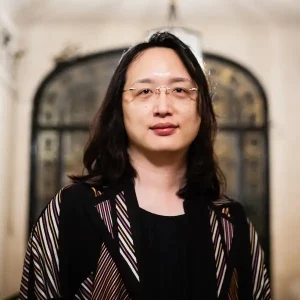
Former Digital Minister of Taiwan and 2025 Right Livelihood laureate — the only keynote speaker who has stress-tested participatory innovation against a nation-state threat.
Taiwan’s first Digital Minister (2016-2024) and current Cyber Ambassador-at-large, Tang did not theorize about participatory innovation — they built it under genuine pressure. This includes deploying AI-assisted deliberation platforms that replaced polarized debate with consensus-building, orchestrating a pandemic response that became an international model for open-data governance, and defending Taiwan’s 2024 elections against coordinated foreign interference. At the 2025 Paris AI Summit, Tang co-launched ROOST (Robust Open Online Safety Tools), a decentralized safety infrastructure now being adapted by governments and platforms globally. They were awarded the 2025 Right Livelihood Award and named to TIME’s AI100.
For corporate audiences, Tang’s value is not in civic technology specifically — it is in what open, participatory systems reveal about how innovation actually scales. Organizations that involve the people closest to problems in generating solutions consistently outperform those that centralize ideation at the top. The governance mechanisms Taiwan developed — radical transparency, crowd-sourced signal collection, AI-assisted synthesis of diverse input — are organizational design principles as much as they are political ones. Tang’s book Plurality, co-authored with E. Glen Weyl, develops these ideas into a framework for any institution seeking to harness collective intelligence. Event planners can find further detail on Audrey Tang’s profile and speaking formats directly through Aurum Speakers Bureau.
Keynote topics: Digital democracy and participatory governance, AI ethics and open-source safety, innovation through radical transparency, collective intelligence as organizational strategy. Best for: Government and public sector events, organizations navigating AI governance, leadership audiences at the intersection of technology, trust, and institutional design.
Philippe Aghion — The Economics of Innovation That Lasts
Every speaker on this list addresses how to generate innovation. Philippe Aghion addresses something harder: why some innovation produces sustained growth while other innovation exhausts itself quickly, and what organizational and policy conditions make the difference.
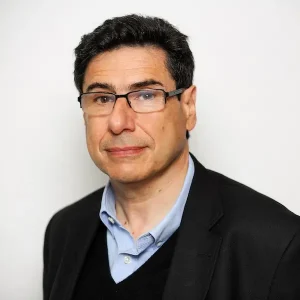
Nobel laureate in Economics, 2025 — because not all innovation creates growth, and knowing the difference is a strategic decision.
Speaker Philippe Aghion is one of the most decorated economists of his generation. In October 2025, the Royal Swedish Academy of Sciences awarded him the Nobel Prize in Economic Sciences — jointly with Peter Howitt and Joel Mokyr — for their foundational work explaining innovation-driven economic growth. The framework at the center of his research, the Aghion-Howitt model of creative destruction, provides the most rigorous available answer to why established industries decline and what actually determines whether the organizations replacing them can sustain their advantage over time.
For senior executives and boards, Aghion’s thinking operates at a level of strategic depth that most keynote programming does not reach. His work explains why competition, properly designed, accelerates innovation rather than suppressing it — a counterintuitive insight with direct implications for decisions about market positioning, M&A, and competitive strategy. Since the Nobel announcement, Aghion has addressed the Finnish government’s Economic Council, spoken at MIPIM in Cannes, and continues his academic roles at the Collège de France, INSEAD, and the London School of Economics. Aurum’s full feature on Philippe Aghion’s ideas on innovation and growth is the best starting point for boards and strategy teams considering his keynote.
Keynote topics: Creative destruction and long-term growth strategy, innovation economics and competitive advantage, the role of regulation and institutions in enabling innovation, AI and the future of productivity. Best for: Board and C-suite strategy sessions, economic forums, financial services and policy audiences, organizations designing long-term innovation investment strategy.
How to Choose the Right Innovation Speaker for Your Event
The five speakers above represent genuinely different entry points into innovation — culture, behavioral science, AI strategy, civic governance, and economic theory. The right choice depends on where your organization’s most pressing challenge sits.
For teams where creativity is present but execution is the problem, Wardle’s organizational toolkit is the most direct fit. For teams where internal adoption of new ideas is the bottleneck, Berger’s behavioral science of influence is the relevant framework. For organizations navigating AI transformation and needing someone who can make that concrete and strategic, Beacraft is the right call. For audiences grappling with trust, transparency, and institutional innovation at scale, Tang offers a perspective no other speaker on this list does. And for boards and leadership teams who want to situate their innovation decisions inside the economics of long-term growth, Aghion provides the intellectual scaffolding.
Reach out to Aurum Speakers Bureau to discuss availability, event fit, and how any of these speakers can be shaped to your specific audience and objectives.
Frequently Asked Questions
What types of organizations benefit most from innovation keynote speakers?
Innovation keynote speakers add the most value when an organization is at a decision point — entering a new market, navigating technological disruption, redesigning its culture after a merger, or preparing leadership for a strategic shift. They are particularly effective for annual leadership conferences, strategy offsites, and executive forums where the goal is to shift perspective rather than deliver information. Any sector benefits: financial services, healthcare, manufacturing, and technology companies all face innovation challenges that world-class keynote speakers can reframe productively.
What is the difference between an innovation speaker and a technology speaker?
Innovation speakers focus on how organizations generate, develop, and implement new ideas — including the cultural, behavioral, and structural conditions that enable or suppress that process. Technology speakers focus on specific technologies, their mechanics, and their market implications. The two often overlap — Beacraft and Tang, for example, move fluently across both domains — but the distinction matters when designing a program. An audience that needs to understand what AI means for their industry benefits from a technology lens. An audience that needs to build a culture capable of responding to whatever comes next benefits more from an innovation lens.
How far in advance should we book an innovation keynote speaker?
Top innovation speakers typically book out three to six months in advance for major conferences and four to twelve weeks for smaller executive sessions. Speakers with recent Nobel recognition or a major book release — like Philippe Aghion following his October 2025 prize — often have calendars that fill significantly faster. For flagship events with a fixed date, beginning the process six months out is the safest approach. Contact Aurum Speakers Bureau early to check availability and hold a date while internal approvals are finalized.
Can innovation speakers tailor their keynote to a specific industry or audience?
All five speakers profiled here customize their content for the specific context — sector, audience level, strategic priorities, and format. Wardle’s workshops are built around the organization’s actual innovation challenges. Berger draws on industry-specific case studies from his consulting work across sectors. The depth of customization typically increases with the level of pre-event alignment calls built into the contract. Aurum Speakers Bureau manages this process and can advise on which speaker formats translate best for your audience type.
Building a culture of sustained innovation is one of the most difficult management challenges an organization faces — and one of the most consequential. The right keynote speaker does not solve that challenge in 60 minutes, but they can give a leadership team the shared language, the conceptual tools, and the urgency to start. Contact Aurum Speakers Bureau to explore which speaker best fits your event and how we can help you build a program that moves your organization forward.