


Steve Chen, YouTube cofounder and original CTO, helped build the technical infrastructure that transformed online video into a global creator economy worth hundreds of billions of dollars.
The creator economy now generates hundreds of billions of dollars annually and employs more people than many traditional media industries combined. None of it would exist without a decision made in a San Mateo garage in 2005, and the person most responsible for the technical architecture behind that decision is Steve Chen.
Chen, YouTube’s co-founder and original CTO, spent roughly 20 months turning a rough concept into the infrastructure that would permanently alter how the world consumes, creates, and monetizes video. When Google acquired YouTube in October 2006 for $1.65 billion (the largest acquisition of an internet company at the time) it was both a validation of that vision and the starting gun for everything that followed.
What makes Chen compelling as a speaker is not simply the origin story; it’s what his trajectory reveals about the decisions entrepreneurs face at each inflection point: when to build versus partner, how to survive hypergrowth without losing technical integrity, and why the platforms that endure are the ones that hand power to their users.
Building the Infrastructure for a New Economy
Before YouTube, user-generated video simply wasn’t viable at scale. The bandwidth costs were prohibitive, the encoding standards were fragmented, and there was no clean economic model. Chen’s core insight was that the technology problem and the business problem were the same problem: if you could make video frictionless enough, content would take care of itself.
That turned out to be correct in a way even the founders didn’t fully anticipate. By removing the technical barriers between creators and audiences, YouTube didn’t just build a platform; it created a new class of economic actor: the independent creator. Their earning potential had no clear ceiling and the relationship with their audience was direct in a way traditional media had never permitted.
Chen speaks directly to this architecture question in his fireside chats. According to these, the platforms that generate lasting value are not the ones that extract the most from creators, but the ones that make it easiest for creators to succeed. It’s a principle that applies well beyond video hosting, and it’s one that technology speakers and entrepreneurship speakers rarely frame with the same first-principles clarity.
The PayPal Mafia, Risk Tolerance, and the Founding Moment
Chen joined PayPal before YouTube, and the overlap with the so-called PayPal Mafia is not incidental. The alumni network that emerged from that company, which includes figures across finance, AI, and consumer tech, shared a particular approach to risk: move faster than the environment seems to permit, because the environment’s perception of what’s possible is almost always behind reality.
At PayPal, Chen worked alongside Chad Hurley, who would become YouTube’s co-founder, and Jawed Karim, who famously uploaded the platform’s first video. That team’s willingness to build without permission, to occupy regulatory and market space before incumbents had even registered a threat, became the template for how the creator economy would develop.
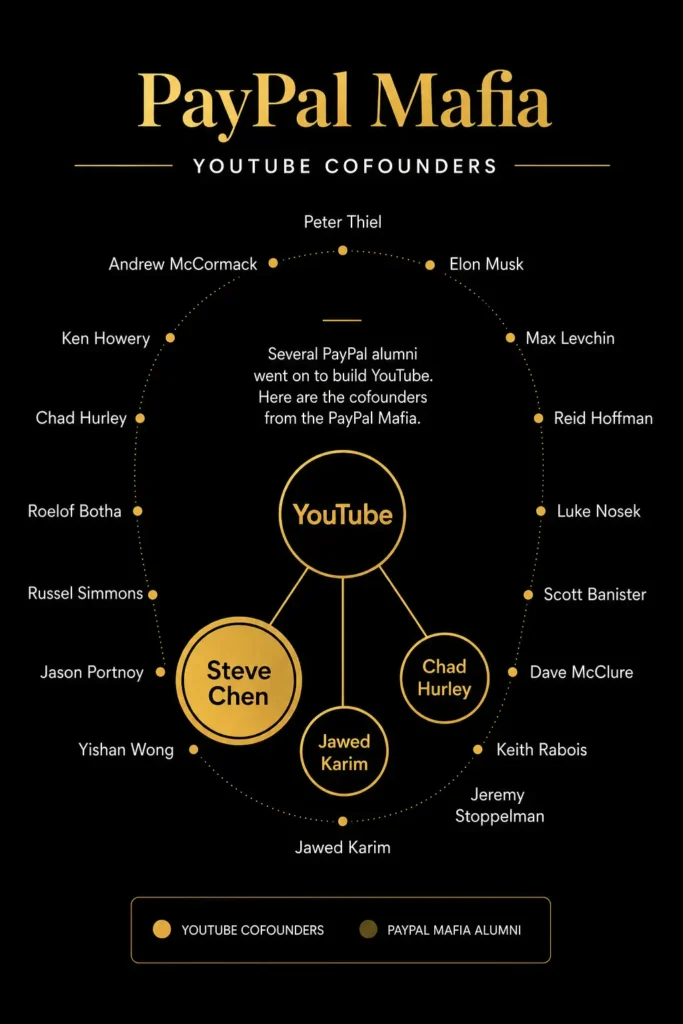
Chen’s material on this period is not nostalgia. It is a practical lesson in how founding teams make decisions under radical uncertainty, and how the culture established in those early months determines whether a company survives its own success.
After the $1.65 Billion Sale: What Comes Next
The Google acquisition made Chen wealthy. It also removed the existential pressure that had shaped every decision up to that point. What Chen did next is one of the more instructive parts of his biography for event planners and executives looking to book a speaker who can speak credibly about life after a major exit.
He co-founded AVOS Systems with Hurley, which acquired Delicious from Yahoo. He experimented with MixBit, an early attempt at collaborative mobile video. In 2014, he joined Google Ventures as a general partner, shifting from builder to backer. This transition gave him visibility into hundreds of startups at various stages and sharpened his thinking on what separates ideas that scale from ideas that merely seem good.
Chen’s investment lens is particularly relevant for corporate audiences because it reflects the same question he was answering as a founder: which of these technologies will create new economic categories, and which will simply optimize existing ones? For innovation speakers to engage meaningfully with that question, they need to have sat on both sides of the table. Chen has.
The Creator Economy Today: What Chen Sees That Others Miss

Steve Chen speaking at a live event on how YouTube evolved from a video-sharing platform into a global creator economy powering billions of users, new business models, and long-term audience relationships.
YouTube now has more than two billion logged-in users visiting monthly, and the platform’s partner program has paid out tens of billions of dollars to creators since its launch. The YouTube ecosystem represents a real economy, not a side economy; one with talent agencies, production companies, brand partnerships, and career arcs that look nothing like traditional media.
Chen has been consistent in his chats about the structural shifts still underway. The next phase of the creator economy, in his view, is not about more content, it’s about more durable relationships between creators and their audiences. The platforms that will matter in ten years are the ones that figure out how to facilitate those relationships without inserting themselves as extractive intermediaries.
This is a genuinely useful frame for any organization dealing with digital transformation, media, or the shifting economics of consumer attention. It is also a frame that requires someone who built the underlying infrastructure to articulate credibly. Chen’s position is singular in that regard.
FAQ
Why should organizations book Steve Chen as a guest speaker?
Steve Chen offers an origin story that almost no other speaker can match: he built one of the five most-visited websites in history and negotiated its sale while it was still running on borrowed infrastructure. Beyond the founding narrative, Chen brings a venture capital perspective from his time at Google Ventures that gives his observations on innovation, digital media, and platform economics a precision that more theoretical speakers cannot access. Event organizers looking to open a technology or digital strategy conference with genuine authority should explore availability at Aurum Speakers Bureau.
What topics does Steve Chen typically address in public?
Chen’s fireside chat material with an onstage moderator spans the founding of YouTube and the decisions made under pressure, the architecture of platforms that empower creators rather than extract from them, lessons from the PayPal and Google orbits, and the current and future state of the creator economy. He draws on both his founding experience and his venture capital career, making him equally relevant to technology, media, marketing, and entrepreneurship audiences.
How did YouTube change the economics of media?
Before YouTube, distribution in media required institutional backing; a broadcaster, a studio, a publisher. YouTube eliminated that requirement. By making upload and playback free and increasingly frictionless, it created a direct channel between creators and audiences that had no structural gatekeepers. This was not a minor efficiency gain; it was a reordering of who gets to participate in media creation. The knock-on effect is the creator economy, a labor market where individual creators can build businesses, audiences, and influence without requiring institutional permission.
What distinguishes great platform builders from everyone else?
Chen’s consistent answer in interviews and on stage is specificity at the infrastructure level combined with genuine indifference to what users will do with the platform once it works. YouTube was not built around a specific content category; it was built around removing friction. The platforms that achieve lasting scale tend to share that property: they solve a technical problem cleanly and then get out of the way of the people using them.
Contact Aurum Speakers Bureau to discuss booking Steve Chen for your next conference or corporate event.