Most successful companies look inevitable in hindsight. Netflix is no exception, but the story Marc Randolph tells from the keynote stage is nothing like the tidy origin myth that has circulated for decades. It’s messier, more instructive, and considerably more useful for any organization that needs to make better decisions under uncertainty.

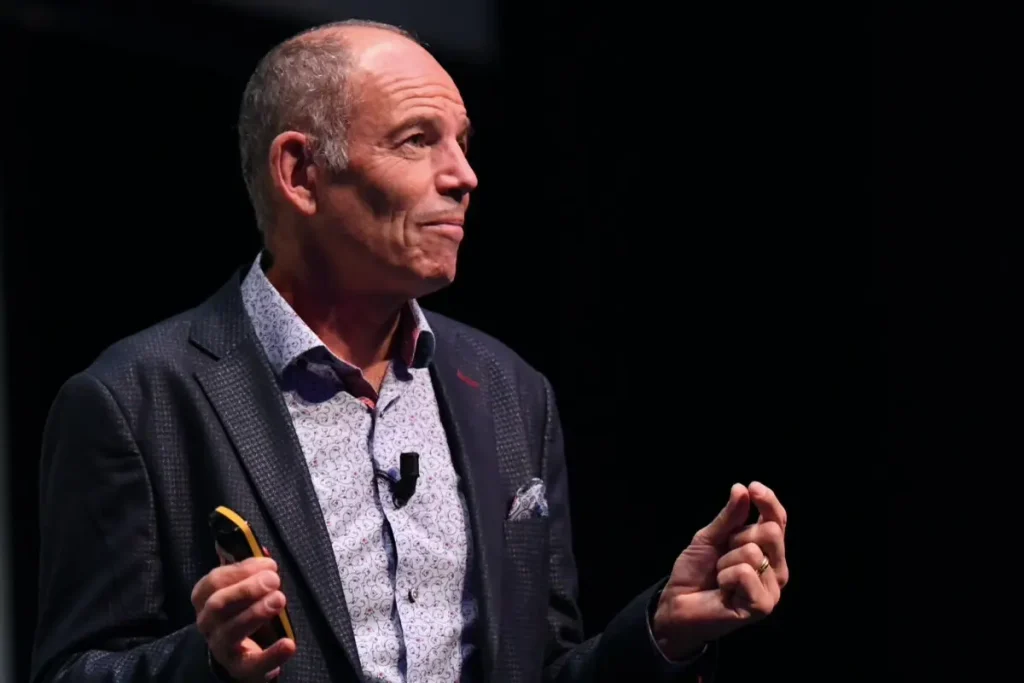
Marc Randolph, co-founder and first CEO of Netflix, speaks about uncertainty the way most founders only understand it in retrospect: not as a polished strategy, but as a series of imperfect decisions made before anyone knew the outcome.
Randolph is the co-founder and first CEO of Netflix, the service that now reaches more than 300 million subscribers worldwide. He was there before the business model existed, before the subscription idea emerged, and long before anyone believed it would work. We represent Marc through Aurum Speakers Bureau because his keynotes do something rare: they translate genuine founder experience into practical insight that lands equally well with a room of executives as it does with a room of entrepreneurs.
The Commute That Started Everything
Netflix was not born in a boardroom or a venture capital pitch. It started during a car commute between Santa Cruz and Silicon Valley, where Randolph and Reed Hastings would spend their mornings brainstorming business ideas. Most of those ideas were terrible: personalized baseball bats, custom shampoo, anything that could be sold online and delivered by mail. The Netflix idea itself, renting DVDs by mail, was just one of many. Hastings was skeptical. Even Randolph’s wife told him it would never work.
What Randolph did next is the part organizations consistently underestimate. Rather than projecting or debating, he mailed a used CD to his own house to see if it would survive the postal system. It did. That single, cheap experiment became the foundation of a company worth hundreds of billions of dollars.
The lesson he draws from this is not that persistence pays off. It’s more specific: the cost of finding out if an idea works is almost always lower than the cost of assuming it doesn’t. For entrepreneurship speakers who genuinely come from the founder’s chair, that kind of concrete, testable insight is rare. In our experience booking Marc for corporate audiences, it is also the insight that produces the most visible shift in how a room thinks.
Building Culture Before There Was a Playbook
Netflix became known for something almost as influential as its product: its culture. No vacation policy. No expense policy. One guiding principle (use your best judgment) in place of a rulebook that most companies would have built by instinct.
Randolph’s newest keynote, “Building Netflix: Culture, Trust, and The Courage to Let Go,” goes inside how that culture was actually formed. Not through a design process, but through a series of near-catastrophic moments that forced the team to stop controlling and start trusting. The theme that emerges resonates far beyond startups: the most counterintuitive management decisions Netflix made were also its most effective ones.
For event organizers seeking leadership speakers for innovation summits or senior leadership off-sites, this keynote lands differently than the standard culture talk. Randolph isn’t presenting a framework developed after the fact. He’s describing decisions made under pressure, with money running out and the company’s survival uncertain. Audiences leave with a different relationship to risk than when they walked in.
From “That Will Never Work” to 300 Million Subscribers
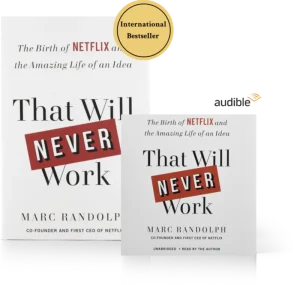
That Will Never Work became more than Marc Randolph’s memoir. It became a case study in how world-changing companies are often dismissed long before they are understood.
The title of Randolph’s internationally bestselling memoir, That Will Never Work: The Birth of Netflix and the Amazing Life of an Idea, is drawn from something he heard constantly in the early years. Investors passed. Partners doubted. When Netflix approached Blockbuster with an acquisition proposal (asking $50 million for the company), Blockbuster’s executives reportedly laughed them out of the room. That same company, which could have bought Netflix for $50 million, later filed for bankruptcy. Netflix’s current market capitalization exceeds $400 billion.
Randolph does not tell this story to gloat. He tells it because it illustrates something organizations at every stage face: the pressure to abandon unconventional bets under social pressure. The people who told him it would never work weren’t fools. They were operating from entirely rational assumptions. What Randolph developed over four decades of founding and advising companies was a method for distinguishing between the ideas that are genuinely bad and the ones that are simply unfamiliar.
The book, available on Amazon, has since become a standard text in entrepreneurship programs and a top-10 Apple podcast of the same name, where Randolph continues mentoring founders in real time.
Why Aurum Recommends Marc Randolph for Your Event

Marc Randolph’s keynotes resonate because they replace startup mythology with something far more valuable: a practical framework for innovation, risk, and better decision-making under pressure.
Randolph’s keynote portfolio covers five distinct formats: the Netflix founding narrative, a stand-alone session on where great ideas come from, the culture-and-trust keynote, the Blockbuster disruption story, and a corporate innovation keynote built specifically for established companies that need to think like startups again.
His audiences span business speakers programming at Fortune 500 annual conferences, founder-focused entrepreneurship summits, and senior leadership off-sites where the goal is a genuine shift in how a team approaches risk. From our work placing Marc with corporate clients, the sessions that consistently earn the highest feedback scores are those where the audience includes senior leaders who know the Netflix story well but have never heard it told from the founding CEO’s perspective. That gap between what they thought they knew and what actually happened is where the keynote does its best work.
He works globally, adapts content for specific industries, and is equally effective in fireside chat and traditional keynote formats. For events that need a speaker who works for both executives and founders in the same room, he is one of very few who can do that without adjusting the substance.
For more on how we think about the top voices in this space, see our full list of top entrepreneurship speakers.
FAQ
Why should organizations book Marc Randolph as a keynote speaker?
Marc Randolph offers something most keynote speakers cannot: a first-person account of building one of the most studied companies in business history, delivered without the polish that usually sanitizes the hard parts. His sessions are grounded in specific decisions (what was tested, what failed, what held) rather than general principles. Organizations that bring him in consistently report that audiences leave with a different orientation toward risk and experimentation. To explore availability and fees, contact Aurum Speakers Bureau and our team will respond within 24 hours.
What keynote topics does Marc Randolph cover?
Randolph’s core keynote topics include the Netflix founding story and startup lessons, the role of testing and experimentation in innovation, how Netflix’s corporate culture was built under pressure, where great ideas come from and how to validate them, and how established companies can recover a startup mindset. He also delivers a fireside chat format and a keynote specifically on how a small startup took down Blockbuster.
Is Marc Randolph the right speaker for a corporate audience, or only for startups?
His keynotes are designed to work across both. The founding story of Netflix is as relevant for a team inside a large organization trying to justify an unconventional bet as it is for an early-stage founder. Randolph draws this connection explicitly: his “How to Make Your Company Think Like a Startup” keynote is built specifically for established organizations, not founding teams.
What is the That Will Never Work book about?
That Will Never Work is Randolph’s memoir covering the first years of Netflix, from the original idea through the near-failures, the Blockbuster meeting, and the eventual IPO. The Wall Street Journal called it “engaging and insightful.” It has been updated with a new afterword and remains one of the most cited entrepreneurship books in business school programs. It is distinct from the podcast of the same name, in which Randolph mentors early-stage entrepreneurs in real-time conversations.
Marc Randolph is represented by Aurum Speakers Bureau for keynote engagements worldwide. To discuss availability and format options for your event, reach out to our team directly.