
In 1999, a business school student pitched an idea that professors at MIT and Stanford dismissed as impossible: a way to identify any song playing anywhere, instantly, using nothing but a mobile phone. There were no smartphones, no app stores, and no algorithm capable of pulling a single track out of a noisy room. The idea should have died in a lecture hall. Instead it became Shazam, downloaded more than two billion times and, eventually, Apple’s sixth-largest acquisition.
The person behind that idea, keynote speaker Chris Barton, has spent the years since turning that experience into something organizations can actually use. He calls it Start from Zero: a way of thinking that treats innovation less as a flash of inspiration and more as a discipline anyone can learn.
Why Start from Zero Is Different from Most Innovation Advice
 Most innovation talks tell audiences to be bold and to embrace failure. Barton’s premise is sharper. He argues that the brain is wired by habit and social pressure to defend whatever already exists, and that genuine breakthroughs require deliberately clearing those assumptions before building anything at all.
Start from Zero is his name for that reset, a set of counterintuitive thinking methods for questioning the things everyone else treats as fixed. The point is not to chase novelty for its own sake. It is to notice the constraint that the rest of the field has quietly accepted as permanent, and then to ask what becomes possible if it isn’t. That is exactly the move that produced Shazam. Six other companies were trying to identify songs by monitoring radio broadcasts. Barton asked a different question entirely: what if the phone itself could recognize the music in the room?
For organizations facing problems that look unsolvable, the value is in the method, not the anecdote. Barton gives teams a repeatable way to interrogate their own assumptions, which is why his sessions resonate with audiences booking innovation speakers for cultures that have grown comfortable.
Shazam and the Birth of Consumer AI
Shazam was the first mass-consumer artificial intelligence product in history, and it arrived two decades before the current wave. Founded out of UC Berkeley’s Haas School of Business, where Barton had his original idea during a strategic innovation course, the company built a search-engine supercomputer and the world’s largest music database from scratch. According to the Berkeley Haas account of the company’s origins, the early concept was nearly unrecognizable from the product that eventually shipped.
The path was anything but smooth. Shazam teetered near bankruptcy for roughly six years, waiting for the rest of the technology landscape to catch up. The App Store’s launch in 2008 finally gave it a way to reach people at scale, and the trajectory changed. In 2018, Apple completed its acquisition of Shazam, folding the technology into Siri and Apple Music. Barton belongs to a small group of founders who actually shipped the AI the rest of us now take for granted, a cohort worth knowing if you are weighing keynote voices who built the technology rather than narrating it.
That history matters now more than it did even a few years ago. Audiences spent the last stretch treating AI as something brand new. Barton’s story reframes it: pattern recognition at consumer scale is something he shipped before most of the room owned a smartphone, and the lessons about building under deep uncertainty translate directly to teams deploying AI today.
Guard: The Same Method, Higher Stakes
Shazam was not a one-time stroke of luck, and Barton’s current company is the proof. His third startup, Guard, applies artificial intelligence to a problem that has resisted technology for decades: detecting drowning in swimming pools before it becomes fatal. Drowning is fast and often silent, especially with young children, who tend to slip under without the splashing or shouting bystanders expect. Catching it reliably means building a system that can recognize the subtle, ambiguous signals even attentive people miss.
It is the same instinct that produced Shazam, now aimed at something with life-or-death consequences rather than a song title. Barton has described the effort as something never accomplished before, which places it squarely in Start from Zero territory: a risk most people accept as the unavoidable price of owning a pool, reframed as a constraint that might not be permanent after all. For audiences, Guard turns the framework from a war story into a live demonstration. The methods he teaches are the ones he is using right now, which makes the keynote feel less like a retrospective and more like a working session with someone still in the arena. It is also why he sits comfortably among AI keynote speakers who have built rather than forecasted.
What Audiences Actually Take Away
Barton’s keynotes pair the Shazam narrative with a quieter, more personal thread. He has spoken openly about growing up with undiagnosed dyslexia, which he now describes as an advantage rather than an obstacle, crediting it with pushing him toward novel solutions when conventional paths failed. That framing gives his sessions emotional range, not just a tidy business case.
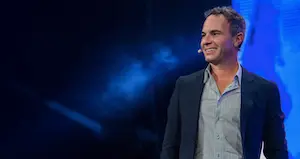
Chris Barton shares insights on innovation, entrepreneurship, and the creation of Shazam during a live keynote appearance.
The recurring theme is what he calls creative persistence: the recognition that a strong idea is worthless without the tenacity to survive years of rejection, and that disruption demands both invention and stubbornness. It is a message that travels well beyond the technology sector, which is why his work appeals to organizers building lineups of entrepreneurship speakers and innovation voices alike. If you are assembling a program around creativity and growth, he sits naturally alongside our roundup of top innovation keynote speakers.
For event organizers, the practical fit is broad: innovation summits, leadership offsites, sales kickoffs, and transformation programs. He is also a strong anchor for founder-focused agendas, the kind featured in our guide to the best entrepreneurship speakers, where the goal is to shift how a team thinks before asking it to change what it does.
Frequently Asked Questions
Why should organizations book Chris Barton for a keynote?
Few speakers can claim to have built a category that did not exist and watched it become one of the most recognized apps on earth. Barton offers that rare combination of a genuinely cinematic story and a transferable method, which means audiences leave inspired and equipped. To check availability and fit for your event, reach out to Aurum Speakers Bureau and one of our agents will walk you through options.
What is Chris Barton’s Start from Zero method?
It is his framework for breakthrough thinking, built around deliberately discarding inherited assumptions before attempting to solve a problem. Rather than optimizing within existing constraints, the method trains teams to identify which constraints are actually optional, then to build from that cleared starting point.
Is Chris Barton still building companies?
Yes. After Shazam, and roles in the early days of Google and Dropbox, his current venture is Guard, which uses AI to detect drowning in swimming pools. He continues to hold a dozen patents across his work and remains active as both a founder and an investor.
What types of events suit an innovation keynote like this?
His sessions work best where leadership wants to reset how people approach problems: innovation and technology conferences, executive offsites, and transformation or culture initiatives. The message scales from technical audiences to general business crowds because the framework is about thinking, not coding.