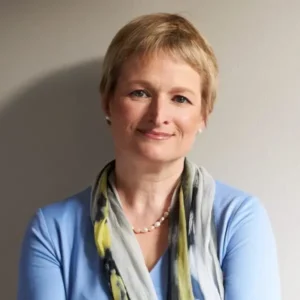
Rita McGrath, strategist, Columbia Business School.
A capital committee faces two proposals:
One is a multibillion-dollar plant for painkillers and other consumer health products, with stable demand and predictable margins.
The other is a bet on a cancer therapy that looks nothing like the company’s usual science.
The plant looks like the safe choice.
The Rita McGrath strategic centering framework starts from a question many companies have never answered: what single idea defines us?
McGrath is a Columbia Business School professor, the founder of Valize, and one of the world’s top ten management thinkers according to Thinkers50.
She is one of the business strategy speakers available through Aurum Speakers Bureau.
This guide walks through the idea from her Harvard Business Review article The Power of Strategic Centering (July–August 2026), including the five centers from which a company can choose.
What the Novartis case shows
When Vas Narasimhan became CEO of Novartis in 2018, he centered the company on innovative medicines in specific disease areas. That made the radioligand investment look like a natural extension of the strategy, a bet the company already knew how to judge. Novartis acquired two pioneering companies in the field and divested its consumer healthcare business.
In McGrath’s account, the separate companies that resulted (Novartis, Alcon, Sandoz, and Haleon, which now includes the former Novartis consumer unit) are together worth about twice what Novartis was worth in 2018.
She calls the principle behind that decision strategic centering: deliberately choosing an organizing principle that gives a strategy clarity and coherence when the traditional anchors (defensible positions, stable industries, long-lived physical assets) lose their power.
A center guides where resources go, which opportunities to pursue, and what to set aside.
McGrath separates it from purpose, vision, and core competence, and her keynote spends time on exactly that distinction.
A center gives a company three things:
- a defined range of opportunities
- an end to capital allocation standoffs, and
- what McGrath calls permissionless action, where people who share the center act without waiting for approval from above.
Here is McGrath making the case against stability for Big Think:
Five centers, five questions
McGrath’s research identifies five types of centering. Each starts with a question and carries a signature danger. The organizations with the clearest strategy usually have one dominant center and the discipline to subordinate everything else to it.
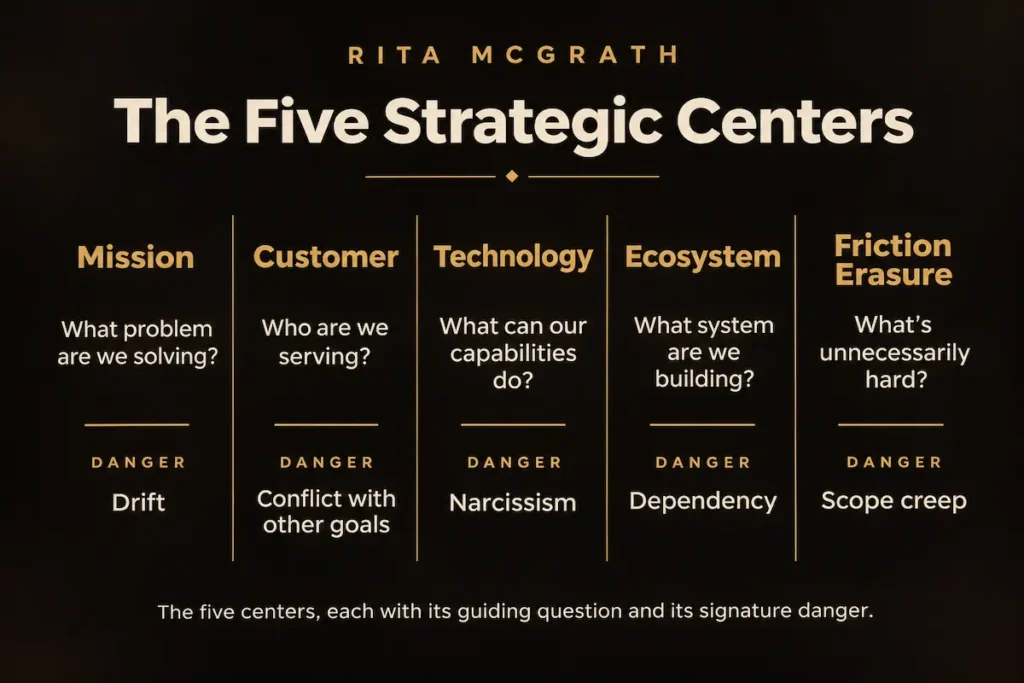
The five centers, each with its guiding question and its signature danger.
Mission: what problem are we solving?
A mission-centered company follows a problem wherever it leads, whatever the technology or customer. Novartis is her lead example. Shopify is another: its mission of making commerce better for everyone carried it from online storefronts into payments, shipping, point-of-sale systems, and business financing, a portfolio that looks incoherent through an industry lens and coherent through a mission lens.
The danger is mission drift, broadening the mission until it means everything.
Customer: who are we serving?
A customer-centered company follows its customers’ evolving needs across industry lines. Amazon moved from books to cloud computing, streaming, grocery, and healthcare on that logic. Airbnb offers a story of recentering: after drifting toward becoming a platform for hosts and institutional operators, Brian Chesky pulled the company back to the guest experience.
The danger is that serving customers can collide with other corporate goals, and drift is the warning sign.
Technology: what can our capabilities do?
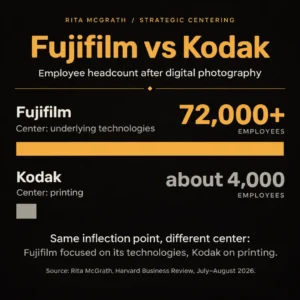
Same inflection point, different center: Fujifilm focused on its technologies, Kodak on printing.
A technology-centered company builds deep capabilities and then looks for applications in any domain.
McGrath’s sharpest contrast is Fujifilm and Kodak. Both faced digital photography. Kodak’s CEO focused on printing, and in her telling the company is now a small B2B player of about 4,000 people. Fujifilm focused on the underlying technologies (chemical compounds, precision coating, optical films, imaging science) and moved into cosmetics, medical imaging, pharmaceutical manufacturing, and materials for LCD screens, and today has more than 72,000 employees. Nvidia followed the same logic from gaming graphics to the backbone of AI.
The danger is technological narcissism, falling so in love with a capability that the company misses the moment it becomes obsolete.
Ecosystem: what system are we building?
An ecosystem-centered company ties its strategy to the productive capability of a region or nation.
TSMC treated Taiwan’s semiconductor capability as its center, which supported fabrication plants costing more than $20 billion each. Samsung’s history is intertwined with South Korea’s development goals in the same way.
The danger is dependency: such companies can become instruments of state policy, and Huawei’s revenue fell 29% from 2020 to 2021 after the US-led clean network initiative.
Friction erasure: what is unnecessarily hard?
A friction-erasure company organizes itself around removing difficulty.
The Korean fintech Toss was founded by S.G. Lee, a dentist by training, who asked why moving money was so hard. That question carried Toss from payments to banking, insurance, investing, stock trading, and media without losing coherence, and its structure relies on “directly responsible individuals” rather than reporting lines.
DBS in Singapore took a similar path from a sleepy institution to what McGrath calls the world’s best digital bank.
The danger is scope creep, since everything can look like friction.
Which center fits your industry?
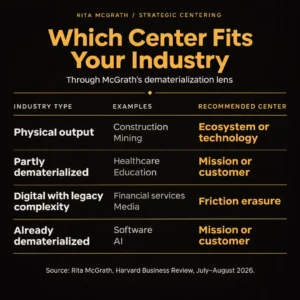
Which center fits which industry, through McGrath’s dematerialization lens.
McGrath links the choice to how far an industry has dematerialized, meaning how much of its value has moved from physical assets to data, software, and capabilities.
Physical output, such as construction and mining: ecosystem or technology centering may fit best.
Partly dematerialized, such as healthcare and education: mission or customer centering usually guides the transition well.
Digital value with legacy complexity, such as financial services and media: friction erasure is frequently the strongest choice.
Already dematerialized, such as software and AI: mission or customer centering, because technology alone no longer differentiates when everyone has the same tools.
What the leader does once the center is set
McGrath expected the leaders of centered organizations to be servant leaders who hire well and step aside. Her research found something different. They are visible, engaged, and present.
Narasimhan records multiple videos a day and travels widely to Novartis facilities. Jensen Huang of Nvidia reads employee emails every Sunday and put whiteboards in every meeting space. Chesky went back to reviewing product designs he had once delegated.
She does not call this micromanaging. These leaders maintain the center: they sense weak signals, give direction without dictating methods, and keep the center concrete in daily decisions. That also lowers the payoff from office politics, because people orient to the center instead of the hierarchy.
It connects to a second McGrath keynote, on the permissionless organization. In her words, centering is the prerequisite: removing hierarchy produces confusion without a clear center, and speed with one.
To check Rita McGrath’s availability for your event, contact Aurum Speakers Bureau and one of our founders will respond within 24 hours.
Try this in your next leadership meeting
Pick a pending investment and run it through three questions drawn from McGrath’s framework:
Which of the five centers describes our strategy today?
Name it, and ask whether it is the one you would choose.
What would the center say about this proposal?
A clear center tends to make the answer obvious, as it did in the painkiller and radioligand debate.
What are we ready to set aside?
A center only works if it costs something.
The Rita McGrath strategic centering keynote
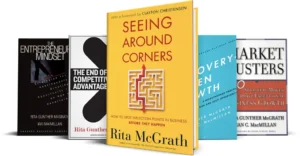
Rita McGrath’s books: The Entrepreneurial Mindset, The End of Competitive Advantage, Seeing Around Corners, Discovery-Driven Growth, and MarketBusters.
McGrath’s keynote, Strategic Centering: The Antidote to Constant Disruption, is based on her Harvard Business Review article and her forthcoming book. She shows why every organization needs one coherent organizing principle, how centering differs from purpose, vision, and core competence, and how a well-chosen center lets companies move into new technologies and markets without losing coherence. Audiences leave knowing how to identify their own center, use it to make tough decisions feel obvious, and give people the clarity to act fast without waiting for permission.
Her other sessions cover the permissionless organization, AI and the new rules of competition, competing on transient advantage, spotting inflection points before rivals do, and building an innovation engine that works. They draw on her five books, shown below, and a new book on strategic centering is forthcoming.
The best known are The End of Competitive Advantage, which challenged the idea of lasting advantage, Discovery-Driven Growth, which Clayton Christensen cited as one of the most important management ideas ever developed, and Seeing Around Corners, her guide to spotting inflection points early.
The companies that move fastest are usually the ones that know their center, and Rita McGrath shows leaders how to find it.
Rita McGrath is also available for virtual keynotes and webinars as well as in-person sessions, and you can find more options among our virtual keynote speakers.
Every topic is listed on her Rita McGrath speaker profile. For another strategy voice, see our profile of Renée Mauborgne on Blue Ocean Strategy.
Booking Rita McGrath
Her fee depends on the event date, format, duration, and preparation required. To receive a quote, contact Aurum Speakers Bureau and one of our founders will respond within 24 hours. Yet, want to hear the best part? Thanks to our commercial agreements with the speakers with whom we work, booking through Aurum Speakers Bureau involves no additional cost to you. We earn a commission directly from the speakers for promoting and managing their engagements. Our goal is to simplify your life and help organize your event without extra fees or complications. Contact us to learn more.