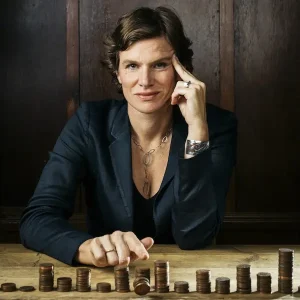
Mariana Mazzucato, one of the world’s most influential economists, has spent her career rethinking who really drives innovation and creates value.
Ask most people what drives innovation and they will point to the private sector: the garage startup, the visionary founder, the venture capital. Mariana Mazzucato has spent her career arguing that this story is, at best, half true. One of the most influential economists of her generation, she makes the case that the boldest innovations of the modern era, from the technologies inside the smartphone to the foundations of the internet, were funded and shaped by the state taking risks the market would not. For leaders trying to solve hard problems, her reframing of who actually creates value is genuinely disruptive.
Mazzucato is not offering comfort to any side of the usual political debate. She challenges the private sector to acknowledge the public investment it stands on, and she challenges governments to be far more ambitious about the value they create. That willingness to unsettle everyone in the room is exactly what makes her one of the most sought-after economic voices on the stage today.
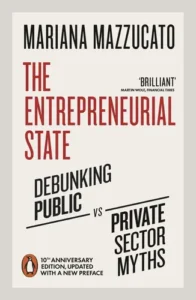
In The Entrepreneurial State, Mazzucato marshals the evidence that public investment, not just private enterprise, sits behind the era’s defining technologies, from the internet to the components of the smartphone.
The entrepreneurial state
Mazzucato’s breakthrough idea, laid out in The Entrepreneurial State: Debunking Public vs. Private Sector Myths, dismantled the notion that governments merely fix markets while the private sector innovates. She showed that the state has often been the risk-taking investor of first resort, funding the early, uncertain research that private capital avoids until the path is clear. It is a case grounded in evidence rather than ideology, and it has reshaped how policymakers around the world talk about the role of public investment. As Professor in the Economics of Innovation and Public Value at University College London, where she founded the Institute for Innovation and Public Purpose, she has turned that argument into a global research and policy agenda.
A mission economy
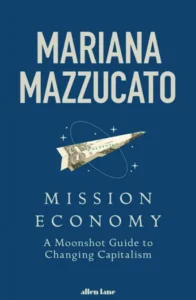
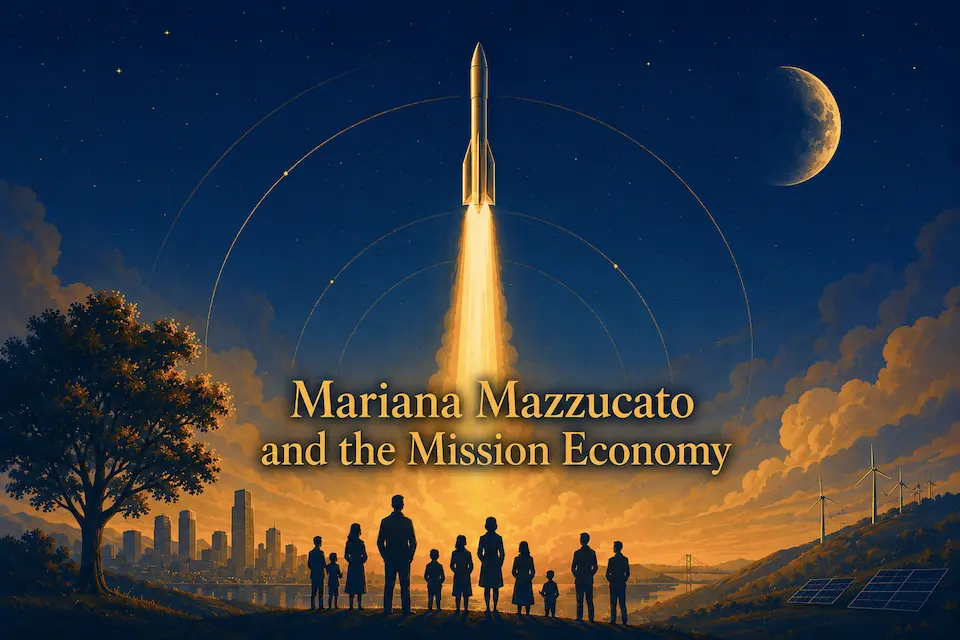
In Mission Economy, Mazzucato takes the moon landing as her model: proof that when government sets a bold objective and aligns public and private effort behind it, seemingly impossible problems become solvable.
If the entrepreneurial state is her diagnosis, the mission economy is her prescription. In Mission Economy, Mazzucato argues that we should tackle our biggest challenges, climate change, public health, inequality, the way the United States approached the goal of putting a person on the moon: as clearly defined missions that align public and private effort behind a shared objective. Rather than governments passively funding and getting out of the way, she calls for them to shape markets, set the direction, and organize innovation around outcomes that matter. It is an idea that resonates well beyond economics, which is why she is a compelling voice for leaders across innovation and sustainability programs alike.
The common good economy
Mazzucato’s most recent work extends that thinking into a fuller framework. In The Common Good Economy: A New Compass, published in 2026 after three years of writing, she argues that economics has too long treated “the good,” whether public goods or the commons, as a matter of patching up market and government failures at the edges. That reactive framing, she contends, traps us in a cycle of fixing problems rather than proactively building the economy we actually need. Her alternative is to organize economic life around the common good as an operating framework rather than a slogan, built on principles of reciprocity rather than extraction and collective action rather than individualism.
The book offers what she calls a “common good compass,” a practical set of elements, purpose and direction, participation and co-creation, shared knowledge, access and reward-sharing, and transparency, meant to hold anyone who talks about “missions” and “purpose” accountable for what they actually deliver for people and the planet. Drawing on real-world examples from the governance of water to the redesign of public procurement and finance, it is the natural next step in a body of work that has run from the entrepreneurial state through the mission economy. For an audience, it gives her keynotes a current, forward-looking spine and a concrete argument leaders can apply to their own organizations.
Taking on the consulting industry
Mazzucato is also willing to name names, and her 2023 book The Big Con, written with Rosie Collington, did exactly that. Its argument is pointed: economies have become dangerously dependent on the big consulting firms, from McKinsey, Boston Consulting Group, and Bain to the Big Four of Deloitte, PwC, EY, and KPMG, and that dependence comes at a steep cost. The “big con,” in her telling, is a confidence trick. Consultancies, she argues, often know less than they claim, cost more than they appear to, and, over time, hollow out the in-house capacity of the governments and companies that hire them, leaving clients less able to solve their own problems.

Mazzucato built her reputation on evidence, and she brings the same rigor to the stage, telling audiences not what flatters them but what the research actually shows.
It was a deliberately provocative book, and it landed that way, drawing both critical acclaim and pushback from an industry unaccustomed to that kind of scrutiny. For corporate audiences, its value is not the controversy but the challenge beneath it: a hard question about which capabilities an organization should build and keep rather than outsource. That same challenge runs through our roundup of the top economics keynote speakers, where rigor tends to matter more than reputation. It is a large part of why Mazzucato commands attention: she does not tell audiences what is comfortable, she tells them what she has found in the evidence.
Why audiences book her

Equally credible in a finance ministry or a boardroom, Mazzucato gives audiences a genuinely new lens on value, risk, and ambition.
What makes Mazzucato valuable on a stage is not that she has a single message to sell, but that she equips an audience to think differently about value, risk, and the role of ambition in solving big problems. She speaks to policymakers, corporate leaders, and investors alike, and she is as credible in a finance ministry as in a boardroom. For event planners building a theme, she pairs naturally with the voices in our top sustainability keynote speakers and top innovation keynote speakers roundups, though her real value is the way she cuts across both. Her advisory roles, from chairing the World Health Organization’s Council on the Economics of Health for All to co-chairing the Global Commission on the Economics of Water, mean she brings frontline experience of putting these ideas to work, not just theorizing about them. For any organization grappling with innovation, purpose, or long-term strategy, she offers a rare thing: a genuinely new lens.
Frequently asked questions
Why should organizations book Mariana Mazzucato?
Because she reframes the questions leaders think they have already answered, about where innovation comes from, who creates value, and how ambitious an organization should be. She is one of the most influential economists in the world, and she translates that authority into ideas leaders can act on. To check her availability and fit for your event, contact Aurum Speakers Bureau and we will gladly walk you through options.
What does Mariana Mazzucato speak about?
Her keynotes cover mission-driven innovation, the entrepreneurial state, the common good economy, the future of capitalism, sustainability and the green transition, and the relationship between public investment and private value. She tailors the focus to the audience, from policy and finance to corporate strategy.
What is Mariana Mazzucato best known for?
She is best known for The Entrepreneurial State and Mission Economy, and for reshaping how policymakers understand the role of public investment in innovation. Her more recent books, The Big Con and The Common Good Economy, have extended her influence into debates on consulting and the future of economic policy.
What types of events suit a speaker like Mariana Mazzucato?
She is a strong fit for innovation summits, economic and policy forums, sustainability and future-of-capitalism events, finance and investment conferences, and leadership programs that want a rigorous, provocative perspective on value and long-term strategy.
To explore whether Mariana Mazzucato is right for your next event, reach out to Aurum Speakers Bureau to discuss availability and goals. We look forward to connecting with you.