
The keynote introduction is the smallest moment in an event program with the largest consequences. Ninety seconds, give or take, and the room has already decided how much attention it is going to give the person about to speak. A strong introduction creates a current of anticipation. A weak one forces the speaker to spend the first ten minutes of their talk rebuilding credibility the introduction should have established for them.
Most introductions are weak. Not because the person delivering them lacks goodwill, but because they are prepared last minute, written from a LinkedIn bio, and delivered by someone who underestimates what the moment requires.
What a Keynote Introduction Is Actually Supposed to Do
The job of an introduction is not to summarize the speaker’s career. That information is already in the program, on the event app, and on the speaker’s profile page. Reading it back to an audience that can access it themselves is not an introduction. It is a delay.
The job of an introduction is to answer three questions for the audience before the speaker opens their mouth. Why this topic, right now, for this room? Why is this person the right voice on it? And what should the audience be ready to receive?
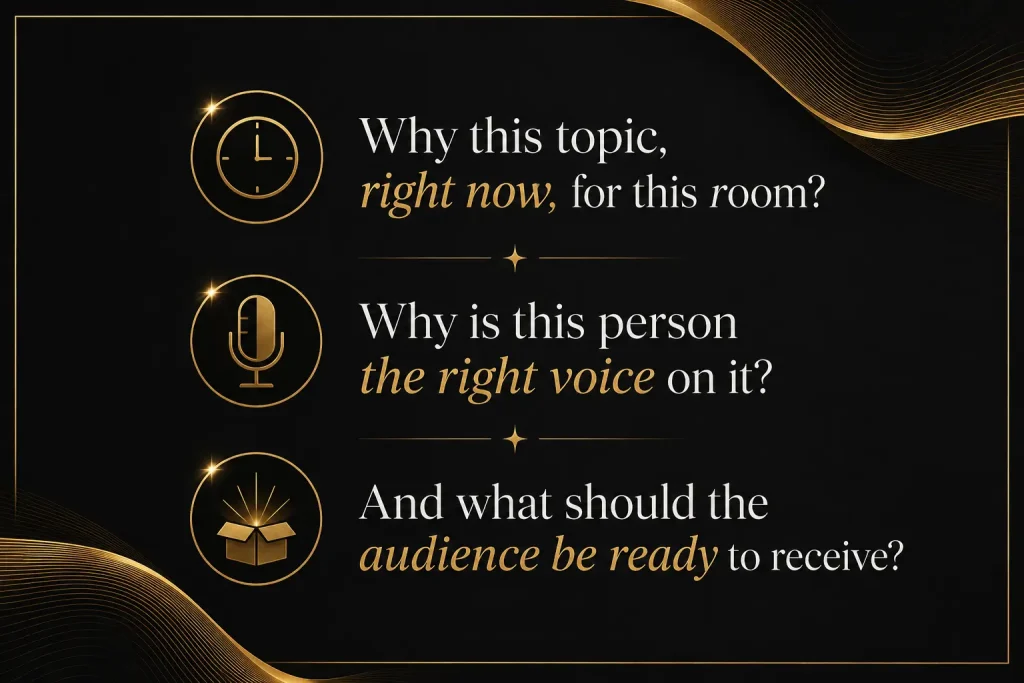
Those three questions, answered well in under two minutes, create the conditions for a keynote to land. The speaker arrives to a room that is already oriented, already curious, already open. That is the difference a good introduction makes. It is not decoration. It is preparation.
What to Include, and What to Leave Out
Include the connection between the speaker’s expertise and the audience’s specific situation. Not a generic statement of credentials, but a sentence that makes the room feel seen. “You have spent the last two years navigating what this speaker has spent twenty years studying” lands differently than “our next speaker has twenty years of experience.”
Include one credential that establishes genuine authority without reciting the full biography. The most powerful credential is the one most relevant to the moment. For an innovation speaker addressing a company facing disruption, the relevant credential is not the speaker’s bestseller or their TED talk; it is the specific experience that qualifies them to speak to this room’s problem.
Here is a brief introduction of a Nobel Prize winner in Physics as a sample:
What else to include?
Include a clear signal of what the audience is about to experience. Not a spoiler, but an orientation. “Over the next 45 minutes, you are going to hear a framework that will change how you think about X” is more useful than “please welcome our keynote speaker.”
Leave out the full career chronology. Pick one thread, not the whole tapestry. Leave out credentials that impress in general but do not connect to this audience or this topic. Leave out personal anecdotes about how much you personally admire the speaker, which shifts attention from the room to the introducer. And leave out anything the speaker has asked you not to mention. That conversation should happen in advance.
How to Get the Right Information
Every speaker who works through a professional bureau has a prepared introduction. Ask for it. Most speakers have refined their introduction across dozens of engagements and know which credentials land with which audiences. That document is the starting point, not the finish line.
The finish line is an introduction tailored to this event and this audience. Take the speaker’s prepared introduction, identify the one or two credentials most relevant to the room, and reframe them in the context of what your organization is navigating. If you are not sure how to make that connection, the content call that happens before the event (the structured briefing session between the client and the speaker, coordinated through Aurum) is the right moment to ask the speaker directly: what do you want this audience to understand about your background before you begin?
Some speakers already have a well-prepared introduction and/or a short video for it. Sometimes this visual element is very helpful or impactful. Some clients also create their own short video with a voiceover, which also works very well for setting the stage.
Definitely confirm the pronunciation of the speaker’s name before the day of the event, for example. This sounds elementary because it is, and it is still wrong with surprising regularity. A mispronounced name in the first sentence of an introduction is a small error with a disproportionate effect on the room’s first impression.
Length, Delivery, and the Handoff
A keynote introduction should run between 60 and 90 seconds when delivered at a natural pace. That is roughly 150 to 200 words on the page. Anything longer begins to work against itself: the room’s patience shortens and the speaker inherits a slightly depleted audience before they have said a word.
Delivery matters as much as content. Read the introduction once, then put it down and practice delivering it. The difference between someone reading from a page and someone speaking from genuine familiarity with the material is visible from the back row. The introducer’s energy is contagious in both directions.
The handoff is the final element. End with the speaker’s name, begin clapping immediately, and step to the side to welcome them to the stage. Do not hover at the podium. Do not offer a handshake that requires the speaker to cross the full stage to reach you. Step aside cleanly, and let the speaker own the space from their first step onto it.
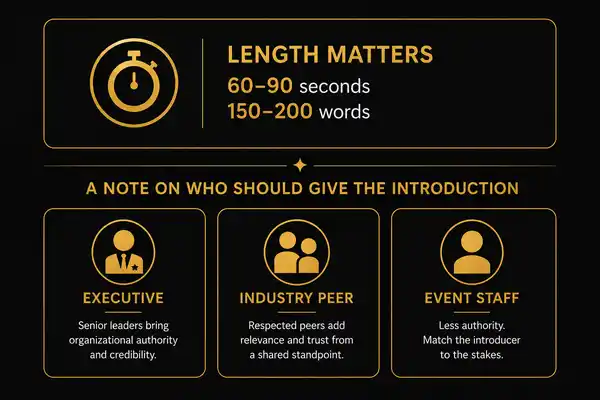
A Note on Who Should Give the Introduction
The person introducing the speaker should have enough credibility with the audience to lend weight to the endorsement. A CEO introducing a speaker on organizational culture carries different authority than an event coordinator doing the same, and a respected peer from the audience’s own industry carries different authority again. Match the introducer to the stakes of the moment.
When the event is large and the keynote is the centerpiece, it is worth assigning the introduction as deliberately as any other element of the program. Working with a speakers bureau through the full booking process means you have a partner who can advise on this as part of the overall event preparation, not an afterthought assembled in the green room.
Contact Aurum Speakers Bureau to discuss how we support the full event experience, from speaker selection through the moment they step off the stage.
Frequently Asked Questions
How long should a keynote speaker introduction be?
Between 60 and 90 seconds when delivered aloud, which corresponds to roughly 150 to 200 words on the page. Shorter than that risks feeling perfunctory; longer begins to drain the audience’s attention before the speaker has started. The goal is to create anticipation, not to satisfy curiosity. If the introduction answers every question the audience has about the speaker, there is nothing left for the speaker to reveal.
Should I use the speaker’s own prepared introduction or write my own?
Start with the speaker’s prepared introduction as your source material, then adapt it for your specific audience and event context. Most professional speakers have a prepared introduction that has been refined over many engagements. It is a strong foundation. What it will not do, by definition, is connect the speaker’s expertise to your organization’s specific moment. That connection is your contribution, and it is what transforms a competent introduction into a genuinely effective one.
What are the most common mistakes in keynote introductions?
Reading a LinkedIn bio verbatim. Running too long. Mispronouncing the speaker’s name. Including personal admiration that centers the introducer rather than the speaker. Starting to clap too late after the speaker’s name, which creates an awkward pause. And failing to rehearse, which makes even well-written material feel uncertain in delivery. Every one of these is avoidable with fifteen minutes of preparation before the event.
How do I find out what the speaker wants included in their introduction?
Ask them directly, or ask through the bureau handling the booking. Most speakers will provide a prepared introduction and are willing to discuss which elements they would most like emphasized for a particular audience. The content call that precedes the event is the natural moment for this conversation. If you are working through Aurum, we facilitate that call and can ensure the introduction question is addressed as part of the standard pre-event preparation.