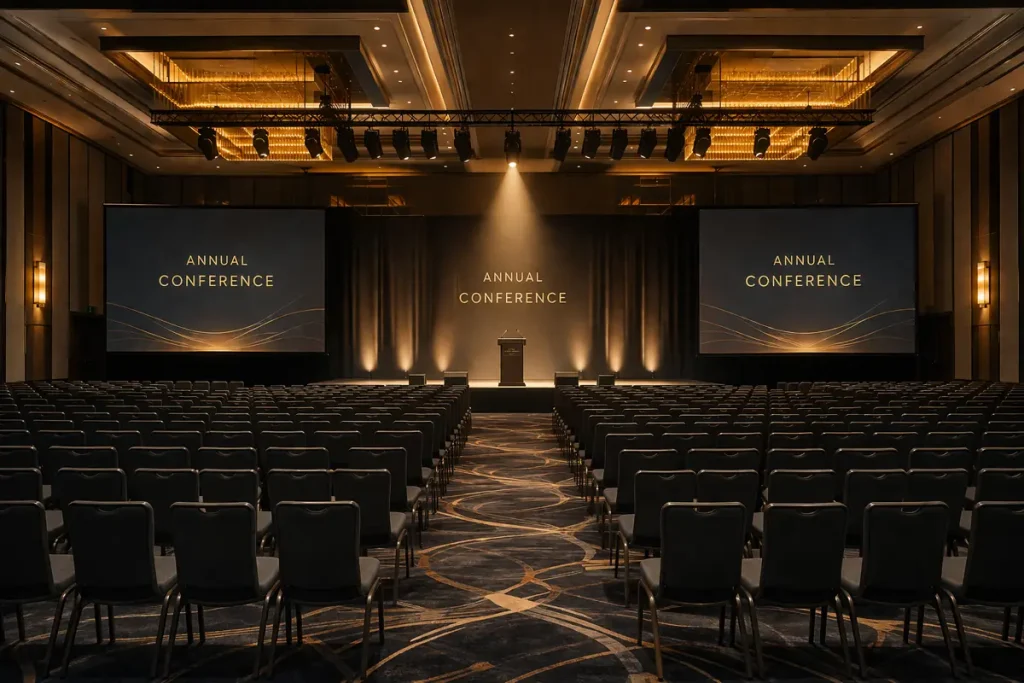
Most annual conferences are remembered by one thing: the keynote. Not the breakouts, not the networking lunch, not the panel discussions – the keynote. It sets the tone, signals what the organization values, and gives attendees something to carry back to their teams. Get it right, and the rest of the event rises with it. Get it wrong, and nothing else can make up for it.
Planning that keynote well is not complicated – but it requires more deliberate thought than most event teams give it, and it requires starting earlier than most event teams expect.
Start the Process Earlier Than You Think
 The single most common mistake in conference keynote planning is underestimating the lead time required. Top-tier keynote speakers – the ones who command a room and leave audiences with something genuinely useful – are in high demand. Many are booked six to twelve months in advance, especially for prime conference season dates in autumn and spring.
Working within these windows is standard practice across the industry – Meeting Professionals International, the largest association for event professionals worldwide, consistently points to early speaker sourcing as one of the highest-leverage decisions in conference planning.
A realistic planning timeline looks like this:
- Nine to twelve months out: Define the theme and message objectives for the event. What do you want attendees to think, feel, or do differently after the keynote? This strategic question must be answered before you start looking at names.
- Six to nine months out: Research and shortlist potential speakers. Brief your speakers bureau. Confirm availability and hold dates.
- Four to six months out: Contract signed, logistics confirmed, speaker briefing delivered.
- Six to eight weeks out: Final audience and context briefing sent to the speaker. Run-of-show aligned.
- One to two weeks out: Tech rehearsal, A/V requirements confirmed, final check-in with the speaker’s team.
If you are beginning this process with fewer than four months to go, your options will narrow considerably. It is still possible to secure a strong speaker on shorter notice – but the shortlist shrinks, and the negotiating position weakens. Working with keynote speakers through a bureau gives you access to pre-qualified availability information and saves significant sourcing time.
Define the Message Before Choosing the Speaker
This is where most planning goes wrong. Teams identify a speaker they admire, then try to reverse-engineer a theme to justify the booking. The result is a keynote that feels disconnected from the event’s actual goals.
 The sequence should always be:
- What is the one idea we want this audience to leave with?
- What kind of speaker can deliver that idea credibly and compellingly?
- Who, specifically, can do that?
An annual conference for a financial services firm exploring digital transformation calls for a fundamentally different speaker than the same topic addressed at an HR summit or a startup ecosystem event. The audience’s sophistication level, their familiarity with the subject, and their appetite for challenge all shape the right choice.
Once you have a clear message objective, you can brief candidates meaningfully – and evaluate proposals against something concrete rather than gut feeling.
The Speaker Briefing: What to Include and Why It Matters
A great speaker will research your audience independently. A brief does not replace that research – it accelerates and focuses it. If you want to get the most out of this step, our guide to writing an event brief covers exactly what to include. Yet, for now, also, the most effective briefings cover five elements:
Audience profile. Seniority, function, industry tenure, geographic mix, and any relevant prior context from the organization. If this audience heard three keynotes on AI last year, your speaker should know that.
Event theme and adjacent content. What has the event been about in prior years? What panels or workshops precede the keynote? A speaker who echoes the morning session unintentionally looks underprepared. One who deliberately builds on it looks masterful.
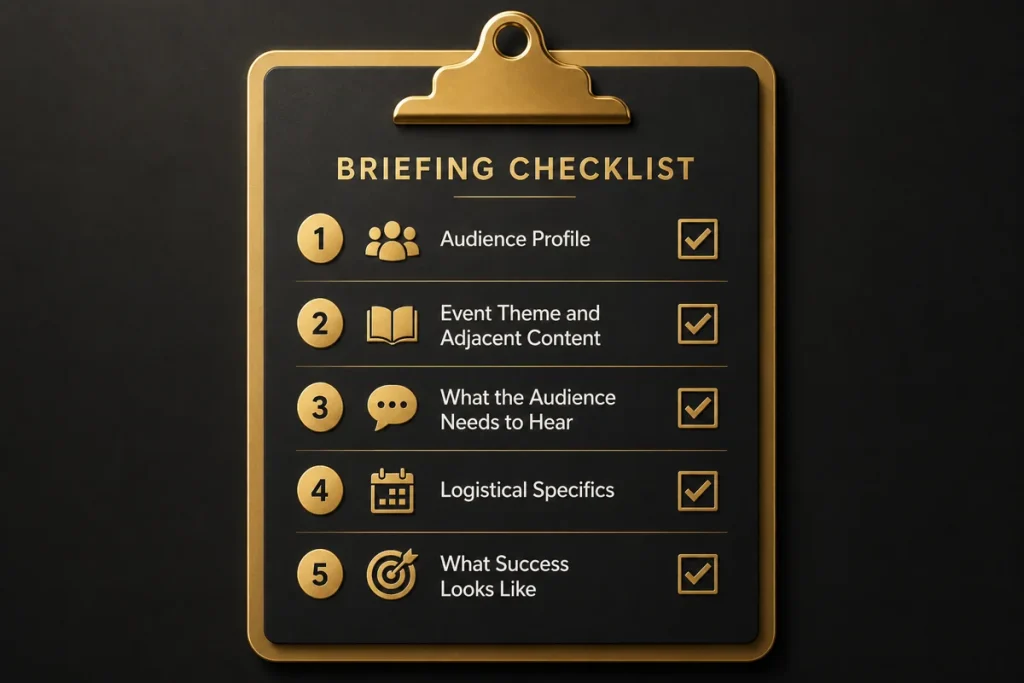
What the audience needs to hear (not just what they want to hear). The most valuable keynote speakers are not there to validate – they are there to shift perspective. Share any organizational tensions or strategic challenges honestly. Speakers who understand the real stakes deliver sharper content.
Logistical specifics. Session length, room layout, whether Q&A is expected, any protocol around slides or pre-recorded video, and whether the keynote is opening or closing the event (these call for very different energy and structure).
What success looks like. Give the speaker a definition of the outcome you are aiming for. This gives them something to calibrate against – and gives you a meaningful way to evaluate the result.
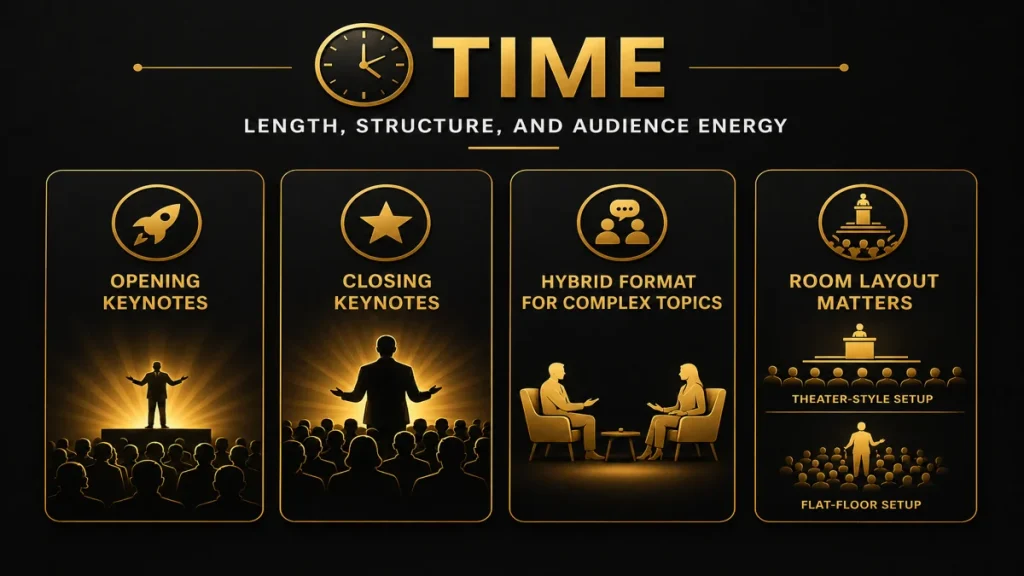
Format: Length, Structure, and Audience Energy
The standard keynote slot is 45 to 60 minutes, and most experienced speakers have content calibrated to that window. But format deserves more consideration than simply defaulting to convention.
Opening keynotes set energy. They should move quickly, establish credibility fast, and give the audience a reason to pay attention for the rest of the day. A 45-minute slot with no Q&A often works better here – it maintains momentum without the unpredictability of open questions.
Closing keynotes carry a different burden: they must land the event’s emotional message and send people home with conviction. These can afford slightly more reflection, and a 10-minute Q&A at the close – when the audience is warmed up – often produces genuinely memorable exchanges.
For leadership speakers and business speakers addressing complex strategic topics, consider a hybrid format: 35-40 minutes of structured keynote followed by a moderated conversation rather than open Q&A. This gives the organizing team more control while still creating a sense of dialogue.
Room layout matters more than most planners realize. A theater-style setup with a raised stage creates authority and focus but limits intimacy. A flat-floor setup with the speaker working the room creates energy but requires a speaker experienced with that format. Confirm with the speaker’s team which formats they are comfortable with before locking the room design.
Logistics That Protect the Keynote
The strategic work matters – but so does the operational detail. Several logistical factors consistently derail otherwise well-planned keynotes.
A/V alignment is the most common failure point. Speakers have presentation files, video clips, custom fonts, and specific advance requirements. Request these at least two weeks out and build in a technical rehearsal on the day – ideally with the speaker present, or at minimum with their team’s sign-off on the setup.
Green room and transition time are often underestimated. A speaker arriving to the stage 90 seconds after their car pulled up will not deliver the same keynote as one who had 20 minutes to acclimate, review their notes, and connect briefly with the event organizer. Build that buffer into the run-of-show.
Recording permissions should be clarified in the contract, not on the day. Many speakers allow recording for internal distribution but not public posting. Some require approval of any clips before sharing. A useful benchmark when evaluating speaker experience: the National Speakers Association’s CSP designation is held by fewer than 17% of its members – a meaningful signal of platform credibility when shortlisting candidates.
Finally, post-event follow-through is often neglected entirely. Speakers who feel genuinely appreciated become long-term partners – available for future events, more likely to refer colleagues, and more likely to go beyond their contractual obligations when something goes wrong on the day. A personal note from the event lead, within 48 hours, goes further than most organizations realize.
Frequently Asked Questions
Why should organizations work with a speakers bureau to plan a conference keynote?
Working with a bureau removes the most time-consuming parts of keynote planning: sourcing credible options, vetting availability, and managing the negotiation and contracting process. For a full picture of what a speakers bureau handles from first inquiry through event day, Aurum’s guide covers the complete process.
A bureau with deep roster relationships can also advise on fit in ways that a cold speaker search cannot, such as understanding which speakers excel with which audience types, which topics, and which event formats. Contact Aurum Speakers Bureau to discuss which approach fits your conference goals.
How far in advance should we book a keynote speaker for an annual conference?
For premium speakers at major annual conferences, six to twelve months is the standard lead time. High-demand speakers in fields like artificial intelligence, sustainability, and leadership are often fully booked well in advance of peak conference season. Securing availability early also gives the speaker more time to tailor their content – which consistently produces a better result.
What is the right length for a conference keynote?
Most keynotes run 45 to 60 minutes, though the ideal length depends on placement in the agenda and the speaker’s format. Opening keynotes benefit from tighter 45-minute structures that maintain energy. Closing keynotes can run slightly longer, especially when followed by a moderated Q&A. Very few audiences benefit from a keynote exceeding 75 minutes without a break.
Can a keynote speaker customize their talk for our specific audience?
Yes – and the quality of that customization depends directly on the quality of the briefing you provide. Experienced speakers can adapt significantly when given clear audience context, event themes, and message objectives. The briefing is not a bureaucratic formality; it is the input that turns a standard keynote into something that feels built for your organization. The more specific you are, the more tailored the result.
Reach out to Aurum Speakers Bureau to discuss speaker options, availability, and how to structure the keynote that anchors your next annual conference.