
Randi Zuckerberg
Creator of Facebook Live | Founder, Zuckerberg Media | 3x Tony Award Winner | Bestselling Author & AI Keynote Speaker


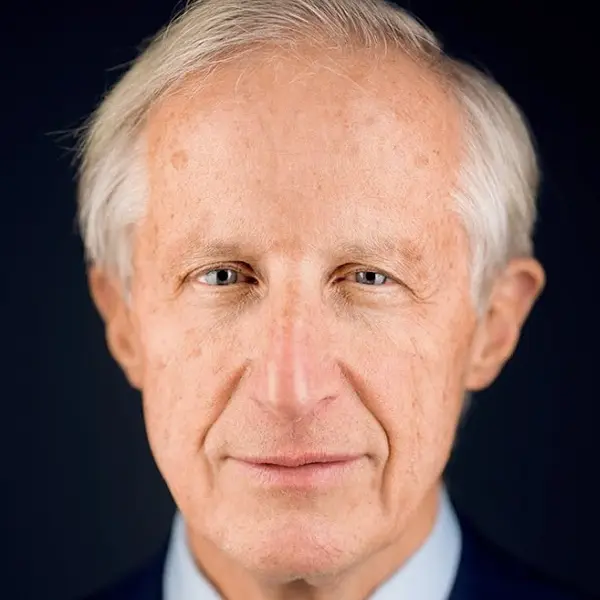
2018 Nobel Laureate in Economic Sciences | Sterling Professor Emeritus, Yale University | Father of Climate-Change Economics | Creator of the DICE Model
William Nordhaus spent fifty years building the economic case for pricing carbon — and the models governments now use to do it. The 2018 Nobel Laureate in Economic Sciences and creator of the DICE model, he is the founding figure of climate-change economics, whose work on carbon taxes, the social cost of carbon, and climate clubs continues to define the terms of global climate policy debate.
Want to book William Nordhaus as a speaker for your event? Please provide the info below and we’ll get in touch within 24h:
William Nordhaus is the economist who put a price on the planet’s future. Over five decades at Yale University, he built the intellectual and quantitative foundation for how the world thinks about the economics of climate change — pioneering frameworks that are now used by governments, central banks, and international institutions to evaluate climate risk, design carbon pricing systems, and calculate the true social cost of carbon emissions. Often called the “father of climate-change economics,” Nordhaus stands as the most influential economist in the history of environmental policy.
Economics speaker William Nordhaus shared the 2018 Nobel Prize in Economic Sciences with Paul Romer for “integrating climate change into long-run macroeconomic analysis.” The Royal Swedish Academy recognized decades of work that began in the 1970s, when Nordhaus was among the first economists to treat global warming as a serious economic problem — at a time when most of the profession ignored it entirely. His central contribution was the creation of the DICE model (Dynamic Integrated model for Climate and the Economy), first published in 1992 and continuously updated since, most recently with the landmark DICE-2023 paper published in the Proceedings of the National Academy of Sciences. DICE is the most widely used climate-economic integrated assessment model in the world: the U.S. government and other nations rely on it to calculate the social cost of carbon and evaluate climate policy.
The model’s core insight is deceptively simple and enormously consequential: climate change is fundamentally an economic externality — a cost imposed on society by carbon emissions that markets do not automatically price. The solution Nordhaus has championed for decades is a global carbon tax, calibrated to reflect the true social cost of each ton of CO₂ emitted. His DICE-2023 findings estimate that a global carbon price of $80 per ton of CO₂ would be necessary to meet the Paris Accord goals — yet the current global average price is just $3. This gap between economic prescription and political reality defines the central challenge of climate policy.
Nordhaus’s contributions extend well beyond DICE. In 2015 he introduced the concept of a “climate club” — a coalition of nations adopting coordinated carbon pricing with border tariffs on imports from non-participating countries — a framework that has influenced the design of the European Union’s Carbon Border Adjustment Mechanism. He also co-developed the Measure of Economic Welfare with James Tobin in 1972, one of the first attempts at environmental accounting, and has written landmark books including The Climate Casino: Risk, Uncertainty, and Economics for a Warming World and The Spirit of Green: The Economics of Collisions and Contagions in a Crowded World (2021). A Sterling Professor Emeritus at Yale, he has served on the Brookings Panel on Economic Activity since 1972, on President Carter’s Council of Economic Advisers, and as chairman of the Federal Reserve Bank of Boston.
As a speaker, William Nordhaus brings the unmatched authority of the economist who created the field of climate economics — and who remains its most active and rigorous practitioner. His keynotes address the economic logic of climate change, the design and politics of carbon pricing, why current global policies fall dangerously short, and what a realistic path to climate stability actually requires. For senior audiences in business, policy, finance, and sustainability, few speakers offer greater intellectual depth or more consequential insight.
Climate change is not just a scientific challenge — it is an economic one. In this keynote, based on his landmark book of the same name, Nordhaus explains why carbon emissions represent one of the greatest market failures in economic history, what the true cost of inaction looks like when modeled rigorously, and why the gap between current global policy and what his DICE-2023 model recommends is not a matter of scientific uncertainty but of political will. Audiences leave with a clear-eyed, evidence-based framework for understanding climate risk — not as an environmental abstraction, but as a measurable economic variable with calculable consequences.
A global carbon tax is, by broad economic consensus, the most efficient mechanism available for reducing greenhouse gas emissions. Yet the current global average carbon price is roughly $3 per ton of CO₂ — compared to the $80 Nordhaus estimates is needed to meet Paris Accord goals. In this policy-focused keynote, Nordhaus explains how carbon pricing works, why it is more effective than alternative regulatory approaches, what the social cost of carbon actually means and how it is calculated, and what political and institutional obstacles have prevented its adoption at the necessary scale. Essential for corporate leaders, investors, and policymakers thinking seriously about climate transition strategy.
Why has international climate cooperation repeatedly fallen short of its stated goals? In this keynote, Nordhaus presents his climate club framework — a proposal for a coalition of nations that adopt coordinated carbon pricing and impose border tariffs on imports from non-participating countries, creating economic incentives for global participation rather than free-riding. He explains the game theory behind current cooperation failures, why the Paris Agreement architecture is structurally insufficient, and how a well-designed climate club could achieve the emissions reductions that decades of international negotiation have not. Directly relevant to executives and policymakers navigating carbon border adjustment mechanisms and ESG strategy.
Standard GDP accounting treats the destruction of natural capital as invisible — a profound distortion that leads to systematically poor economic decisions. In this keynote, Nordhaus traces his pioneering work on environmental accounting — from his 1972 Measure of Economic Welfare with James Tobin to his 2021 book The Spirit of Green — and makes the case for a new economic framework that properly values natural resources, prices pollution, and aligns market incentives with long-term human welfare. For leaders in finance, sustainability, and public policy, this is a compelling argument for why getting the economics right is not optional.
Creator of Facebook Live | Founder, Zuckerberg Media | 3x Tony Award Winner | Bestselling Author & AI Keynote Speaker

Organizational Psychologist & Author of Wrong Fit, Right Fit | Former Chief Talent Officer at Google, Nike & Mars | Expert on the Future of Work, Culture & Talent

4x European Champion Coach, FC Barcelona Handball | Bestselling Author | High-Performance & Leadership Expert

Former USAID Administrator & President Emeritus of the Wilson Center | Former U.S. Ambassador & Congressman | Global Authority on Development, Diplomacy & Democracy


© 2026 Aurum Speakers Bureau. All Rights Reserved

| Basic Data Protection Information | |
|---|---|
| Data controller | AURUM SPEAKERS BUREAU S.L. |
| Address | Parc Audiovisual de Catalunya 1, Oficina S11, 08225 Terrassa, Spain |
| Purposes | We will use your data to respond to your requests and deliver our services to you. |
| Marketing | We will only send you marketing correspondence if you have given your prior consent, which you can do by ticking the box for that purpose. |
| Lawful basis | We will only process your data if you have given your prior consent, which you can do by ticking the box for that purpose. |
| Recipients | Generally, only our members of staff who have been duly authorised may access the data that you have provided. |
| Your Rights | You have the right to know what information we hold about you, to rectify it and to erase it, as explained in the additional information available on our website. |
| Additional Information | For more information, please see our "PRIVACY POLICY". |