
Daniel Pink
#1 New York Times Bestselling Author of Drive & To Sell Is Human | Authority on Motivation, Timing & Human Behavior | Thinkers50 Top-10 Business Thinker


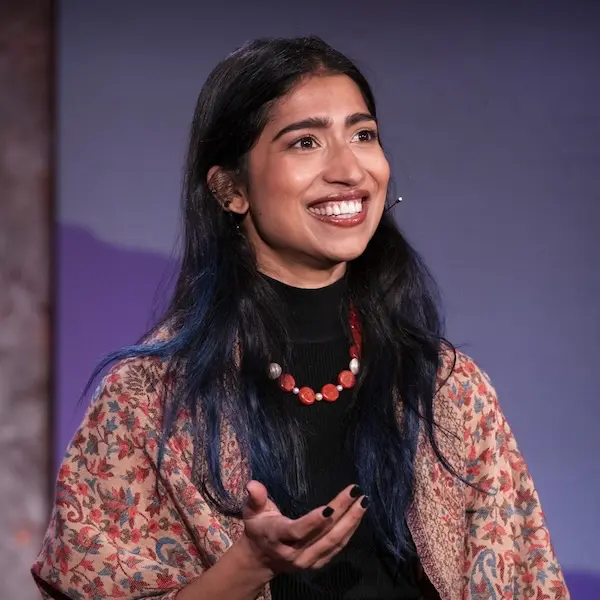
Co-Founder & Executive Director, Collective Intelligence Project | AI Governance & Democracy Expert | Former Microsoft CTO Office & UK AI Safety Institute
Divya Siddarth is among the most important voices on governing artificial intelligence. As founder of the Collective Intelligence Project, she has run pioneering experiments with OpenAI, Anthropic, and national governments to put democratic input at the heart of AI development. For senior audiences weighing AI governance and public trust, she offers a rare blend of technical depth and practical optimism that leaves rooms better equipped to act.
Want to book Divya Siddarth as a speaker for your event? Please provide the info below and we’ll get in touch within 24h:
Speaker Divya Siddarth is a political economist and social technologist redefining how humanity governs artificial intelligence. As co-founder and Executive Director of the Collective Intelligence Project, she builds governance models that channel collective human wisdom into the design and oversight of transformative technologies. Her work sits at the meeting point of democracy and frontier AI, asking a deceptively simple question: who decides how these systems shape our lives, and how can far more people have a voice in that decision?
Before founding CIP, Divya worked as a political economist in Microsoft’s Office of the CTO and led AI and democracy initiatives at the United Kingdom’s AI Safety Institute. She holds a B.S. in Computational Decision Analysis from Stanford University and pursues doctoral research at the Oxford Internet Institute, where she studies governance, collective intelligence, and the design of public goods. She has been affiliated with Oxford’s Institute for Ethics in AI, the Ostrom Workshop, and Harvard’s Plurality Lab.
Divya’s ideas move from theory into practice through collaborations with leading AI labs, including OpenAI and Anthropic, and with governments such as the UK Frontier AI Task Force and Taiwan’s Ministry of Digital Affairs. These projects test how public participation can steer the direction of advanced AI rather than leaving it to a handful of engineers and executives. Her TED talk and widely cited writing have helped popularize the idea that democratic input is not a constraint on innovation but a source of legitimacy and resilience.
As a speaker, Divya Siddarth combines technical rigor with genuine optimism. She reframes AI not as a force beyond human control but as a space for collective design and shared values, challenging audiences of executives, policymakers, and technologists to help build systems that strengthen democracy rather than erode it. Explore more AI speakers through Aurum Speakers Bureau.
Artificial intelligence and democracy are often framed as opposites, with one moving faster than any institution can keep up. Divya Siddarth argues the reverse: democratic principles such as participation, transparency, and collective oversight are exactly what powerful AI systems need to earn public trust. Drawing on real experiments she has run with leading labs and governments, she shows how AI can also expand civic engagement and widen access to decision-making. Audiences leave with a hopeful, concrete framework for building technology that serves the many rather than the few.
Some of the most valuable things a society can build, from open research to shared digital infrastructure, are chronically underfunded because markets struggle to capture their returns. Divya Siddarth draws on her work in collective intelligence and economic design to lay out new funding models that reward collaboration and long-term value instead of zero-sum competition. This talk challenges leaders, investors, and policymakers to imagine economies organized around shared prosperity, where progress and inclusion reinforce one another.
The hardest challenges facing organizations and societies rarely yield to a single expert or a single algorithm. In this keynote, Divya Siddarth explains how collective intelligence, the structured combination of human insight, institutional knowledge, and machine learning, can produce better decisions at scale. Through examples from governance, science, and frontier technology, she shows how groups can think more clearly together and how leaders can design systems that make collaboration as powerful as computation.
#1 New York Times Bestselling Author of Drive & To Sell Is Human | Authority on Motivation, Timing & Human Behavior | Thinkers50 Top-10 Business Thinker
Former NFL Player | American Ninja Warrior | Founder of Dark Work | Author of Identity Shift | Identity Transformation Coach

2014 Nobel Laureate in Physiology or Medicine | Founding Director, Kavli Institute for Systems Neuroscience, NTNU | Grid Cells, Memory & the Brain's GPS

Bestselling Author of The Split | Founder & Managing Director, China Market Research Group | Leading Authority on China's Economy


© 2026 Aurum Speakers Bureau. All Rights Reserved

| Basic Data Protection Information | |
|---|---|
| Data controller | AURUM SPEAKERS BUREAU S.L. |
| Address | Parc Audiovisual de Catalunya 1, Oficina S11, 08225 Terrassa, Spain |
| Purposes | We will use your data to respond to your requests and deliver our services to you. |
| Marketing | We will only send you marketing correspondence if you have given your prior consent, which you can do by ticking the box for that purpose. |
| Lawful basis | We will only process your data if you have given your prior consent, which you can do by ticking the box for that purpose. |
| Recipients | Generally, only our members of staff who have been duly authorised may access the data that you have provided. |
| Your Rights | You have the right to know what information we hold about you, to rectify it and to erase it, as explained in the additional information available on our website. |
| Additional Information | For more information, please see our "PRIVACY POLICY". |