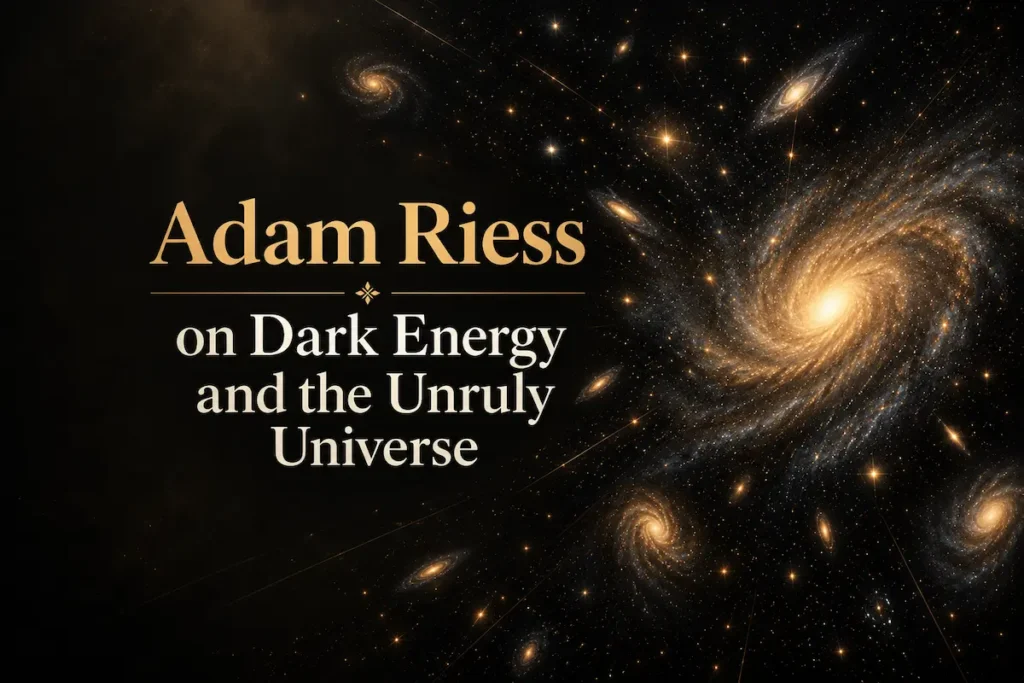

Adam Riess won the 2011 Nobel Prize in Physics for discovering that the universe’s expansion is accelerating. Today, he leads the team at the center of cosmology’s biggest unsolved problem, and makes it feel thrilling to any audience.
In 1998, a young astronomer found something the entire field of physics believed was impossible: the universe is not just expanding, it is speeding up. That discovery earned Adam Riess the 2011 Nobel Prize in Physics and introduced the world to dark energy, the mysterious force now thought to make up roughly 70 percent of everything that exists.
Nearly three decades later, Riess is again at the center of the action, this time because the universe is refusing to behave, and the way he tells that story makes him one of the most compelling scientific voices any event can put on a stage.
The discovery that rewrote cosmology
Riess is a Bloomberg Distinguished Professor at Johns Hopkins University and a Distinguished Astronomer at the Space Telescope Science Institute, with a bachelor’s from MIT and a PhD from Harvard. But his authority rests on one of the most consequential findings in the history of science.
As a key member of the High-Z Supernova Search Team, he led the analysis showing that distant Type Ia supernovae, stellar explosions of predictable brightness that serve as cosmic measuring sticks, were fainter and therefore farther away than anyone expected. The only explanation was that the universe’s expansion had been accelerating, driven by an invisible force soon named dark energy.
Science magazine called it the Breakthrough of the Year, and in 2011 it earned Riess the Nobel Prize, shared with Saul Perlmutter and Brian Schmidt.
His shelf also holds a MacArthur “genius” grant, the Shaw Prize, the Gruber Prize, the Breakthrough Prize, and the Albert Einstein Medal. As a Nobel Prize speaker, he sits in genuinely rare company.
The Hubble tension: a crack in our best theory
What makes Riess so relevant now is that the story did not end with the Nobel.
Today, he leads the SH0ES Team, the most precise ongoing effort to measure the Hubble constant, the rate at which the universe is currently expanding, using both the Hubble and James Webb space telescopes. And it has surfaced a genuine crisis.
Measured directly from the nearby universe, the expansion rate comes out around 73 kilometers per second per megaparsec. Predicted from the afterglow of the Big Bang using the standard model of cosmology, it comes out closer to 67. The two numbers should match. They stubbornly do not, and Riess’s team has ruled out measurement error as the cause at greater than eight-sigma confidence.
This is the “Hubble tension,” and its implication is staggering: the standard model of cosmology, the most successful framework in the history of science, may be missing something profound.
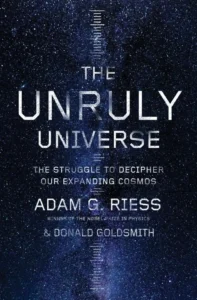
In his forthcoming book The Unruly Universe, expected in 2027, Riess chronicles the century-long quest to measure the cosmos, and the crisis now facing our best theory of it.
As a science speaker, Riess offers audiences a front-row seat to a paradigm shift as it happens.
A new book, and a story still unfolding
That unfolding drama is the subject of Riess’s forthcoming book, The Unruly Universe: The Struggle to Decipher Our Expanding Cosmos, written with science writer Donald Goldsmith and expected from Harvard University Press in 2027.
It chronicles the high-stakes, century-long quest to pin down a single number, the universe’s expansion rate, and the surprising possibility that our best account of dark matter, dark energy, and cosmic history may be incomplete.
For event organizers, the book is a signal of something useful: Riess is not a laureate resting on a decades-old prize. He is an active scientist at the frontier of an unresolved question, which is exactly what makes his keynotes feel urgent rather than historical.
Why business and leadership audiences respond to him
It would be easy to assume a cosmologist suits only science conferences. In practice, Riess resonates just as strongly with business, finance, and leadership audiences, because the deeper subject of his work is how to think.
His talks are, at their core, about following evidence that contradicts consensus, telling a real signal from noise, and holding your nerve when the data points somewhere uncomfortable. Those are precisely the disciplines that separate good decisions from bad ones in any high-stakes field.
It is a sensibility he shares with fellow Nobel laureate Michael Spence, whose work on the economics of AI rests on the same evidence-first rigor. For any organization navigating genuine uncertainty, Riess offers not just wonder but a model of how to reason under it.
What audiences take away
Riess brings audiences to the edge of human knowledge and makes them feel at home there. He translates the universe’s deepest puzzles, dark energy, the distance ladder, the tension threatening to rewrite physics, into vivid, accessible narratives that require no scientific background to follow.
Audiences leave with more than a new understanding of the cosmos; they leave with a sharpened appreciation for evidence-based thinking, the anatomy of a paradigm shift, and what it genuinely means to operate at the frontier of the unknown.
He is a strong fit for innovation summits, leadership conferences, university events, and any gathering that wants to send its audience home thinking bigger.
Frequently Asked Questions
Why should organizations book Adam Riess?
Because he offers a rare combination: a Nobel Prize-winning scientist behind one of the most important discoveries in modern history, who is also an exceptional communicator still working at the frontier of his field. He walks audiences through what it felt like to encounter data that defied all expectations, and what it takes to trust the evidence anyway, a message that resonates with leaders in science, finance, technology, and policy. To check his availability, contact Aurum Speakers Bureau and one of our founders will respond within 24 hours.
What did Adam Riess win the Nobel Prize for?
Adam Riess shared the 2011 Nobel Prize in Physics with Saul Perlmutter and Brian Schmidt for the 1998 discovery that the universe’s expansion is accelerating. By measuring distant Type Ia supernovae, his team found they were dimmer and farther away than expected, revealing that cosmic expansion is speeding up, driven by a previously unknown force now called dark energy, which accounts for roughly 70 percent of the universe.
What is the Hubble tension?
The Hubble tension is one of the biggest unsolved problems in cosmology: a persistent gap between two independent measurements of how fast the universe is expanding. Measured directly from the nearby universe (the method led by Riess and his SH0ES Team), the rate is about 73 km/s/Mpc; predicted from the early universe using the standard model, it is about 67. The roughly 8 to 9 percent gap is too large to be measurement error, suggesting our standard model of cosmology may be fundamentally incomplete.
What does Adam Riess speak about?
Adam Riess speaks on the accelerating universe and the discovery of dark energy, the Hubble tension and the possible incompleteness of the standard cosmological model, the science of measurement and uncertainty, and the Hubble and James Webb telescopes as instruments of discovery. Beyond the science, his talks explore evidence-based reasoning, navigating paradigm shifts, and the courage to challenge consensus, themes that suit science, technology, finance, and leadership audiences alike.
The universe, it turns out, still has secrets that our best theories cannot explain, and few people can make that fact feel as exhilarating as the Nobel laureate working to uncover them.
Whether your audience is scientific or not, Adam Riess leaves them thinking differently about evidence, uncertainty, and the edge of what we know.
To bring his perspective to your stage, contact Aurum Speakers Bureau and one of our founders will respond within 24 hours.