

Jorge Guajardo, Mexico’s longest-serving ambassador to China and now a partner at DGA Group, argues that supply chain weaponization is a distinct risk most boards have yet to absorb.
In late September 2025, the Dutch government seized control of Nexperia, a semiconductor company headquartered in the Netherlands and owned by China’s Wingtech Technology. Within days, Beijing imposed an export ban on chips produced at Nexperia’s Chinese plants.
Nexperia does not make advanced processors. It makes the cheap, unglamorous chips that run power steering and automatic windows, the kind of component nobody puts on a strategy slide.
Honda cut production across North America, Japan, China, and Mexico, reduced its annual sales forecast by 110,000 units, and absorbed close to a billion dollars in lost operating profit.
Stellantis stood up a dedicated crisis war room. European carmakers warned they were days from halting their lines.
This is the episode that Jorge Guajardo, Mexico’s longest-serving ambassador to China and now a partner at DGA Group, argues should be required reading in every boardroom.
In a new essay for American Affairs, he makes a case most corporate risk registers have not yet absorbed: the thing that can stop your production line is no longer your access to the Chinese market; it is your dependence on Chinese inputs, and the two are not the same problem.
Two kinds of coercion, and only one of them is familiar
For most of the last two decades, companies operating around China worked with a rough, unwritten rulebook. Avoid Taiwan, Tibet, Xinjiang, and Tiananmen. Do not question territorial claims. Do not embarrass the Party. Break those norms and you lost market access.
 The precedents are well known: Norway’s exports to China collapsed after the Nobel Committee honored Liu Xiaobo in 2010; the South Korean conglomerate Lotte was pushed out of China entirely after providing land for a US missile-defense system; French companies faced coordinated boycotts after President Sarkozy met the Dalai Lama. In each case the lesson was the same: Beijing draws no line between a government’s decisions and a private company’s exposure.
Guajardo’s argument is that a second, more serious instrument arrived quietly in 2010, when China cut off rare earth exports to Japan during a territorial dispute. That was not a threat to close the Chinese market to Japanese goods; it was a threat to withhold what Japan needed in order to manufacture anything at all.
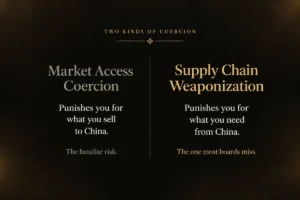
Market access coercion punishes you for what you sell to China. Supply chain weaponization punishes you for what you need from China. Most boards have contingency plans for the first and none for the second.
Japan understood the distinction immediately. Its companies did not wait for a diplomatic fix, reasoning that governments change and a friendly one today may be adversarial tomorrow. They invested in Australian supply, funded recycling and substitution research, and built stockpiles.
Nissan spent fifteen years engineering the rare earth content out of the Leaf motor, cutting it by more than 90 percent against the 2010 model. Japanese dependence on Chinese rare earths fell from roughly 90 percent to under 60 percent. Everyone else concluded 2010 was Japan’s problem and moved on.
Leaving China is not the same as being free of China
The second Nexperia lesson is the one Guajardo thinks has been most badly missed, and it is the one that should worry any executive who believes a relocation project has solved this.
Nexperia is a Dutch company; its headquarters are in the Netherlands. Beijing restricted its output anyway, because part of the manufacturing sat in China and the parent company was Chinese.
Ownership, not incorporation, is what determines exposure. A supplier that runs through a Chinese-owned entity remains leverage regardless of the flag over its head office.
The related point is about scale. Nexperia is not a dominant player in semiconductors. A modest share of a narrow segment, concentrated in China, with no alternative available on short notice, was enough to bring several of the world’s largest manufacturers close to a standstill.
Most supply chain risk assessments screen for monopoly suppliers and single-source components. This one would have passed.
China has now written the rules down
On March 31, 2026, Premier Li Qiang signed State Council Order No. 834, the Provisions on the Security of Industrial Chains and Supply Chains. It took effect immediately, with no transition period. It is China’s first dedicated regulation on supply chain security, and Guajardo reads it as an offensive instrument rather than a defensive one.
The regulation coordinates more than fifteen agencies and gives them broad authority to investigate and impose countermeasures against foreign governments, organizations, and individuals judged to threaten Chinese supply chain security. Its reach extends explicitly to commercial conduct: decisions to exit Chinese supply chains, due diligence Chinese authorities consider excessive, and compliance with foreign sanctions that disrupts Chinese counterparties.
Available countermeasures include export bans, restrictions on executives entering or leaving the country, and seizure of property in China.
The vagueness is the point. If companies cannot predict what will trigger countermeasures, the rational response is to avoid anything that might, which is precisely the intended effect.
The regulation is built to make decoupling feel too risky to attempt.
That framing matters for anyone weighing a diversification program against the cost of doing nothing, because it means delay is not a neutral option. It is the outcome the rule was designed to produce.
Why your EV supply chain is really a robotics supply chain
The part of the argument with the longest shadow concerns what these components are actually for. Analysts estimate that roughly 60 percent of the humanoid robot supply chain overlaps with the electric vehicle supply chain. The batteries, sensors, actuators, and motors developed for EVs are the same parts that go into drones, robots, and the next generation of autonomous systems, a convergence we explore in our look at the future of humanoid robots.
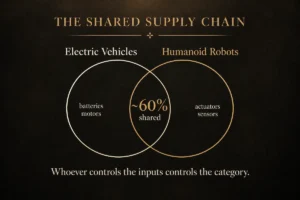
Guajardo’s contribution is to point out that whoever controls those inputs controls the entry ticket to the whole category. His example is Skydio: after the American drone maker sold to Taiwan’s National Fire Agency, Chinese sanctions cut off its battery supply, one of the few components it had not moved out of China. A single call from Beijing to a supplier left the largest US drone company rationing parts.
The strategic reading is that the electric vehicle transition was never mainly a climate question or a consumer-preference question; it was an industrial-capacity question.
A country that steps back from EVs on political grounds does not simply cede the car market. It forfeits the manufacturing scale, the supplier ecosystem, and the engineering learning curve that determine who leads the technologies that follow.
Nissan’s fifteen years of work on rare earth reduction was exactly the kind of knowledge that only accumulates by staying in the race.
What building the alternative actually costs
Guajardo is blunt about the difficulty, which is what makes the essay useful rather than alarming.
Reshoring everything to the United States is not viable on the timeline required. The country faces a projected shortfall of nearly two million manufacturing workers by 2033, a shortage of experienced tooling engineers he considers the single greatest obstacle to rapid reshoring, and a grid where more than 70 percent of transmission infrastructure is over twenty-five years old and already strained.

Jorge Guajardo makes the case that building a resilient alternative to Chinese supply chains runs fastest through allied nations, with Latin America positioned as a natural safe-shoring bloc.
His preferred path runs through allied countries, and he makes a specific case for Latin America: lithium and copper in Chile and the Andes, three decades of automotive and electronics manufacturing in Mexico, young labor forces and improving logistics in Colombia and Central America, and a run of governments across the hemisphere currently disposed to work with Washington. He calls the goal a safe-shoring bloc, a network of allied countries whose supply chains can be certified free of Chinese control.
Companies expecting a plug-and-play substitute for China will be disappointed. He sets out what to budget for: higher unit costs, because China’s price advantage is the product of decades of deliberate industrial policy and scale; supplier training, on the same terms multinationals once trained Chinese factories to their specifications; a quality learning curve, with higher rejection rates early on; financing, because many alternative suppliers must build capacity before they can absorb serious volume; ownership screening, because the Nexperia case settled whether incorporation is enough; and triage, because no single country absorbs everything, so each chokepoint must be mapped to the fastest viable alternative, component by component.
The questions worth putting to your board
The truce reached between Washington and Beijing in Busan in October 2025 has held, and the May 2026 summit maintained it. Guajardo’s warning is not to mistake a pause for a settlement.
The pattern he traces has been consistent for two decades: probe with market access pressure, escalate to supply chain weaponization, formalize the tools, tighten the screws. Each step was telegraphed. Each was ignored until the crisis arrived.
For leadership teams, the practical questions are narrower than the geopolitics suggests:
Which of our inputs have no alternative available within ninety days?
Which of our suppliers are Chinese-owned, wherever they are incorporated?
Which of our products would move us into the dual-use category, or into a sector where Beijing believes it is losing an innovation race?
And what would it cost us to be wrong about the answer to any of these?
It is the kind of scenario thinking that runs through the work of the field’s top geopolitics speakers, and it builds directly on the diplomat’s-eye view of trade and nearshoring in our earlier feature, Jorge Guajardo on leadership in uncertain times.
Frequently Asked Questions
What is supply chain weaponization?
Supply chain weaponization is the use of control over critical inputs, components, materials, or manufacturing, as a coercive tool, cutting off what a company or country needs to make things rather than restricting access to a market to sell things.
Jorge Guajardo dates its clearest arrival to 2010, when China restricted rare earth exports to Japan.
It differs from traditional market-access coercion: one punishes you for what you sell to China, the other for what you need from China.
What was the Nexperia chip crisis?
In late September 2025, the Dutch government seized control of Nexperia, a Netherlands-based chipmaker owned by China’s Wingtech Technology. Beijing responded by banning exports of chips from Nexperia’s Chinese plants. Although Nexperia makes only low-cost legacy chips, the disruption forced Honda to cut production on several continents and pushed European carmakers close to halting production, showing how a minor supplier can cripple global manufacturing.
What is China’s State Council Order No. 834?
Signed on March 31, 2026, and effective immediately, Order No. 834 is China’s first dedicated regulation on industrial and supply chain security. It coordinates more than fifteen agencies and authorizes countermeasures, including export bans and asset seizures, against foreign parties judged to threaten Chinese supply chain security, explicitly including companies that try to exit Chinese supply chains.
Guajardo reads it as an offensive tool designed to make decoupling feel too risky to attempt.
Why should organizations book Jorge Guajardo to speak on this?
Because he brings a rare dual vantage: Mexico’s longest-serving ambassador to China, now advising C-suite leaders on political risk at DGA Group. He translates supply chain geopolitics into concrete board-level questions about exposure, ownership, and diversification. He is ideal for leadership summits and strategy events dealing with tariffs, nearshoring, and supply chain risk.
To check his availability, contact Aurum Speakers Bureau and one of our founders will respond within 24 hours.
Book Jorge Guajardo for your event
Jorge Guajardo served as Mexico’s Ambassador to China from 2007 to 2013, the longest uninterrupted tenure in the post, and was the first Mexican ambassador to visit all 22 provinces. He is now a partner at DGA Group in Washington, D.C., where he advises C-suite leaders on political risk and market disruption across China, Latin America, and Europe.
A regular voice in the Wall Street Journal, The Economist, CNBC, and the Associated Press, he is one of our most requested geopolitics speakers for executive audiences working through tariffs, nearshoring, and supply chain exposure.
To discuss availability and fees, contact Aurum Speakers Bureau and one of our founders will respond within 24 hours.