A leadership offsite is one of the most expensive rooms a company ever assembles. You have pulled your most senior people out of their day jobs, moved them somewhere away from the noise, and cleared two or three days of calendars; all to think, align, and decide. Choosing keynote speakers for leadership offsites is a different discipline from booking a big-stage conference act, and it rewards a different kind of speaker.
Get it right and the session sets the tone for everything that follows. Get it wrong and you have spent a morning of your leadership team’s most valuable attention on a talk they will not remember too keenly on their way home.
Everything below is the practical version of how to get a leadership offsite right: the four qualities that actually matter in a small senior room, three real offsites we have placed, the reasoning behind each choice, and the format and briefing decisions that determine whether the hour lands.
The information here is enough to build your own shortlist so you can book someone who will work towards your goals rather than just book a name. So here we go:
Why an offsite is not a conference
Most people’s first instinct is to book a name that would top a ranking of leadership keynote speakers for a 2,000-person hall. That is often a big mistake.
Also, just as a friendly reminder, when the audience is the entire company rather than the leadership team, a different kind of speaker is needed. In that case, see our guide to the best speakers for a company all-hands or town hall.
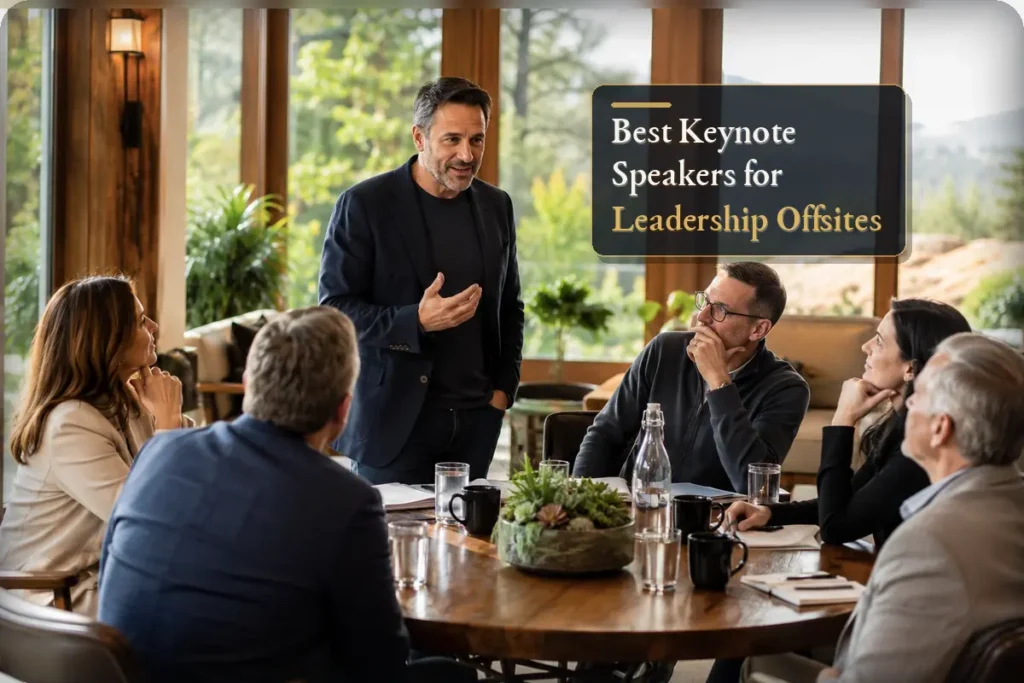
An offsite, on the contrary, is small, senior, and intimate, sometimes a dozen people around a table, rarely more than a few hundred. There is no big stage to hide behind and no anonymous crowd to carry the energy. The audience is experienced, skeptical, and quick to disengage if a talk feels generic or overly rehearsed.
What works is a speaker who can read a small room, field unscripted questions from senior leaders, and go deep rather than broad. Spectacle matters less. Substance and presence matter more.
How to choose keynote speakers for leadership offsites
Four qualities separate a great offsite speaker from a great stage performer: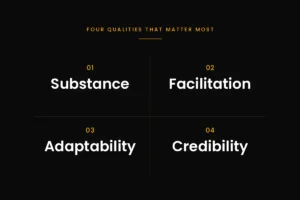
1. Substance over spectacle. Senior audiences want a genuine expert, not a motivational highlight reel.
2. A facilitation instinct. The best offsite speakers shift fluidly from keynote to conversation, drawing the room in rather than talking at it.
3. Adaptability. They tailor the material to your organization’s actual situation, not a stock deck.
4. Credibility with your specific audience. A room of chief executives listens differently to someone who has sat where they sit. When you are weighing CEO keynote speakers for an offsite, this should count for more than headline fame.
What this looks like in practice
The clearest way to explain the difference is with recent offsites we have placed. Client names are confidential, but the reasoning behind each choice is instructive.
An analyst team at one of the world’s largest hedge funds
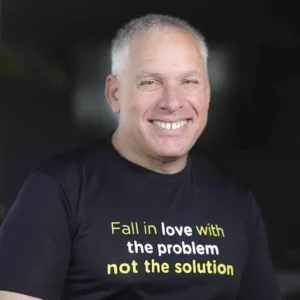
Uri Levine has taken two companies to billion-dollar exits, Waze to Google and Moovit to Intel, and now teaches the problem-first method that got him there twice.
The goal was not market commentary, which they have in abundance in-house. It was to put people who evaluate companies for a living in front of someone who has built them.
Uri Levine co-founded not one but two companies that reached billion-dollar exits; Waze, acquired by Google for $1.1 billion, and Moovit, acquired by Intel for $1 billion. He has also led teams from startup through acquisition.
For an audience whose job is judging value from the outside, hearing how it gets created from the inside, twice, was both a sharper analytical lens and a genuine lift.
His handbook, Fall in Love with the Problem, Not the Solution, is the method behind both exits, and the title is the whole argument. Levine is blunt that most startups fail for a single reason: they never solved a problem big enough to matter to enough people.
For a room of analysts, that inverts neatly into a diagnostic they can apply to anything they cover. The question is not how elegant the product is, but how real and how widespread the underlying problem is, and whether the company has genuinely found it or is still in love with its own solution.
He is equally candid about what has gone wrong. Across more than a dozen companies he has seen failure alongside the two exits, and the updated edition of the book added a chapter on surviving a crisis, which is not the sort of thing a founder writes if he is only interested in telling the good part.
That honesty is what earns a skeptical audience: someone who explains what he misread, and what he checks for now, is far harder to tune out than someone recounting only the wins. He also keeps a large portfolio of board and advisory roles, so the perspective is current rather than a retelling of 2013.

Sebastian Thrun founded Google X and the self-driving car project that became Waymo, after his Stanford team won the 2005 DARPA Grand Challenge by treating what everyone else saw as a hardware race as a software problem.
A partner retreat at a leading global law firm specializing in M&A and IPOs
Our client’s partners advise on the transactions that reshape industries, which meant the useful brief was not legal at all. It was about the mindset of the companies on the other side of the table.
Sebastian Thrun founded Google X, the moonshot lab that produced the self-driving car project which became Waymo, and he has spent his career building things with no precedent to work from. For a room trained on precedent and precision, that contrast was the entire point.
The story he tells best makes it concrete. In 2005, DARPA offered a prize to any team that could send a driverless vehicle 132 miles across the Mojave Desert. Nearly 200 teams entered, and almost every one of them treated it as a hardware problem: better sensors, tougher vehicles. Thrun’s Stanford team treated it as a software problem instead, and their car, Stanley, was the one that crossed the finish line. It sits in the Smithsonian today. Larry Page happened to be watching that day, which is how Google X came to exist a few years later.
For lawyers who make their living on deals, the lesson lands immediately: the winner is frequently not the best-funded competitor but the one who reframed what kind of problem they were solving. That instinct runs through the work of the innovation speakers we place most often, and for partners whose clients are either disrupting a market or being disrupted in one, learning to spot the reframe early has obvious commercial value.
An upcoming offsite with a European boutique hedge fund.
The theme is the economic impact of artificial intelligence, and the speaker is Michael Spence, the 2001 Nobel laureate in economics.

Michael Spence won the 2001 Nobel Prize in economics and now studies how AI reshapes growth and productivity as a Visiting Fellow in Google’s Technology and Society program.
For an investment team, the interesting question is not whether AI is transformative but where the economic value actually lands, over what horizon, and who captures it.
A Nobel economist turns that from a technology conversation into an economics one, which is a far more useful discussion for that audience, and it is a very different starting point from the names on our list of top AI keynote speakers for corporate events.
What makes Spence unusually well suited to that brief is that he is actively researching it. He is a Visiting Fellow in Google’s Technology and Society program, conducting original research on how AI affects growth, productivity, and work. His argument cuts against both the hype and the gloom: the short-term productivity effect of AI investment is small, the long-run potential is very large, and the returns depend less on frontier breakthroughs than on how widely the technology diffuses into the sectors that actually employ most people. For an investment audience, that reframing is the whole value of the session.
Notice what these three have in common. Not one of them is an obvious pick from a leadership list. Each was chosen because of what that specific room needed to think about, and that is usually where the best offsite choices come from.
Match the speaker to your goal
The strongest offsites start from the outcome, not the name.
Decide what the leadership team needs to walk away with, then work backward to the expertise that delivers it.
If the aim is cultural alignment across the leadership team, our roundup of the best corporate culture keynote speakers is a strong place to build a shortlist.
If the decision on the table concerns strategy or capital, the room usually wants an outside operator or one of the economics speakers who can frame the macro picture, rather than a motivational voice.
If it is composure and performance under pressure, that points somewhere else again. The category matters far less than the fit.
The logistics that make or break an offsite keynote
Even the right speaker underperforms in the wrong format.
Keep the keynote shorter and more interactive than a conference slot, and place it where it sets up the work rather than interrupting it, often as an opening frame or a mid-agenda reset.
Decide in advance whether the session should feed directly into a strategy discussion or whether it is meant to open minds before the real debate begins. Those are different briefs and they suit different speakers.
Above all, brief the speaker properly. The more they know about your team’s situation and the decision you are trying to reach, the more the talk feels built for the room.
Frequently asked questions
What kind of speaker works best for a leadership offsite?
One with genuine expertise, the presence to hold a small senior room, and the flexibility to move between keynote and conversation. Headline fame matters less than substance, adaptability, and credibility with your specific audience. Define the outcome you want first, then choose the expert who delivers it.
What kinds of speakers suit financial and professional services offsites?
More often than not, someone from outside the industry.
We have placed a two-time unicorn founder with hedge fund analysts and a Google X founder with M&A lawyers, precisely because each gave a highly specialized room a perspective it could not generate internally.
The best brief usually asks what the team cannot see from where it sits.
How long should a keynote be at an offsite?
Shorter and more interactive than a conference slot.
Thirty to sixty minutes of content followed by facilitated discussion or Q&A usually beats a long lecture, because the value of an offsite lies in what the room does with the ideas, not just in hearing them.
How do we get the most out of an offsite speaker?
Brief them thoroughly on your team’s situation, the decisions you are trying to make, and the outcome you want, then build in time for interaction.
The best offsite speakers tailor their material and engage the room directly. Aurum Speakers Bureau can help you brief a speaker so the session lands. Contact us and we will get back to you with all the expertise that backs us.
A leadership offsite is too valuable to anchor with the wrong voice.
Tell us the outcome you are after and the makeup of your team, and Aurum Speakers Bureau will shortlist speakers who fit the room, not just the marquee. We look forward to hearing from you.