

For two decades, Pierluigi Collina made high-stakes decisions under the scrutiny of the entire world.
Eighty thousand people in the stadium. Hundreds of millions watching from home. A contested moment in the box, and one man with three seconds to decide. There is no timeout, no committee, no second draft. Whatever he calls becomes the truth of the match, and every camera in the building exists to prove him wrong.
That was the working environment of Pierluigi Collina for two decades, and it is why he has become one of the most distinctive voices on leadership and decision-making available to corporate audiences today. Executives talk about making calls under pressure. Collina actually did it, in real time, with no ability to take any of them back, while being judged frame by frame by people who already believed they knew the answer.
As the 2026 World Cup gets underway, his perspective is worth revisiting, because the question he spent his career answering is the same one that defines leadership in any high-stakes organization: how do you make the right decision when you have almost no time, incomplete information, and an audience certain you will get it wrong.
The Authority That Came From Preparation, Not Volume
Named the world’s best referee by FIFA for six consecutive years, Collina officiated the 1999 Champions League final and the
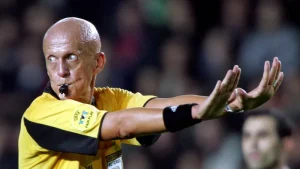
The world’s most trusted referee built his authority long before the whistle blew.
2002 World Cup final, a record of trust at the highest level of the sport that has never been matched. What set him apart was never intimidation. It was preparation.
Collina studied teams the way an analyst studies a market. He learned which players were left or right footed, how a particular coach would react when his side went a goal down, and where conflict was likely to erupt before it did. By the time the whistle blew, most of his decisions had already been rehearsed in his mind. The composure that looked like natural authority on the pitch was actually the visible surface of work nobody saw.
For leaders, that is the first lesson, and the one most often skipped. Authority in the moment is earned in the hours of preparation that precede it. Collina’s calm was not a personality trait. It was a method.
Making the Irreversible Call

The same discipline that defined Collina’s career applies whenever leaders must act without perfect information.
The defining feature of refereeing is that decisions are final. A leader can usually revise a strategy, walk back a statement, or course-correct over a quarter. A referee cannot un-award a penalty. Collina built his entire approach around that constraint, and it produced a discipline most executives never develop: the ability to commit fully to a judgment in the instant it is required, and to live with it publicly afterward.
His talks draw directly from that position. He speaks about separating the decision from the noise around it, about resisting the pull to please the loudest party in the room, and about the difference between being liked and being respected. He was never the one scoring goals or collecting headlines. He was the one accountable for the integrity of the entire contest, expected to be invisible when things went well and exposed the instant they did not.
That is a posture many senior leaders will recognize, and few have articulated as clearly. The same theme of acting decisively when the stakes are highest runs through our look at what modern leaders can learn from the Andes survival story.
Technology as a Tool, Not a Replacement for Judgment
Collina’s current role makes him unusually relevant to organizations wrestling with automation and AI. As Chairman of the FIFA Referees Committee, he has overseen the introduction of video assistance, semi-automated offside technology, referee body cameras, and stricter timekeeping rules, leading the preparation of match officials for the 2026 World Cup across the United States, Canada, and Mexico.
What he has refused to do is let the technology make the decision. When critics described semi-automated systems as “robot officiating,” his answer was direct: technology is a tool used by human beings, and the official remains responsible for the final call. The data improves accuracy and speed; it does not absolve the decision-maker of accountability. For any leader integrating AI into high-stakes workflows, that framing is more useful than most consulting decks. The instinct to hide behind the system is the thing to resist.
His book The Rules of the Game has been translated into more than ten languages and remains a reference on authority, fairness, and judgment under pressure.
Why Collina Resonates With Corporate Audiences

From referees to champions, discover the voices shaping the leadership lessons of the 2026 World Cup.
The reason Collina works on the corporate stage is that his expertise does not require a translation step the audience has to perform itself. The parallels are immediate. Every leader has faced a version of the contested call: the moment where theinformation is incomplete, the clock is running, and whatever you decide will be scrutinized by people with the benefit of hindsight.
He fits naturally alongside Aurum’s sports speakers and is equally at home among leadership speakers, which is what makes him a strong choice for leadership summits, executive retreats, and any event built around decision-making, governance, or performing under scrutiny. He is also featured among the voices in our roundup of the top World Cup speakers for 2026, where his refereeing perspective sits alongside players and managers who lived the tournament from the other side of the line.
To explore whether Collina is the right fit for your next event, reach out to Aurum Speakers Bureau to discuss availability and booking options.
Frequently Asked Questions
Why should organizations book Pierluigi Collina?
Collina offers something few speakers can: a career spent making irreversible, high-stakes decisions in front of the largest audiences on earth. For leadership summits, executive retreats, and events centered on decision-making or governance, he turns that experience into practical insight on preparation, composure, and accountability. Aurum Speakers Bureau can advise on his availability and handle the entire booking process for your event.
What does Pierluigi Collina speak about?
His keynotes focus on decision-making under pressure, leadership and authority, managing conflict before it escalates, and the relationship between technology and human judgment. Drawing on his refereeing career and his current role overseeing officiating innovation at FIFA, he speaks to audiences responsible for making consequential calls with incomplete information.
What is Pierluigi Collina’s role today?
Collina serves as Chairman of the FIFA Referees Committee, where he sets global officiating standards and has led the introduction of innovations such as semi-automated offside technology and referee body cameras. He oversaw the preparation of the match officials for the 2026 World Cup, selecting a record pool of referees from 50 countries.
What types of events suit a speaker like Collina?
Collina is best suited to leadership summits, board and governance events, executive retreats, and conferences themed around decision-making, risk, or performance under scrutiny. His perspective also resonates strongly at events tied to major sporting moments, making the 2026 World Cup period a particularly fitting time to feature him.