The hardest part of booking a motivational keynote speaker is not finding one. It is the category itself. Motivational is the most crowded space in the speaking industry, the most emotionally weighted, and the easiest to get wrong. A speaker who moves one audience to tears will leave the next room politely checking their phones, not because the speaker is weak, but because the message was never calibrated to the moment that audience is actually in.
This guide is for event planners, HR leaders, and executives who want to get that decision right. It explains the archetypes that exist inside the motivational category, the questions worth asking before any contract is signed, and five proven voices currently working at the top of the field. For a broader overview of who leads this space, see Aurum’s top motivational speakers ranked and profiled.
The Mistake Most Organizations Make
The single most common mistake is starting with a name. Someone saw a speaker at another conference, a video circulated, and the brief becomes “book someone like that.” The result is a speaker chosen for social proof rather than fit. By the time the keynote happens, the room is hearing the right story at the wrong moment.
A second mistake is treating “motivational” as a single category. It is not. Motivational keynotes serve at least five distinct purposes. Some events need a reset after a difficult year, where audiences want permission to feel what they have felt along with a framework for moving forward. Others are kickoffs for a major transformation, where the audience needs to believe the new direction is possible. Reward and recognition events ask to be celebrated, not lectured. A team rebuilding after restructuring or loss needs someone who has been through something harder than what they are facing. And sales and performance summits need energy paired with a clear behavior people can take back to their work the next morning.
The speaker who fits a sales kickoff will rarely be the right fit for a team that just lost a third of its headcount. Knowing which moment you are designing for is the first decision.
Five Archetypes of the Motivational Keynote Speaker
Most motivational speakers fall into one of five archetypes. Identifying the archetype that fits your event simplifies every subsequent decision, from shortlist to brief to the questions you ask in the booking call.
The Adversity Survivor
Andes survivor and keynote speaker Nando Parrado, whose story anchors the adversity-survivor archetype.
Someone whose life narrative is itself the lesson. They speak from the authority of having survived something most of the audience has not, and the keynote becomes less a presentation than a testimony.
Nando Parrado is the archetype at its most powerful. In 1972, the plane carrying his Uruguayan rugby team crashed at 18,000 feet in the Andes. He and fifteen teammates survived for 72 days, ultimately because Parrado and one other survivor walked out of the mountains to find help.
His story has been told in Pier Paul Read’s book Alive, the 1993 film of the same name, his own New York Times bestseller Miracle in the Andes, and most recently the Oscar-nominated Netflix film Society of the Snow.
He is keynoting Nordic Business Forum in Helsinki in September 2026, and his message has shifted in recent years from the survival itself to what it reveals about trust, shared purpose, and the qualities that hold teams together when nothing else does.
For a deeper look at how his story maps onto the boardroom, see what modern leaders can learn from the Andes survival story.
Best for post-crisis events, leadership offsites after a difficult year, organizations rebuilding culture, and audiences senior enough to sit with a long-form story without needing to be entertained.
The Ideas Authority

Bestselling Stoic author Ryan Holiday, who turns ancient philosophy into a practical framework for adversity and discipline.
Someone who has spent years studying a body of knowledge and turns it into a framework an audience can use. Less personal story, more system. Audiences leave with something they can apply, not just a feeling.
Ryan Holiday is a defining example. He has done more than almost anyone to bring Stoic philosophy into modern business and sport, through The Daily Stoic, The Obstacle Is the Way, Ego Is the Enemy, and his most recent book, Wisdom Takes Work. His books have sold more than ten million copies and are read by CEOs, championship-winning coaches, and military leaders. Holiday belongs in the motivational category because his keynotes do not simply inspire in the moment; they hand the audience a durable operating system for adversity, ego, and discipline that holds up long after the event ends. His material pairs naturally with the question at the heart of whether motivation or discipline drives success, a useful companion read when scoping this kind of keynote.
Best for leadership summits, culture-driven companies, sales organizations that want their teams to understand the principle behind a strategy shift, and any audience that responds to ideas more than to spectacle.
The Behavior Change Practitioner

Mindvalley founder Vishen Lakhiani, whose keynotes translate personal-growth research into usable methods.
Adjacent to the ideas authority but more contemporary and more action-oriented. The behavior change practitioner takes research and turns it into a tool the audience can use immediately. They tend to be excellent on stage and exceptional on camera, which matters for hybrid and global events.
A clear current example is keynote speaker Vishen Lakhiani, founder and CEO of Mindvalley, one of the world’s largest personal-growth education platforms. He is the New York Times bestselling author of The Code of the Extraordinary Mind and The Buddha and the Badass, with a forthcoming book, The Code of the Extraordinary Team, focused on organizational culture. Lakhiani’s work centers on practical methods, from mindset and meditation to how high-performing teams are actually built, which makes his keynotes land as toolkits rather than pep talks.
Best for kickoffs and resets, all-employee events, HR-led culture programs, and audiences that want a method, not just inspiration.
The Elite Performer
Nine-time Olympic gold medalist Carl Lewis, the elite-performer archetype on sustained excellence and discipline.
The athlete or competitor who reached the absolute top of their field, and who can explain the discipline, mindset, and team architecture that got them there in terms that translate to corporate audiences. Done well, this archetype is one of the strongest in the category. Done poorly, it becomes “and then I won the gold medal” for forty minutes.
Carl Lewis sets the standard. Nine Olympic gold medals across four Games, ten Olympic medals in total, and a body of work that places him among the greatest athletes in history. Since retiring from competition, Lewis has served as a United Nations FAO Goodwill Ambassador and as head coach of track and field at the University of Houston, where he has worked with the next generation of elite athletes. His keynotes draw on goal setting, sustained performance over decades rather than a single season, and the difference between motivation and discipline. For events looking for an Olympic speaker, our shortlist of the top sports motivational speakers covers adjacent profiles.
Best for sales kickoffs, performance and incentive events, leadership programs focused on sustained excellence, and audiences who want energy without losing substance.
The Reinvention Story
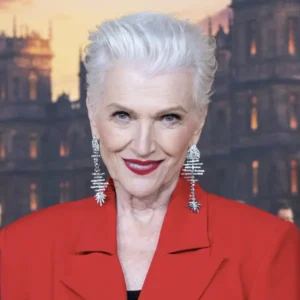
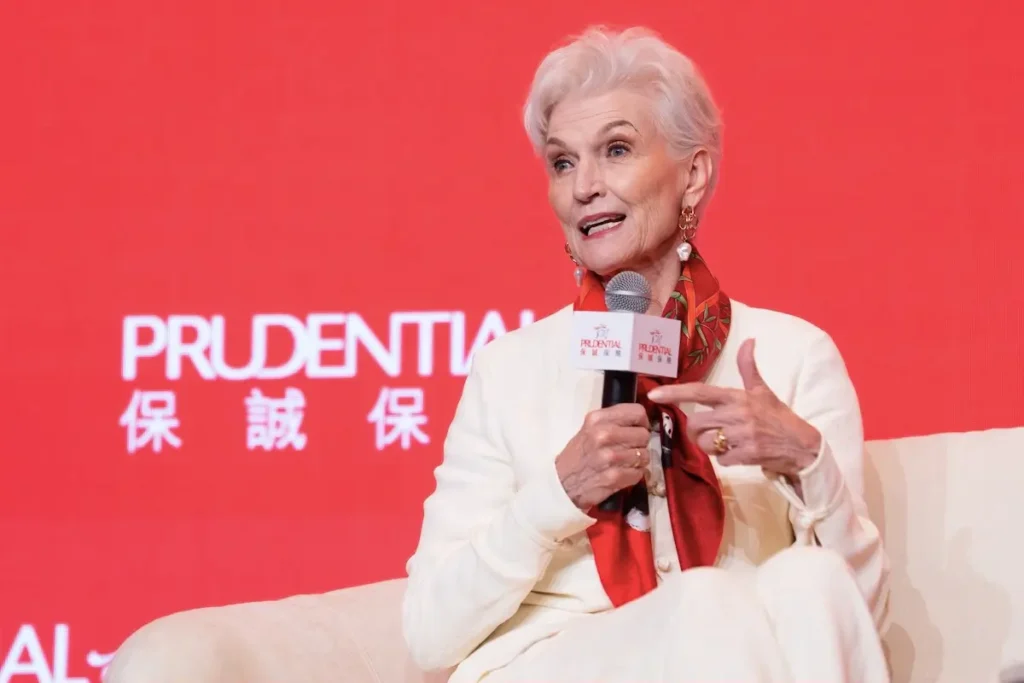
Author, dietitian, and supermodel Maye Musk, whose career embodies reinvention and resilience at any age.
The speaker whose own life makes the audience reconsider what they believe is still possible for them. Less about a single framework, more about recalibrating the room’s sense of what they can attempt, at any stage. This archetype is powerful but easy to get wrong if the speaker leans on sentiment at the expense of substance.
Maye Musk is a compelling example. A registered dietitian with more than five decades in nutrition, she built a practice across three countries while raising three children, and reached the height of her modeling career in her seventies, becoming the oldest cover model for the Sports Illustrated Swimsuit Issue and a Dior Beauty ambassador. Her bestseller A Woman Makes a Plan has been translated into more than thirty languages, and her new book, TIMELESS: The Art of Reinvention and Resilience at Any Age, arrives in September 2026. She speaks on reinvention, resilience, aging, and confidence, and she is a reminder that “motivational” overlaps heavily with the women speakers category, where many of the strongest voices work across both.
Best for all-hands gatherings, women’s leadership events, wellness and longevity programming, and any event where the brief is to shift the audience’s sense of what is still in front of them.
Five Questions to Ask Before You Book
Once the archetype is clear, the shortlist gets short fast. The questions below tend to surface the right speaker quickly.
The first question is what moment the audience is actually in, not what the event is called. What matters is what the audience is privately feeling on the morning of the keynote, because a “growth summit” can be the wrong label for a room that just absorbed a layoff. The second is who is in the room and what they already believe. A C-suite audience that has heard fifteen philosophy-inflected keynotes does not need a sixteenth, while a first-line manager group that has never been spoken to about purpose might genuinely benefit from one.
Watch: Nando Parrado on crisis leadership, resilience, and what teams truly need under pressure (Hoover Institution, 2025).
The third question is whether the speaker’s content still translates. Many motivational speakers were brilliant on the stage where they made their name and have not updated their material in a decade, so a keynote that worked at a 2018 conference may land flat in 2026. Ask for a recent video, not a highlight reel. The fourth is what success looks like the next morning: a behavior, a conversation, a decision the audience makes differently. If the answer is only “they felt inspired,” the brief is incomplete. The fifth is whether the speaker will engage with your context. The best motivational speakers do not deliver a stock keynote; they ask about the audience, the moment, and the strategic backdrop. If a speaker or their representative is uninterested in those details, the engagement is unlikely to land.
Event Types Best Served by a Motivational Keynote
Annual kickoffs, leadership offsites, transformation launches, recognition and reward events, sales summits, all-employee meetings, and any moment where the organization is asking its people to do something hard, new, or sustained all benefit from strong motivational programming. The format, whether keynote, fireside chat, panel, or virtual session, matters less than choosing the speaker whose archetype matches the moment.
For broader context on the booking process itself, see our companion guide on how to choose the right keynote speaker for a corporate event and our breakdown of the best leadership keynote speakers.
Working with a Bureau on a Motivational Booking
The role of a speakers bureau is not to push a name. It is to translate the event brief into the archetype, then the archetype into the right shortlist, then the shortlist into a confirmed booking that fits the budget and the calendar. Aurum represents motivational speakers across all five archetypes above, in English and Spanish, for in-person and virtual events.
Contact Aurum Speakers Bureau to discuss which motivational speaker fits your event, audience, and the moment your organization is actually in.
Frequently Asked Questions
What is the difference between a motivational speaker and a keynote speaker?
A keynote speaker is anyone delivering a primary address at an event, on any topic. A motivational speaker is a sub-category whose specific job is to shift how the audience feels and what they believe is possible. Many motivational speakers are also experts in business, sport, science, or leadership, and the strongest bookings tend to come from speakers whose authority sits in a discipline first and whose motivational delivery is the wrapper.
How far in advance should we book a motivational keynote speaker?
Four to six months is typical for established names. For speakers with active book or tour cycles, such as Ryan Holiday around the release of Wisdom Takes Work or Maye Musk around TIMELESS, booking earlier is wise, since demand rises sharply around publication. Last-minute bookings are possible, but the shortlist narrows quickly.
How much does a motivational keynote speaker cost?
Fees depend on the speaker, the date, the location, the format, and whether the event is in person or virtual, and they change over time. Rather than work from a generic range, it is worth requesting a quote for the specific speaker and specific date you have in mind. Aurum provides a tailored quote for any speaker on your shortlist, so you are comparing real numbers for your event rather than estimates.