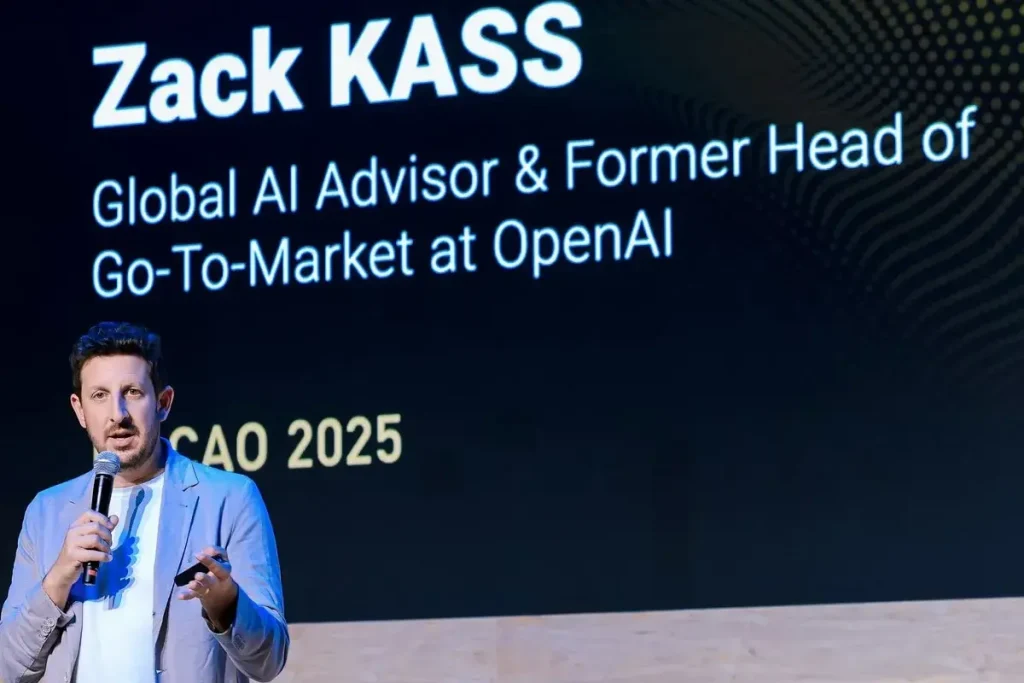

Zack Kass, Global AI advisor and former Head of Go-To-Market at OpenAI, helping organizations navigate the next era of artificial intelligence
Zack Kass’ AI optimism is not a marketing stance — it is a structured intellectual argument, and in 2026 it is resonating in boardrooms in ways that fear-driven narratives simply cannot. Most conversations about artificial intelligence are, at their core, conversations about fear: fear of job loss, fear of misuse, fear of a technology that evolves faster than the institutions meant to govern it. That framing is understandable. It is also, according to Zack Kass, the wrong place to start.
Kass — former Head of Go-To-Market at OpenAI, global AI advisor, and bestselling author — has spent the better part of a decade arguing that the dominant narrative around AI undersells both the stakes and the opportunity. His January 2026 book, The Next RenAIssance: AI and the Expansion of Human Potential, makes that argument in full. It landed immediately on the USA Today, LA Times, and Publishers Weekly bestseller lists. The timing was not accidental.
The Renaissance Metaphor — and Why It Works
The title is not a rhetorical flourish. Kass uses the historical Renaissance deliberately, as a period most people recognize as foundational — a time of parabolic progress across science, art, and politics that reshaped what humanity believed was possible.
His argument is that we are entering an equivalent inflection point, not because AI is smarter than us, but because it is making intelligence abundant. He calls this concept “Unmetered Intelligence”: the idea that cognitive capacity is becoming as cheap, reliable, and ever-present as electricity. Just as electrification did not replace human ambition but supercharged it, abundant intelligence changes the source of competitive advantage — from raw cognitive output to the distinctly human qualities that AI cannot replicate.
Zack Kass AI optimism is grounded in this framework — not in wishful thinking, but in sixteen years at the frontier of applied AI, including his tenure at OpenAI through the launch of ChatGPT, and more than 500 boardroom conversations across 20 countries.
What the Book Actually Argues

Zack Kass shares his perspective on AI and human potential, bringing complex technological shifts into practical, real-world insight
The Next RenAIssance resists the binary framing that dominates most AI discourse. Kass is not interested in either techno-utopianism or doom-scrolling futurism. The book works in two parts: first, a clear-eyed mapping of where AI stands, how we got here, and what adoption actually looks like across industries; second, a sector-by-sector exploration of where AI-driven transformation will be most consequential — education, healthcare, finance, and the workplace.
One of the book’s central distinctions is between the technological threshold (what AI can do) and the societal threshold (what we allow it to do). Kass argues that the gap between those two thresholds — not technical limitation — will define the pace of progress over the next decade. That adoption gap is a human and institutional challenge, which means it is a leadership challenge.
He also names the costs honestly: dehumanization, identity displacement, the concentration of power, the risk of low-resource actors misusing powerful tools. These are not buried in footnotes. They appear because, for Kass, hope and reason are not in conflict — they are co-dependent.
From Theory to Keynote Stage
The book is not a detached academic exercise. Kass developed these ideas in real time, inside boardrooms at Coca-Cola, Morgan Stanley, Samsung, and Amgen, as well as through research roles at the University of Virginia’s McIntire School of Commerce and as Chair of Ruder Finn’s AI Advisory Council. He has delivered keynotes to more than 300,000 people across five continents.
What distinguishes his keynote from the standard AI talk is the same thing that distinguishes the book: the refusal to separate the technological argument from the human one. Among AI keynote speakers, Kass occupies a specific niche — one focused less on what AI can do and more on what leaders should decide about it. His framework gives organizations somewhere to stand when the pace of change outstrips their planning cycles. His four principles for navigating an AI-driven world — go outside, be human, learn how to learn, and lead with optimism — are not corporate slogans. They are practical orientations for a moment when the ground is genuinely shifting.
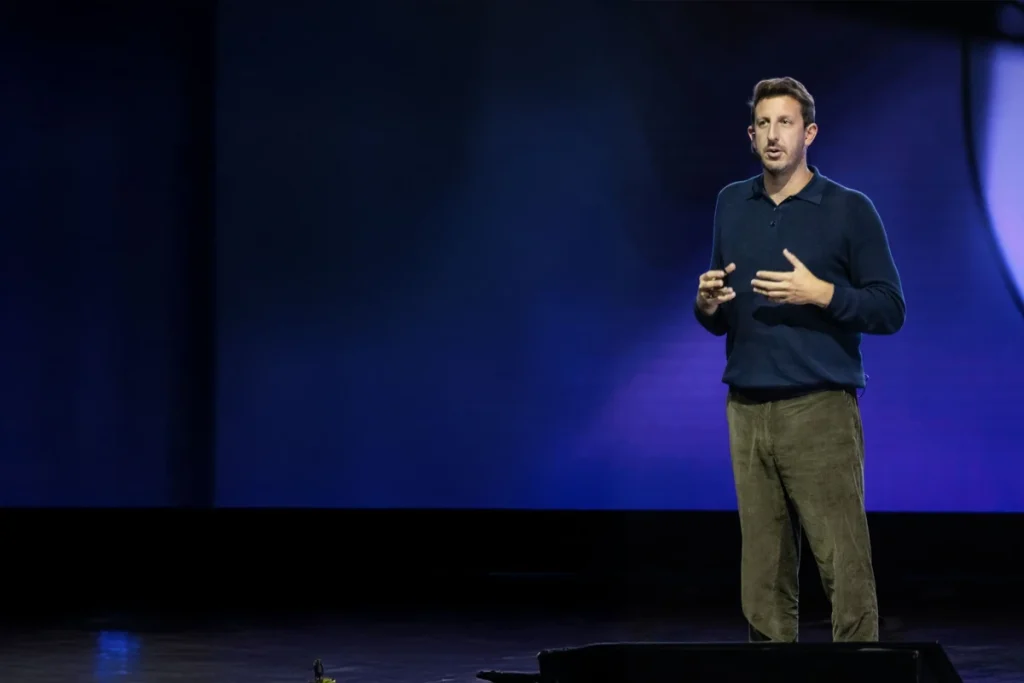
Zack Kass delivering a keynote on the future of AI, exploring how emerging technologies will reshape business, work, and human potential
His central contention, as he has explained in interviews with McKinsey, Motley Fool, and others, is that the question is no longer whether AI will change everything. It already is. The question is whether leaders are designing institutions — companies, schools, governments — that distribute that change toward human flourishing rather than away from it.
For a closer look at what makes him one of the most requested voices on the circuit today, see why Zack Kass stands out among AI keynote speakers in 2026. For a broader view of the field, see Aurum’s guide to the top AI keynote speakers for corporate events.
Zack Kass AI Optimism as a Strategic Position
There is a version of AI pessimism that feels responsible — cautious, sober, aware of the risks. Kass makes the case that this is a misreading. Pessimism, when it becomes the default frame, produces passive organizations. It generates delay, avoidance, and a failure to make the design choices that actually shape outcomes.
Optimism, by contrast, is not a prediction. It is a strategic orientation. It asks: given what AI can do, what do we want to build? It is the orientation that produced the innovation speakers and technology leaders who now sit on advisory councils, shape policy, and help organizations adapt — rather than simply react.
This is the argument Kass has been refining since before generative AI was a household phrase, and it is the argument that lands differently in 2026, when the tools are real and the decisions are no longer hypothetical.
FAQ
Why should organizations book Zack Kass as a keynote speaker?
Organizations book Zack Kass because he occupies a rare intersection: firsthand experience inside OpenAI during its most consequential growth phase, a structured intellectual framework developed over sixteen years and codified in a bestselling book, and the ability to make that framework immediately actionable for executive audiences. His sessions consistently receive some of the highest ratings event organizers report — across industries and audience types. Reach out to Aurum Speakers Bureau to discuss availability and fit for your event.
What is “Unmetered Intelligence” and why does it matter for business?
Unmetered Intelligence is Kass’s term for the shift in which cognitive capacity — the ability to reason, analyze, and generate — becomes abundant and low-cost, much as electricity became abundant in the early twentieth century. For business leaders, this reframes the competitive question: rather than investing in cognitive output alone, organizations must identify where human judgment, creativity, and connection create irreplaceable value. That is where sustainable differentiation lives in an AI-driven economy.
What topics does Zack Kass cover in his keynotes?
Zack Kass’s work on AI and the future of humanity, offering a clear and optimistic framework for thriving in an age of rapid technological change
Kass speaks on AI as infrastructure, the future of work and leadership in an AI economy, responsible AI governance and adoption, the concept of Unmetered Intelligence, and how to design organizations that expand rather than diminish human potential. He customizes his keynote for specific industries — including finance, healthcare, retail, and the public sector — and offers executive workshops and C-suite advisory sessions in addition to main-stage appearances.
What distinguishes The Next RenAIssance from other AI books published recently?
Most AI books either catalog risks or catalog possibilities. The Next RenAIssance does something harder: it holds both simultaneously, draws on Kass’s direct commercial experience at OpenAI, and arrives at a practical argument about what leaders should actually do. It was praised by Kirkus Reviews as “a refreshing, well-crafted treatise on the many possible good things that thinking machines can bring” — notable for a genre often dominated by alarm or hype. It is also, unusually, a book written for a general audience: Kass has said he wrote it for his mother, and for anyone trying to make sense of a genuinely disorienting moment.