
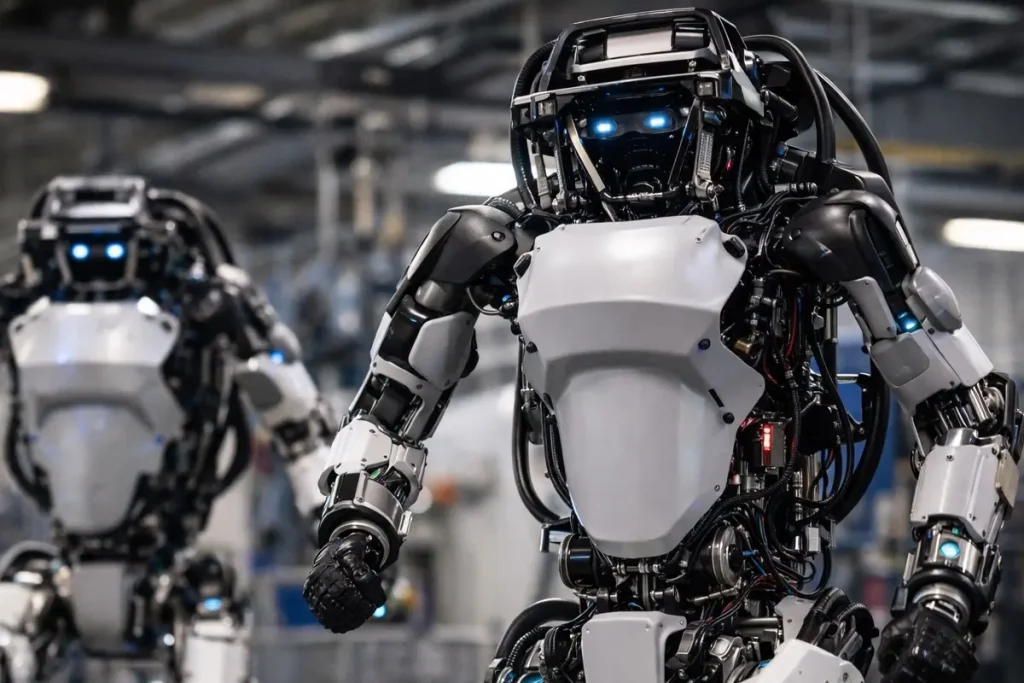
A new chapter in robotics just began.
A Beijing-based startup has open-sourced what it describes as the world’s first full-stack humanoid robot prototype, releasing hardware designs, control software, and engineering documentation to the global developer community. Within weeks, the project attracted thousands of GitHub stars and early kit orders, signaling a surge of interest in open, collaborative humanoid robotics.
The announcement is more than a viral tech headline. It represents a structural shift in how embodied AI may develop over the next decade.
To understand what this means for business and global innovation, it helps to step back and examine how we got here and who laid the foundations for this moment.
What Is the Future of Humanoid Robots?
The future of humanoid robots lies at the intersection of embodied AI, dynamic locomotion, and collaborative development ecosystems. This is why our AI speakers are paramount.
Humanoid systems are moving beyond controlled lab demonstrations and into real-world applications such as logistics, inspection, infrastructure monitoring, public safety, and advanced manufacturing. As hardware becomes modular and AI models improve in physical reasoning and adaptive control, development cycles are accelerating.
The next phase will determine whether humanoid robots remain specialized industrial tools or evolve into widely deployed autonomous platforms capable of operating safely alongside humans.
The open-source movement may dramatically speed that transition.
The Open-Source Humanoid Breakthrough
The newly released bipedal robot, developed in approximately 120 days, runs at speeds of 3 meters per second using a proprietary anthropomorphic gait algorithm. Its creators published structural drawings, supplier lists, low-level control code, simulation tools, and engineering validation workflows.
This level of transparency is rare in robotics.
The stated goal is to reduce development costs by as much as 80 percent while building a shared embodied infrastructure where researchers, startups, and enterprise engineers collaborate rather than duplicate foundational work. Future of work speakers also have their more than two cents to add to these conversations.
If successful, this approach could do for humanoid robotics what open-source software did for operating systems and cloud computing.
But none of this progress emerged overnight.
From Research Lab to Global Robotics Race
Long before humanoid robots were trending globally, foundational breakthroughs in dynamic locomotion were reshaping robotics research.
In the 1980s and 1990s, pioneering work in legged motion demonstrated that robots could balance, recover from disturbances, and move dynamically rather than rely on rigid, pre-programmed steps. That research eventually led to the founding of Boston Dynamics in 1992.
Under the leadership of its founder, the company developed machines that fundamentally changed public perception of robotics:
-
BigDog, capable of navigating rugged terrain
-
Atlas, a humanoid robot performing backflips and parkour
-
Spot, deployed in construction, energy, and industrial inspection
-
Handle, designed for logistics and warehouse environments
Boston Dynamics showed that robots could move fluidly in complex, unpredictable environments. That shift from static automation to agile embodied systems set the stage for today’s humanoid acceleration.
For deeper context on that innovation legacy, see our profile of Boston Dynamics’ founder Marc Raibert.
Embodied AI Is the Real Inflection Point
The current wave of humanoid robotics is not just about hardware.
It is about embodied AI.
Traditional robots followed scripted instructions. Modern humanoids increasingly integrate machine learning models capable of adapting to new tasks, environments, and physical constraints. The next frontier involves Behavior Foundation Models that allow robots to generalize across movements and tasks rather than rely on narrow training data.
This is where robotics and artificial intelligence converge.
Organizations such as The AI Institute are actively researching how intelligent control systems and physical machines co-evolve. The future will likely depend on seamless integration between mechanical design, perception systems, reinforcement learning, and real-world validation.
Open platforms may accelerate experimentation. Scaling safely will require deep engineering discipline.
Why This Matters for Industry Leaders
The global race in humanoid robotics has direct implications for:
Manufacturing and logistics
Infrastructure and utilities
Energy and hazardous environments
Defense and public safety
Healthcare and assistive technologies
As humanoid systems become more capable, leaders must evaluate:
-
Where robots create economic advantage
-
How to integrate AI-driven machines into operations
-
What workforce transitions will look like
-
How regulatory and safety frameworks evolve
-
What geopolitical dynamics shape robotics leadership
The conversation is no longer theoretical. It is strategic.
From Closed Innovation to Collaborative Ecosystems
 Historically, robotics companies operated with tightly controlled proprietary systems.
The open-source humanoid model challenges that paradigm. By publishing hardware schematics, control stacks, and engineering documentation, emerging players are attempting to create shared embodied infrastructure.
This approach addresses three long-standing industry barriers:
High development costs
Fragmented hardware designs
Disconnected software architectures
If collaborative ecosystems succeed, innovation cycles could compress dramatically. Smaller research teams may gain capabilities once reserved for well-funded corporations.
Yet scaling humanoid robots into mission-critical environments requires reliability, safety validation, and long-term systems integration expertise.
The future will likely blend open experimentation with disciplined engineering leadership.
The Global Robotics Race Is Accelerating
China, the United States, and Europe are investing heavily in humanoid robotics. Startups, research institutions, and large technology companies are competing to define the next standard platform.
The visibility of humanoid systems in media has increased public awareness. But the deeper story is geopolitical and industrial.
Whoever defines the foundational infrastructure for embodied AI may influence:
Global supply chains
Manufacturing competitiveness
Defense capabilities
Workforce productivity
Technological sovereignty
Humanoid robotics is no longer niche research. It is becoming strategic infrastructure.
What Comes Next?
Several technical hurdles remain before humanoid robots become commonplace:
Power efficiency and battery life
Dexterous manipulation and fine motor control
Reliable operation in unpredictable environments
Cost-effective large-scale production
Human-safe autonomy
But momentum is building.
Development timelines are shrinking. AI models are improving. Hardware is becoming more modular. Open ecosystems are expanding global collaboration.
The next decade will determine whether humanoid robots become specialized industrial assets or a foundational layer of intelligent physical infrastructure.
What is certain is that the pace of change is accelerating.
For organizations shaping the future of AI, automation, and advanced industry, understanding the trajectory of humanoid robotics is no longer optional. It is essential.