Many conversations about innovation focus on tools, trends, or cultural slogans. Far fewer address the deeper forces that determine whether innovation actually leads to sustained growth. This is where Philippe Aghion’s ideas on innovation and long-term growth help explain why some systems generate sustained progress while others consistently stall.
As one of the most influential economists shaping how leaders think about innovation, competition, and long-term growth, Philippe Aghion brings rare clarity to questions that organizations are facing today. His perspective helps decision-makers move beyond surface-level narratives and toward a more grounded understanding of how progress truly happens.
Awarded the Nobel Prize in Economic Sciences for his pioneering work on innovation, growth, and the dynamics of creative destruction, his research fundamentally reshaped how economists, policymakers, and business leaders understand the forces that drive long-term economic progress.
The Nobel Committee recognized his contribution to modern growth theory, alongside collaborators such as Peter Howitt and Joel Mokyr, whose work also helped redefine how innovation, competition, and institutions interact over time.
For audiences seeking insight rather than hype, his ideas offer lasting value. Learn more about Philippe Aghion as a keynote speaker and his work with organizations worldwide.
A Global Authority on Innovation Economics
Also a professor at the Collège de France and at INSEAD, Aghion previously taught economics at Harvard University. He is widely recognized for his foundational contributions to modern growth theory, particularly his work on the relationship between innovation, competition, and institutional design.
His research has influenced governments, international institutions, and corporate leaders around the world. It is frequently referenced in discussions about productivity, economic resilience, and the conditions that allow innovation to thrive over time.
What makes his work especially relevant for non-academic audiences is its direct connection to real-world decision-making.
Why Leaders Turn to Aghion’s Frameworks
Organizations engage with Philippe Aghion’s thinking when they want to understand why some systems consistently generate innovation while others stall.
Rather than treating innovation as a moment or a breakthrough, his work frames it as an outcome of incentives, competition, education, and governance working together. This systems-level perspective resonates strongly with senior leaders responsible for long-term performance rather than short-term wins.
For executives and policymakers alike, Philippe Aghion’s thought leadership provides a way to assess strategy through a more durable lens.
Core Themes That Define Aghion’s Perspective
Creative Destruction and Long-Term Renewal
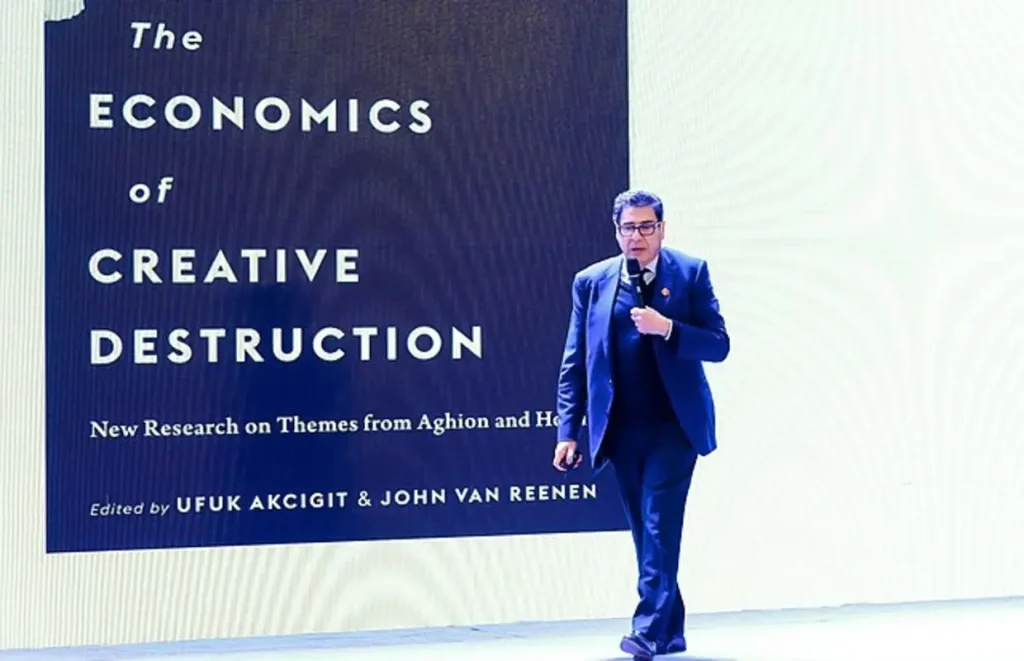
A central pillar of Philippe Aghion’s Nobel Prize–winning work is the concept of creative destruction, originally introduced by Joseph Schumpeter and later refined through Aghion’s economic frameworks. Creative destruction describes how new innovations continuously replace outdated technologies, business models, and industries, driving long-term growth while forcing adaptation.
For companies, organizations, and governments, this process is both an opportunity and a challenge. Aghion’s work helps leaders understand how to encourage innovation without destabilizing institutions, and how to design policies and strategies that allow renewal without undermining social and economic resilience.
Innovation as a Continuous Process
A central theme in Aghion’s work is that innovation is not episodic. It emerges when the right conditions are sustained over time.
He explains how environments that balance competition with support for experimentation tend to outperform those that rely solely on protection or deregulation. This insight helps leaders think more clearly about how to structure organizations, markets, and incentives.
Competition, Incentives, and Growth
One of Aghion’s most influential contributions is his analysis of how competition shapes innovation outcomes. Rather than assuming that more or less competition automatically leads to growth, his work highlights the importance of balance.
This nuanced view challenges simplistic assumptions and encourages leaders to think carefully about how internal and external pressures affect creativity, investment, and long-term success.
Innovation, Inequality, and Social Stability
Another core dimension of Philippe Aghion’s ideas addresses one of the defining tensions of the modern economy: how innovation-driven growth intersects with inequality.
His work explores how innovation can be structured to promote broader participation and resilience, rather than deepening divides. This perspective is particularly relevant for organizations operating in highly visible, regulated, or socially sensitive environments.
Today, Aghion’s ideas on innovation and creative destruction are increasingly applied to debates around artificial intelligence. AI is accelerating the pace at which industries transform, skills become obsolete, and new forms of value creation emerge.
As part of renowned AI speakers, his frameworks offer leaders a way to think more clearly about how AI-driven innovation can boost productivity while managing disruption, workforce transitions, and long-term competitiveness. This is why his perspective resonates strongly in conversations about AI strategy, regulation, and responsible innovation.
How Aghion’s Thinking Differs From Typical Innovation Voices
Many voices in the innovation space focus on trends, predictions, or motivational narratives. Aghion’s work, however, operates at a different level.
He offers leaders a way to think systematically about growth rather than chasing the next idea. His insights are grounded in evidence and history, making them especially compelling for audiences that value rigor and long-term relevance.
This distinction is why his perspective resonates so strongly with executive teams, financial institutions, and policy-driven organizations.
Who Benefits Most From This Perspective?
Aghion’s ideas are particularly relevant for:
• Senior leadership teams
• Boards and strategy groups
• Global organizations navigating transformation
• Financial and investment communities
• Policy-focused and research-driven institutions
These audiences tend to value clarity, depth, and frameworks that extend beyond a single event or initiative.
In his keynote talks, Aghion draws on his Nobel Prize–winning research to explain how innovation-driven growth actually unfolds in practice. Central to his work is the process of creative destruction, through which new technologies and business models replace old ones, raising productivity while reshaping firms, jobs, and entire industries.
He applies this framework to some of today’s most pressing challenges, including artificial intelligence, labor market transformation, inequality, climate transition, and industrial policy. Aghion examines how AI can accelerate productivity growth while also concentrating market power if institutions are poorly designed, why some economies translate innovation into better jobs and wages while others do not, and how competition, education, and policy choices determine long-term resilience.
Across his keynotes, Aghion offers leaders an evidence-based way to think about growth that balances dynamism with inclusion, innovation with social stability, and technological progress with institutional strength. This is why his perspective resonates with organizations navigating disruption without losing long-term direction.
Why Do Philippe Aghion’s Ideas Matter Now?
As organizations navigate rapid technological change, economic uncertainty, and shifting regulatory landscapes, the question of how to sustain growth has become more complex.
Aghion’s work helps leaders step back from short-term noise and focus on the underlying conditions that shape long-term outcomes. By reframing innovation as a system rather than a slogan, he offers a clearer way to think about resilience, competition, and long-term progress.
For leaders looking to elevate how their organizations think about innovation and growth, Philippe Aghion’s ideas offer a rare combination of intellectual rigor and practical relevance. They do not promise quick fixes. Instead, they provide a deeper understanding of how progress is built and sustained over time.
That is precisely why his work continues to resonate across industries and geographies.
Book Philippe Aghion for Your Next Event
Aurum Speakers Bureau can help contextualize Philippe Aghion’s Nobel Prize–winning ideas for different audiences, whether the focus is executive strategy, innovation policy, or long-term economic growth.
Our team manages the process end to end, from confirming fit and shaping expectations to handling coordination, contracts, and logistics. For one-time corporate bookers in particular, this removes unnecessary complexity and allows the focus to stay on the substance of the program.
If you are considering Philippe Aghion for an upcoming event and would like guidance on whether his perspective is the right fit for your audience, we invite you to get in touch with us. A brief conversation is often the simplest way to move forward with clarity and confidence.