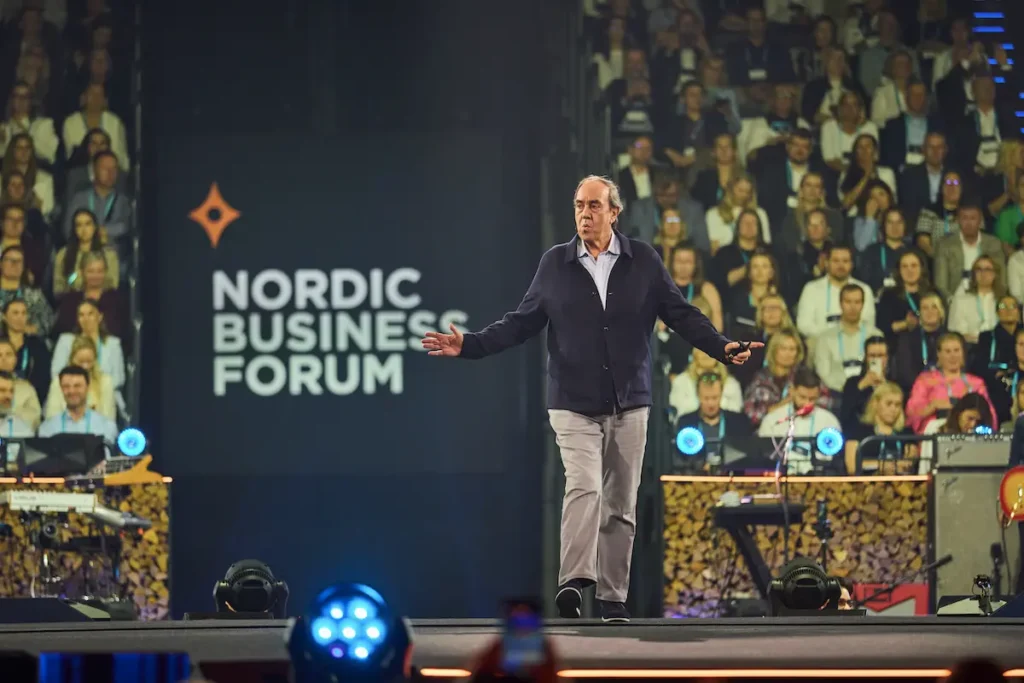

Robert E. Hall of Stanford University, whose work on household decisions reshaped how economists understand demand and consumption.
The final Nobel of 2026 has been announced, and it goes to the economists whose ideas quietly shape how governments and central banks respond to every crisis, recession, and spike in inflation.
On October 12, 2026, the Royal Swedish Academy of Sciences awarded the Nobel Prize in Economic Sciences to Robert E. Hall of Stanford University and Michael Woodford of Columbia University, “for microeconomic foundations of macroeconomic stabilisation.”
In plain terms, they rebuilt the models that let policymakers steady an economy when it lurches, and their work is now embedded in finance ministries and central banks around the world.
Why they won the Nobel Prize

Michael Woodford of Columbia University, whose work on prices and monetary policy became foundational to modern central banking.
For decades, economists struggled with a gap between two ways of seeing the economy:
One looked at the whole system (growth, unemployment, inflation) from the top down.
The other looked at how individual households and firms actually make decisions.
Hall and Woodford closed that gap, showing how large-scale economic outcomes can be built up rigorously from the choices of individual people and businesses.
That reconstruction became the foundation of what is now called New Keynesian economics, the framework most modern central banks use to decide when and how to act.
As the prize committee put it, because of their work “we are better equipped to deal with shocks in the economy, such as energy crises or sudden changes in how much households consume.”
Robert E. Hall: how households really decide
Robert Hall, a professor at Stanford University and a towering figure in American macroeconomics, focused on the demand side of the economy.
His insight was that households do not simply spend according to this month’s paycheck; they make decisions based on what they expect to earn over a lifetime.
That idea reshaped how economists model consumption, saving, and how spending responds, or fails to respond, to tax cuts and stimulus.
Hall has also chaired the committee that officially dates US recessions, making him one of the most authoritative voices on the economic cycle itself.
Michael Woodford: how prices and policy interact
Michael Woodford, a professor at Columbia University, focused on the supply side and on monetary policy.
His work explains how businesses set prices and how that behavior shapes the way interest-rate decisions ripple through the economy.
His book Interest and Prices became a foundational text for modern central banking, giving policymakers a rigorous framework for how their decisions actually influence inflation and output.
When a central banker today weighs a rate change, they are working, often directly, within the architecture Woodford helped build.
Why this prize matters right now
The timing is pointed.
After years of pandemic shocks, energy crises, and the sharpest inflation in a generation, the question of how to stabilize an economy has rarely felt more urgent, or more contested. Hall and Woodford’s work is precisely the toolkit policymakers have reached for through all of it.
For business leaders, investors, and anyone trying to read where the economy is heading, this is a reminder that the biggest forces shaping markets are built on decades of careful economic thinking.
It is the same reason organizations increasingly seek out economists among their top economics keynote speakers: in a volatile world, the people who can explain how stabilization actually works are invaluable.
Nobel economists on the stage
A Nobel laureate in economics occupies a rare position, able to translate the forces behind inflation, growth, and market volatility into insight leaders can act on.
Aurum Speakers Bureau represents a distinguished roster of Nobel Prize-winning economists and world-leading economic thinkers, including voices like Michael Spence on AI and growth and Mariana Mazzucato on the role of public investment.
This year’s laureates join a long line of economists whose ideas move from the academy into the boardroom.
For the full picture of the year’s honorees, see our companion guide to the 2026 Nobel Prize winners in science, and explore the wider roster of Nobel Prize speakers available to book.
Frequently Asked Questions
Who won the 2026 Nobel Prize in Economics?
The 2026 Nobel Prize in Economic Sciences was awarded to Robert E. Hall of Stanford University and Michael Woodford of Columbia University, “for microeconomic foundations of macroeconomic stabilisation.” They were announced by the Royal Swedish Academy of Sciences on October 12, 2026.
What did Robert Hall and Michael Woodford win the Nobel Prize for?
They won for rebuilding macroeconomic models from the decisions of individual households and firms, work that became the foundation of New Keynesian economics. Their models help central banks and governments time fiscal and monetary policy to soften recessions, inflation, and other economic shocks. Hall focused on how households make spending decisions based on expected lifetime income; Woodford focused on how businesses set prices and how monetary policy works.
Why is the 2026 economics Nobel significant?
After years of pandemic disruption, energy crises, and high inflation, the ability to stabilize an economy has become a central challenge for governments worldwide. Hall and Woodford’s models are the tools policymakers use to respond to exactly these shocks, making their recognition especially timely.
Can you book a Nobel Prize-winning economist to speak at an event?
Yes. Aurum Speakers Bureau represents Nobel laureates and world-leading economists available for keynotes, fireside chats, and corporate and investment events. To explore which economist suits your event, contact Aurum Speakers Bureau and one of our founders will respond within 24 hours.
Every year the economics Nobel reminds us that the forces driving markets, jobs, and prices are not random; they are understood, modeled, and increasingly managed, thanks to thinkers like Robert Hall and Michael Woodford.
To bring the insight of a world-class economist to your stage, contact Aurum Speakers Bureau and one of our founders will respond within 24 hours.