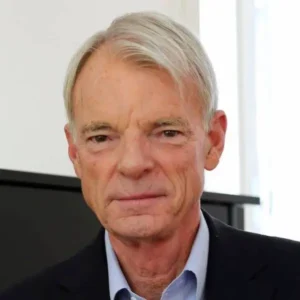
Michael Spence won the 2001 Nobel Prize in Economics. Today, he studies how artificial intelligence reshapes growth and productivity as an academic advisor to Google’s AI and Economy research program, making him one of the few people who can translate the AI boom into hard economics.
Every board and investment committee is asking the same question about artificial intelligence: not whether it matters, but where the economic value actually lands, over what horizon, and who captures it. Most speakers answer that as a technology question. Michael Spence answers it as an economics one, and that is a far more useful conversation for anyone allocating capital or planning for growth.
A Nobel laureate who is now researching AI’s economic impact from inside one of the companies building it, he offers something rare: the authority to separate what AI will genuinely do to the economy from what the hype promises.
A Nobel laureate studying AI where it is being built
Spence shared the 2001 Nobel Prize in Economic Sciences for his work on markets with asymmetric information, the theory of signaling that reshaped modern economics. But what makes him essential right now is where his attention sits today.
He is one of a small group of academic advisors to Google’s AI and Economy Research Program, studying how AI affects growth, productivity, and work, alongside economists Diane Coyle and Mohamed El-Erian.
That vantage point, a Nobel economist conducting original research on AI’s impact from within a company at the center of the field, is one almost no other speaker can offer.
He brings the rigor of the discipline and a direct line of sight into how the technology is actually developing.
His central argument: it’s about diffusion, not just frontier breakthroughs
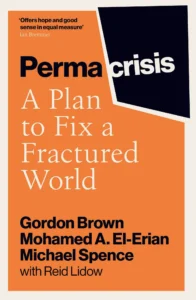
In Permacrisis, written with Gordon Brown and Mohamed El-Erian, Spence lays out why the global economy keeps lurching from shock to shock, and what it would take to fix it.
Spence’s message cuts against both the hype and the doom.
His view, in his own framing: people tend to overestimate the short-term impact of a major technology and underestimate its long-term impact. AI-related investment, he argues, has little effect on productivity in the near term, but the long-run potential is enormous, and whether that potential is realized depends on one thing above all, diffusion.
If AI transforms only technology and finance while the sectors that employ most people, retail, hospitality, education, health, are barely touched, the productivity surge never arrives. The gains come only when the technology spreads across the whole economy.
For business leaders, that reframes the entire question: the competitive advantage is not in admiring the frontier, but in adopting and diffusing the technology through their own operations.
His is a perspective that places him among the most valuable economics keynote speakers for any organization trying to plan around AI rather than react to it.
Why boards and investors listen
Spence connects AI to the forces leaders already worry about: the productivity slowdown since the financial crisis, persistent inflation, aging populations, supply-chain realignment, and the fragmentation of the postwar global economy. He treats AI not as a standalone story but as potentially the most powerful answer to a decade of stalled growth, if the policy and adoption conditions are met.
That systems-level view, connecting the technology to growth, capital, and labor markets in one coherent picture, is why he is sought after by investment teams and boards navigating genuine uncertainty, and why he sits comfortably among the global affairs speakers leaders rely on to make sense of a fragmenting world.
His recent book Permacrisis, written with Gordon Brown and Mohamed El-Erian, lays out that fractured-world framework in full, and his systems-level view connects naturally to the work of fellow economist Mariana Mazzucato on the role of public investment in shaping innovation.
Spence is also one of the voices we place for high-stakes leadership offsites, where a Nobel economist can turn an AI discussion into an economics one.
What audiences take away
Spence speaks with the clarity of someone who has spent a career making complex economics understandable, and he tailors the substance to the room: where AI value will accrue for investors, how to think about adoption and workforce for operations leaders, and how the macro picture, growth, inflation, and risk, fits together for strategists.
Audiences leave able to separate signal from noise on AI’s economic impact, with a clearer framework for where to place bets and how to plan for a technology whose biggest effects are still years out.
He is a strong fit for executive leadership summits, investment and finance conferences, economic forums, and any boardroom weighing where AI truly fits in its future.
Frequently Asked Questions
Why should organizations book Michael Spence?
Because he offers a rare combination: a Nobel Prize-winning economist who is actively researching AI’s economic impact as an advisor to Google’s AI and Economy program.
He helps boards and investors move past the hype to understand where AI value will actually land, over what horizon, and what it means for growth, productivity, and jobs.
He is ideal for events on economics, AI strategy, investment, and the global outlook.
To check his availability and fit, contact Aurum Speakers Bureau and a dedicated advisor will respond within 24 hours with a tailored proposal.
What does Michael Spence speak about?
His keynotes cover the economics of artificial intelligence, productivity and growth, the future of the global economy, inflation and supply chains, and how technological change reshapes labor markets.
Drawing on his Nobel-winning research and his current work advising Google’s AI and Economy program, he tailors each talk to investors, boards, and corporate leaders.
Who is Michael Spence?
Michael Spence is a Canadian-American economist who won the 2001 Nobel Prize in Economic Sciences for his work on markets with asymmetric information.
He is Professor of Economics at NYU Stern and Dean Emeritus of the Stanford Graduate School of Business, a Senior Fellow at the Hoover Institution, and an academic advisor to Google’s AI and Economy Research Program.
He is the co-author of Permacrisis: A Plan to Fix a Fractured World.
What types of events suit a speaker like Michael Spence?
He is a strong fit for executive leadership summits, investment and finance conferences, economic and policy forums, and board or strategy sessions focused on AI, growth, and the global outlook, especially audiences seeking a rigorous, data-grounded read on where the economy and technology are heading.
As AI reshapes the economy, the leaders who thrive will be the ones who understand where its value truly lands, and who plan for the long game rather than chase the frontier. Michael Spence offers exactly that clarity, from one of the most credible vantage points in the world.
To bring his perspective on AI and the economics of growth to your stage, reach out to Aurum Speakers Bureau to discuss availability and dates.